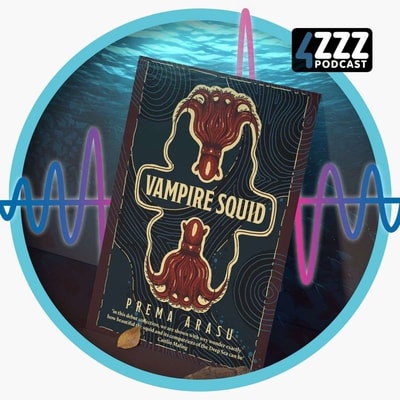
Tranz Verse: Prema Arasu's Vampire Squid
Today Rae (they/them) chats with Prema Arasu (they/she) about their poetry collection Vampire Squid, the relationship between humans and the deep sea, and creatures that resist binary classification, like the vampire squid and hermaphrodidic flatworms. Rae also introduces Tranz Verse, a new segment highlighting poetry readings from trans and gender diverse creatives living in Magandjin and beyond. This month’s Tranz Verse features Ciaren (they/them), m k zariel (it/its), Lucian (they/them), and Amber (they/
Transcript
At 4zzz, we acknowledge the traditional owners of the land on which we broadcast. We pay our respects to the elders past, present and emerging of the Turbul and Jagera people. We acknowledge that their sovereignty over this land was never ceded and we stand in solidarity with.
Speaker B:On4zzz amplifying the trans and gender diverse community of Meanin, Brisbane and beyond. My name is Ray, I use they them pronouns and you are listening to Transmission on 4 Triple Z 102.1 FM today I have a bunch of news and events to share with you, as well as some interviews and an exciting new segment as well that I have decided to create. First of all though, let's get into some news and some events for the news. A trigger warning for transphobia and yeah, you know what? Transphobia. It sure do be a thing in the news at the moment, but we will have some positive news as well to chat about. So in international news, the Pride flag has been reinstated at Stonewall after it was removed by the Trump administration. New York City officials and activists have re raised the Pride flag at the Stonewall National Monument days after it was removed under federal guidance restricting which flags can fly on national park land. The removal sparked outrage from LGBTQIA community and local leaders who said it risked erasing the history of the site. The flag now flies again alongside the US Flag. Stacy Lenz, co owner of the Stonewall Inn, which operates independently from the national Monument, called the removal of the flag an awful attack on the park. We can't trust the government with our history or with our storeys, she said. In National News Ms. The Ms. Tasmania Pageant has condemned online hatred towards a trans contestant Organisers of the Miss Tasmania Pageant have condemned online abuse directed at transgender contestant Lucy Faulkner, calling the comments harmful and unacceptable. The pageant's founder publicly defended Faulkner and emphasised the importance of inclusion and respect for all entrants. The incident has sparked broader discussion about transphobia and the impact of online harassment on LGBTQIA plus participants in public events. Funding for surgery and hormones for trans people could save Medicare millions New research suggests publicly funding gender affirming hormones and surgery could save Australia's Medicare system millions over time by reducing mental health crises and related health care costs. The modelling indicates that better access to gender affirming care leads to improved well being and fewer hospitalizations and emergency interventions. Researchers argue that investing upfront in the care is both economically efficient and life saving for trans Australians. And some positive Even more positive news Open Doors Youth Service has celebrated its 25th 25 year anniversary with a trans youth exhibition Open Doors Youth Service has marked its 25th year with a transformative celebration launching Shimmer, a powerful art installation created with local trans youth. As Open Doors Youth service marks 25 years of supporting LGBTQIA plus young people in Queensland. We wanted to do something that felt true to who we are and the community we exist for, says Rachel Hines, CEO of Open Doors. And that was in discussion with the Star Observer. To quote, rather than simply looking back, we wanted to centre young people, especially trans and gender diverse young people, and create something that reflects both the challenges they face and the joy, creativity and resilience they carry. That intention led to Shimmer, a powerful collaboration between Open Doors Youth Service, Gerwen Davies Museum of Brisbane, Melt Festival and Brisbane Powerhouse. Through this partnership, 12 young trans and gender diverse people work directly with Gerwin Davis to create artworks that reflect who they are, which are now displayed at the Museum of Brisbane until April and in even more events. Come See Me in the Good Light, the documentary featuring the late Andrea Gibson and Megan Falley, the poet who faced a terminal cancer diagnosis of which Andrea passed away in August 2025. So that's a beautiful documentary that you can go see on Thursday 19th February. So this Thursday at Echo and Bounce, thanks to Speakeasy Poetry and Transjoy, Meanin will also be making the world's largest trans flag for Trans Day visibility. They're holding a fundraiser gig Thursday 26 February at the Cave Inn and if you head to their website you can cheque out more information there. Alrighty, you're listening to Transmission on 4zzz. My name is Rae, I use they them pronouns and I'm delighted to share with you this morning a chat that I had with Prema Arisu about their poetry collection Vampire Squid. We also spoke about the relationship between humans and the deep sea and creatures that resist binary classification, like the vampire squid and wait for it, hermaphroditic flatworms. So I'm going to go into the first part of my chat with Prema and then, yeah, we'll, we'll keep listening to their amazing words and definitely cheque out Vampire Squid. The book has been released and it's through Fremantle Press.
Speaker A:My name is Prema Arasu and I'm the author of Vampire Poetics of the Deep. I am a researcher based in Perth Mbulu and an adjunct research fellow at uwa. For the past three years I did a postdoctoral research fellowship at the Minduru UWA Deep Sea Research Centre and during that time I wrote collected poems that have Been published as Vampire Squid and
Speaker C:it's an incredible book. I'd love to talk to you more about like being a writer and an academic at the, the Deep Sea Research Centre and kind of the, you know, how the book kind of first came about and how, you know, how it was inspired.
Speaker A:Absolutely, yeah. So I didn't actually really come from a poetry background. When I started my fellowship, I had just written a PhD on fantasy and young adult coming of age, which had a gender focus, a queer focus, and that was. That took the form of a fantasy novel. But when I started working at the Deep Sea Centre, I found that my research was all about perspectives of the deep sea and trying to find ways to get people to think about it, to care about it, to change the ways in which it was represented in dominant culture. And that led me down research rabbit holes about aesthetics, about subjectivity. It led me to thinking about romantic poetry and the representation of nature in romantic poetry. And poetry ended up as a natural way of exploring aesthetics of the deep sea. It's the form most closely linked to aesthetics and subjective feelings towards aspects of nature that overwhelm, maybe scientific objectivity or facts.
Speaker C:And I think, I love that, you know, because I think, yeah, your research kind of has that transdisciplinary, like creative, you know, way of investigating the, the deep sea and kind of looking at, you know, the, I guess, like the, the things that a lot of people will don't know about the deep sea. And like, as you said, like, wanting to get people to, to care about it. Because I do think that it is something that a lot of people don't. Don't think about.
Speaker A:Yeah. And I think at the same time, I don't try and shy away from the science. I put in lots of effort trying to engage myself with the science and work past those boundaries that might intimidate some people and make the Deep Sea accessible. While also, also doing some science communication as well.
Speaker B:Yeah, because I felt like it was
Speaker C:really, as you said, like both an accessible read and it was also one of those books where like, I had like my phone beside me and I was like searching words and things because I'm like looking in the back to see if there was any like, more information about like, what I was reading. Because there was, there was a lot of. It was quite.
Speaker B:I don't want to say in depth
Speaker C:because we're talking about Deep Sea. I'm like. It's not a pun, I swear. But yeah, like, I think it's really rich. That's the word I'M looking for what was, I guess one of the most exciting experiences that you got to kind of write about in the book and like translate into poetry.
Speaker A:So, I mean, just being part of this team and being treated as a researcher at the same level as someone who had completed a PhD and being treated like a researcher in the context of. We'd meet on Monday and we'd talk about all the papers we're producing, all the collaborations we're doing. I really like that. And it was. I don't know if many humanities academics have had the same experience. It was really exciting to. Within the first few months of starting this job, I was also invited on fieldwork. So this was a two week expedition to the Diamantina Fracture Zone. South of. It's about. South of Bremer bay and it's 6,000 metres deep. So we were on a research vessel sending landers down. I was horribly, horribly seasick the entire time and I never did any field work after that. But I got a couple of good poems out of it.
Speaker C:That sounds like. That sounds incredible. You had me up until I got incredibly seasick and I'm like, oh, God, that, that's, that sucks. But what an incredible experience. And yeah, I do feel like a lot of the, like the whole experience sounds incredible and the. Yeah, the poems that have come out of it are, are amazing. And I love, you know, the way that you're able to, yeah. Examine the relationship between, between humans and the, and the deep sea. And I love the, the kind of. The murkiness you talk about, like, kind of like the murkiness of classification and like how at least this was kind of the. The feeling that I got with a lot of the poems is that like, deep sea creatures will like, resist classification and you know, I guess like in turn, humans, you know, we resist classification and kind of resist the gender binary. You know, at the end of the day, when you kind of look at things in a more detailed observational kind of lens, I really liked how you're. Your work kind of reflected that. If you wanted to talk a bit more about. Yeah. About classification and gender and that kind of stuff.
Speaker A:Yeah, absolutely. So that's, that's the undercurrent running through the whole Connect collection. And that's why I've drawn upon the central metaphor of the vampire squid, which is called a squid, but it's not taxonomically a squid. It exists between squid and octopus. And that resonates with my gendered nonconformity, but also my nonconformity in a disciplinary Sense in that I like science, but I'm working with science, I'm not a scientist myself. It also at times serves for metaphor for my mixed heritage, because I feel that mixed race comes into my sense of identity at times. And yeah, the metaphor just really, I think, suits the ways in which I was learning about taxonomy from the taxonomists and geneticists who were working there, because I think more than anyone, they really understand that taxonomy is a system that is imposed upon a chaotic true universe and that it's a necessary system of organisation, but it's one that's also 300 years old and is constantly being revised for us so that we can try attempt at understanding and systematising something that is inherently unknowable and also changing.
Speaker C:A beautiful way to put it. And I do think, like, yeah, as you said, it's a necessary system, but one that kind of continues to need to be revised, you know, the more.
Speaker A:Absolutely. And gender is the same, right? Gender is the same, right. It's a system that lends people a sense of organisation and conformity and it helps us to organise our society and structure and it is important to many people's sense of self. But ultimately it's a simplified system overlaid on a much more complex culture and biology and ontological reality.
Speaker C:I love that so much. I feel like that's. That's so succinctly put and like, I think that a lot of our, our listeners will kind of vibe with that because I know that, like, whenever I talk about my gender, I'm like, it is both the most important thing to me and something that I, you know, feel very, like, structured about, but also the exact opposite at the exact same time. I'm also like, you know, quite like fluid and chill about it because it is something that, you know, I feel is, yeah, unclassifiable, yet also classifiable. Both things can be true at once.
Speaker B:My name is Ray, I use they them pronouns. And you're listening to transmission on 4 triple Z. We were listening to my chat with Prema Arisu about their latest poetry collection, Vampire Squid. And we're also talking about the relationship between humans and the deep sea and creatures that resist binary classification. So I'm now going to play you the second part of my interview with Prema Arisu.
Speaker A:So Vampire Squid is split into five divisions based on the depth divisions of the sea. It starts at 0 to 200 metres, which is the sunlight zone, which is based on a, I guess a Eurocentric understanding of where light penetrates. It's been shown that it's vastly different in other parts of the world. The sunlight poems are, I guess, more conventional and they are set in sunny, bright, land based or coastal settings. Then we go deeper, so we have twilight representing the twilight zone, midnight, the abyss and Hades. And they get weirder as you go along. The poems are also often situated in the zone that is relevant to their content. So if I talk about a particular animal, such as the Magnapinna species, that lives in the hadal zone, so that's placed in the hadal section. The poem I'd like to read now is from the midnight section and it's called New Species. And it's about the discussion that happened when a new species of amphipod was discovered and this amphipod was found in the midnight zone. So it's in the section midnight. There's a new species that came out a week ago, says the marine biologist, as if this little bug that lives in the deep sea did not exist until it was perceived by humans, did not exist until its genome was sequenced, until its Cox1 subunit was barcoded and its holotype, the platonic ideal of its species, was shelved away safely in a high security off site natural history collection. It came out a week ago, came out like a Marvel movie at midnight with excited fans in amphipod costumes lining up outside the theatre. It came out a week ago, came out of the closet like a gay teenager on 11 October whose parents, long awaiting this moment, had a little rainbow flag ready. It came out a week ago, came out to high society at a debutante ball with long white gloves on its gnathopods and a handsome young amphipod chaperone waiting at the bottom of the stairs. It came out a week ago because this multi authored paper behind an institutional paywall is what makes it real. So that poem was mediating on the way in which my supervisor brought this new discovery of an amphipod to our Monday meeting. He said a new species of amphipod came out and I really enjoyed breaking down that wording and the idea that it just exists because it has been taxonomized in this paper.
Speaker C:I love the playfulness of the poem and I had to put myself on mute because I kept like clicking.
Speaker A:Thank you. Yeah, it's a big comedy is a big part of my poetry, I think, which is unintentional, but it's, it's sort of, I guess, developed as part of my style.
Speaker C:I feel like, yeah, there's a lot of comedy, there's a lot of like I don't know, I felt like I had a little existential crisis every so often, reading some of the poems in the best possible way. But I think there was, like, those moments where I was like, oh, God,
Speaker B:who are we, actually?
Speaker C:And that was. Yeah, that was. That was very, very good.
Speaker A:So. So that poem introduces the marine biologist as a character in this context. It refers to my supervisor, who was the director of the Centre, and it refers to a few of them. A few of the poems are based on actual meetings we had. This one is as well. Throughout the collection, I've used the scientists discipline to refer to their character. This allows a bit of ethical subversion in terms of identifying people, but it also places a focus on the multidisciplinary structure of the team. And it also means that the marine biologist in some other poems is a different person who is also a marine biologist with a slightly different focus in the team. So I would like to draw. I'm intending to draw attention to the different ways in which the different scientists see the deep sea. For the marine biologist, it's the fish. But for the geoscientist, for example, he doesn't even regard life. He's looking at the sea floor. He's looking at how it moves across a timescale of millions of years. And then the oceanographer, she's also not looking at fish at all. She's looking at water and its movement on a much shorter, immediate time scale. So they all have their own deep seas within them, then. I'm reflecting on that and creating my own deep sea as well. Yeah.
Speaker C:And I love how all of those. Yeah, all the characters kind of. They're so distinct in how they all kind of come together to create the. You know, the narrative within the. Within the work. It's really brilliant. Yeah. Did you want to read any more poems from the collection at all?
Speaker A:Yeah, I'd love to read a couple more.
Speaker C:Yeah, go for it.
Speaker A:The second one I'll read is called Top Surgery. And this was a poem written about my PhD student who's doing a fantastic PhD in trans metahistory in Australia. So he's not related to the Deep Sea Centre. My capacity in supervising him is more as a creative writer, but because of where I was based at the university, he came to visit me in my office at the Deep Sea Centre. And in the hallway just before my office, there's a big cabinet of all these deep sea fish, which look a bit fucked up because they've been. They're all dead. They're preserved in ethanol and they're not looking their best because they've been depressurised. All their scales have usually come off a bit and they've been sitting in jars for years or so. So this poem is called Top Surgery. In the hallway there is a cabinet of deep sea fish, each imperfectly preserved in ethanol, shrunken, deflated. A friend visits to discuss his research and pauses outside my office, disturbed not by their sightless eyes or gelatinous scalelessness, but by their transparency, their fleshy colourlessness. He moves with caution, recovering from a double mastectomy and areola graft. The unwanted flesh is of no interest to science. Incinerated now he is a merman, he can breathe with gills of scar tissue.
Speaker C:That was one of my favourite poems. I'm so glad you read that.
Speaker A:Thank you. So, yeah, he had just recovered. He'd just be a few weeks out from Top surgery at that stage. I think he found the fish. He found the fish scary because they had been leeched of all colour, which was a very particular thing to be put off by, I think, because I
Speaker C:like the kind of the body horror that's reflected in both.
Speaker A:It's very.
Speaker C:It's very visceral. I really enjoyed that poem and, yeah,
Speaker A:credit, credit to my student as well.
Speaker B:I'm now going to play you the final part of my interview with Prema Arisu about the poetry collection Vampire Squid. And we also chat about some deep sea creatures and other creatures that resist binary classification, like the vampire squid and hermaphroditic flatworms. And we also chat about fencing. So fun times. And then after that, I'm going to introduce a new segment that I'm really excited about that includes poetry readings from trans and gender diverse creatives living in Magangan and beyond. But first of all, here is the final part of my chat with Prema Arisu.
Speaker A:I think the last poem I'd like to read is from the Vampire Squid sequence. So the. The Vampire Squid is the titular collection of the poem that resonates metaphorically with most of the central ideas. It's a series of five poems. It initially started with one, and the first one is what I named the collection after, but I felt like I had a lot more to say about the Vampire Squid. I wanted to read Vampire Squid 4, which is a reflection on this thing called Squid Timber. So there's this fantastic science communicator called Sarah McAnulty and along with squid biologist Kat Bolstad, who's based in Auckland, they run this thing called Squid Timber where each squid biologist is assigned a squid and then they have a direct elimination of what is the best squid and then the best squid wins. Squid Timber. It's a very big deal in the squid science communication community. Every year the toothologists rile up for squid Timber. The best month of the year. Aside from squidness, it is a social media contest. Each eager biologist, taxonomist and communicator is assigned one of 16 squid and compete in single elimination rounds of popularity votes until one squid is crowned best squid. 8 brackets, 3 rounds. Tangenia vs. Strawberry squid. Neon flying squid vs. Giant squid. Reef squid vs. Rugose hooked squid. Brachioteuthis vs. Big fin squid. Pygmy squid vs. Ancistrocheirus. Humboldt squid vs. Whiplash squid. Colossal squid vs. Grimalda toothus octopus squid vs. Vampire squid. Vampire squid is disqualified from the competition in round one. Not a true squid, they say. Online discourse ensues. Vampire squid are just pretending to be squid so that they can access squid only spaces. Those filaments are equivalent to the tentacles lost by the ancestral octopus. You can call yourself a squid all you like, but you're a biological octopus. Vampire squid is left behind. At the end of the month, bigfin squid emerges victorious.
Speaker C:Oh my God, we love you, vampire squid. What a, you know, gender diverse icon.
Speaker A:Yeah, but isn't it horrible discrimination that they were eliminated for not being a biological squid?
Speaker C:Makes me quite sad actually. I did get quite emotion, I was laughing in that but I also got quite emotional.
Speaker A:I was like, oh my gosh, I was devastated. But I guess what this reflects upon was I'm a committee member in my local fencing club and there in fencing there's been a reversal of trans inclusion competitors basically, and that's happened in America. But Australia has been really, really disappointing in this respect. So I as a, as my club ally was looking into the sort of science and discussion around this and I think was horrified to find the same stuff happening in squid Timber.
Speaker C:Yeah, gosh, that's disappointing all round. Like I, yeah, I, I weirdly would have expected more offences but maybe I'm.
Speaker B:It always ends up being about.
Speaker C:It always ends up being. When there's a competition, I feel people get uppity about gender.
Speaker A:Yeah, yeah. I think the position now is like, oh yeah, we're very happy to have you come and be part of our community. But when it comes to winning and when there are trans fences who are very, very good, not because they're trans, but because they're very good fencers, that's when people suddenly stop being an ally.
Speaker B:Yeah, I'm not.
Speaker C:I'm not about it. And I. Yeah, I think that's a really interesting point. And often, like, it is, you know, like, we've had discussions about this on transmission before, but often it's like one or two, like, trans people who are just competing and it's. And then it ends up being this whole, like, blanket ban just because there's this one person or two people who are, like, really good at the sport.
Speaker A:Yeah. In Australia, it's absolutely that. What's happened? What's happening?
Speaker C:Yeah, I wasn't expecting to talk about fencing this discussion, but I think it's a really good thing to bring up. And it's also something that. That's happening in Squid Timber, which is just utterly ludicrous.
Speaker A:If listeners are interested, I have a nonfiction braided essay called Fencing Lessons with Marine Flatworms, which is available online on the Westerly website. And that is about hermaphroditic flatworms which have a mating process called penis fencing, where they just. They fight with their pointy penises and try and inseminate the other. And the one who gets stabbed turns into a female and has to carry the eggs, which, in biological terms is an expenditure of energy and therefore like a loss. And then that's interspersed with lessons with my fencing coach. And it's about also how affirming fencing can be because you put on this pretty neutral suit and become a worm.
Speaker C:That is. Sounds like the most incredible thing I've ever heard. And we can absolutely link to that
Speaker A:in the show notes. Thank you.
Speaker C:Good heavens. There's definitely going to be, like, a Venn diagram intersection of, like, our listeners, people who are also, like, fences and people who are, like, scientists and, like, really want to read that. That's phenomenal. Is there any other work that you want to kind of shout out or anything else that you've kind of got going on, you know, happening in the next, like, couple of months?
Speaker A:So I have quite a few events lined up in Perth. I will be doing. I will be visiting other major cities in Australia, but the only one that's booked right now is the Words on Water Festival in May, New South Wales in the central coast. In terms of other works, I've got a book called the Book of Sea Leviathans of Literature, which is more of a visual compendium of sea monster storeys, starting from ancient history, going to the present. And that's a nice big book with lots of images and a short commentary from me prefacing each excerpt as well. And that's available at most big bookshops. If you buy a copy of Vampire Squid, try and support your local independent bookshops if you can.
Speaker C:Yeah, absolutely. We have amazing bookshop here in the engine. So if, yeah, any of our local listeners. Yeah. Support local bookshops and, and if they
Speaker A:don't have it, maybe ask them to order it from Freo Press. That would help support my work and thank you for that.
Speaker C:Yeah. 100 I definitely always ask your local bookshop if they have the book that you want. And there's also we have a great library network here as well. So please order it at your local library and request that they get Vampire Squid on the shelves. But yeah, thank you so much for chatting with me today. This has been fantastic.
Speaker A:Thanks so much. It's really nice to hear someone enjoyed it and also like got the queer nuances in it because everyone gets something completely different. Like the scientists reading it is like is wildly different.
Speaker B:Shout out to Celestica who sent us in a message saying that they were loving the interview. So thank you so, so much for that. It's really lovely to know that people are out there listening and hopefully having a amazing morning and having a great queer trans time while you're listening to transmission on 4ZZZ. My name is Ray. I use they them pronouns. And I'm really thrilled to be introducing a new segment to the show Whenever, basically whenever I'm on, which is about once a month or so. I have previously recorded or, you know, got some amazing poets to record their work for me and played them on air and it's been such a hit I thought that I would introduce it as a segment on Transmission going forward. So we're going to be calling it Transverse with a Z of course. And it's going to be a segment highlighting poetry readings from trans and gender diverse creatives living in McGanjan and beyond. And if you are interested in recording a poem for me, that would be fantastic. So you have to be trans or gender diverse and yeah, if you want to do that, feel free to hit me up on Instagram ayraeliot with two Ls white. So yeah, feel free to shoot me through a message and I'd love to chat with you about airing one of your poems. So without further ado, this is the first part of Transverse Transverse featuring the poetry of trans and gender diverse people
Speaker C:from the Gangjan and beyond. Our voices are vivid, valid and vital.
Speaker B:And we're not going away.
Speaker D:Hi, I'm Kieran. My pronouns are they them. I'm a meganjan based poet and I perform regularly at the Echoes from the Cave Inn Poetry Slam. The Slam is held on the first Tuesday of the month at the Cave Inn in Woolloongabba. Admission is free and you can find details on their Instagram echoesfromthecave. The central theme of my poetry is the development of a compassionate inner voice as an antidote to the inner critic. Thanks very much to Ray and Transmission for featuring my work. This poem has no title and I performed it at the Cave Inn in 2025. I wrote of the impression of treading a narrow path as all around the stars are going out and there have been a few sunsets of late. I stood in the red orange glow of Warehouse 25 in the crowd of people dressed in black, but only for a few minutes, and walked back to the train in the dark and I felt the sobriety of a season's end. I scanned the horizon for anything I could have done before shutting out the lights in places I will not revisit. And I can hold simultaneously my philosophy of a successful life and the doubt that it could be a defence for souring grapes. The invoice for the time I spent weighs heavily in my hands, my love. The narrow path, you see, is not the collapse of all possibility. It is the image of someone coming to terms with the direction of their choices and weighing both freedom and consistency constraints against their convictions. It is not in anyone's power to give you every type of freedom, and I see you taking steps now, even ones that curtail liberty under a certain framework and judging the increment of value to you in your own calculus, your own little pebbles strewn in the dirt and assembled into tentative mounds. Please don't forget that your whole life will be a season for trying again.
Speaker E:I'm Lucien. My pronouns are they, them. I live and work on the lands of the Combamari peoples of multiple languages groups. I'm a kind punk genderqueer printmaker and I facilitate creative community workshops. You can find my art and offerings at Lucent Flow. I submitted the following poetic artwork to MB Life Scene the Euphoria Edition. It's called Far Above. I soar soaring far above constructed terrains of gender, once imposing landscapes flatten out before me, paper thin. I can see right through existing outside the scale of this mapped plane. It cannot measure who I am. I fall over the edge, deeper into knowing. Fingers unfurl to release archaic storeys. Pages flutter free, dancing through tailwinds Unbound, I am not easily defined, unclothing language that will not fit around Me cannot be stretched to cover or contain I breathe past the skin of my surviving crisscrossing paths of siblings wrapped in stardust Expansive horizons glitter in our wake Happily arcane we transcend.
Speaker B:And shout out to the poets that we just featured on Transverse. We had Kieran and we also had Lucien. My name is Ray, I use they them pronouns. And you're listening to transmission on 4Z Z Z. I'm thrilled now to be featuring another two poets as part of Transverse. So we'll be hearing from MK Azariel and Amber Transverse, featuring spoken word from trans and gender diverse people in meganjan and beyond. Our voices are fearless, fabulous and fundamental.
Speaker C:Our poetry is here to stay.
Speaker F:My pronouns are ed and this is my poem Transistor, recently published in NB Life magazine. I info dump to you about the Gaia in the vain hope that it might ease your dysphoria to know that you used to be normal. And maybe I tell myself, not being the first makes it a little easier to dream of a world where we're not the last. Because I want survival to feel like a given, not something begged for. I want to stop being one of the good ones. And I'll quote the Daughters of Bilidus at you long enough to realise how deeply problematic that is and wish for just one piece of Tram's history that doesn't end with someone driven underground. I make my home at the core of the earth besides thousand relics of genders once revered, of spaces turned to anticlimactic ruins. And you let me melt with you into something darker yet softer. Some days I find a certain freedom in knowing that we won't be here tomorrow, at least not in the eyes of the 90%, after all. A little existential dread really takes the pressure off. Some days I cry over the Gay Liberation Fronts magazine, but don't most people? And I'll text you vague yet affirming whispers in the hopes that you'll be here tomorrow in faded histories and the artefacts of a life yet to be lived. Thank you.
Speaker G:My name is Amber and I go by they them pronouns. I'm sitting on beautiful Meanjin country.
Speaker D:And
Speaker G:this poem I wrote whilst in Pujak Noongar country, travelling in the Wild west. And it about my experience of coming into my identity. And this is for anyone who's ever felt like there's something wrong with them. It's called Identity. Identity, Identity, Identity. I dented my heart for far too long with the weight of an armoured mask and today I carry the burden of it on my chest. These breasts offering protection every time I step into a public bathroom. Identity Identity, I don't want to be here any more than you having to prove my place in the family of things. Identity, please set me free, allow me to be comfortable in my own skin, able to use a public bathroom without the fear of being told I don't belong. I don't feel like a boy or a girl, but like some sort of freak, a failed version of both. Hi, I'm Amber, I'm queer and non binary. Yes, that means my pronouns are they them. But unlike the main rhetoric, I won't get upset when you get it wrong because I know it's not a reflection of you, of your lack of trying, but of a culture instilled in society of the marginalisation and instance discrimination that's layered upon layers of culturalization and expectation. Plus you almost always get it wrong. So instead I'll hold out for when you get it right, which I wish was more often. But I'm not asking to be celebrated, merely tolerated would be enough for me to not be so exhausted enough for me to get greet you with the smile and enthusiasm I used to have Before I learned the world is awful to folk like us, Before I learned that not all have our best interests at heart, that we have no control over who knows about our most fragile parts? Vulnerability at its finest, exposing society's finest flaws. Discrimination is the cause of loneliness. For how can one trust a world that says you're a nuisance and without the power and agency to choose when to disclose me being me feels like me against the world. One that continues to say is that a boy or a girl? And I say why does it matter? We all have a heart. Is that not enough? Thank you so much for listening and having me on the show. It's a great pleasure.
Speaker A:Take care. Foreign.
Speaker B:My name is Ray, I use they them pronouns and you're listening to Transmission on 4 Triple Z. Shout out to all of the amazing people that I featured on the show today. Prema Arisu with their poetry collection Vampire Squid and the incredible conversation that we had about the deep sea, as well as all of the amazing poets that I featured on Transverse. Shout out to Kieran, Mkzariel, Lucien and Amber. Thanks for listening to Transmission. Catch us Every Monday live on 4zzz from 10am or listen to our podcast on the Community Radio plus app.
Today Rae (they/them) chats with Prema Arasu (they/she) about their poetry collection Vampire Squid, the relationship between humans and the deep sea, and creatures that resist binary classification, like the vampire squid and hermaphrodidic flatworms. Rae also introduces Tranz Verse, a new segment highlighting poetry readings from trans and gender diverse creatives living in Magandjin and beyond. This month’s Tranz Verse features Ciaren (they/them), m k zariel (it/its), Lucian (they/them), and Amber (they/them).

In trans news, Rae chats about the Pride Flag being reinstated at Stonewall; the Miss Tasmania Pageant condemning online abuse directed at transgender contestant Lucy Faulkner; new research suggesting publicly funding gender-affirming hormones and surgeries could save Australia’s Medicare system millions; Olivia Coleman feeling 'sort of non-binary'; and Open Doors celebrating 25 years!
In events, Andrea Gibson's 'Come See Me in the Good Light' will be screening on Thurs 19 Feb at echo & bounce thanks to SpeakEasy Poetry. And Trans Joy Meanjin are holding a fundraiser on Thurs 26 Feb at the Cave Inn to make the world's largest trans flag for Trans Day of Visibility.
🔗 If you'd like to listen back to the unedited episode - with the music - head to our On Demand website. And don't forget to follow our socials at Facebook and Instagram.
Timestamps and Links:
- 00:00 - Acknowledgement of Country
- 00:20 - Welcome to Tranzmission
- 01:04 - Community News and Events
- 05:46 - Prema Arasu: Vampire Squid Part 1
- 15:22 - Prema Arasu: Vampire Squid Part 2
- 16:24 - Prema Arasu: New Species
- 20:50 - Prema Arasu: Top Surgery
- 23:40 - Prema Arasu: Vampire Squid 4 - Squidtember
- 28:16 - Prema Arasu: Fencing Lessons with Hermaphroditic Flatworms
- 29:32 - Prema Arasu: Other works and events
- 32:04 - Tranz Verse
- 33:17 - Tranz Verse: Ciaren 'Untitled'
- 36:09 - Tranz Verse: Lucian 'Far Above Gender I Soar'
- 38:24 - Tranz Verse: mk zariel 'transistor'
- 40:00 - Tranz Verse: Amber 'Identity'
Community News and Events
- Q News: Pride flag back at Stonewall after Trump administration ban by Jordan Hirst
- Q News: Miss Tasmania pageant condemns online hatred towards trans contestant by Dean Arcuri
-
The Conversation: Funding surgery and hormones for trans people can save Medicare millions: new research by Karinna Saxby, Brendan Nolan, Clue Coman, and Dennis Petrie
-
Star Observer: Open Doors Youth Service Celebrates 25 Years With Trans Youth Art Exhibition by Michael James
- Shimmer @Museum of Brisbane until April
- Come See Me In The Good Light
- Star Observer: Queensland To Create World’s Largest Trans Flag To Support Trans Youth by Michael James
- Trans Justice Project - We’ll unveil the world’s largest trans flag this Trans Day of Visibility 🏳️⚧️: Fundraising Concert @The Cave Inn Thursday, 26 Feb, 6pm AEST
Prema Arasu Events and Works
- Vampire Squid
- Fencing Lessons with Hermaphroditic Flatworms
- Words on the Waves Writers Festival
- The Book of Sea Monsters: Leviathans of Literature
Support Services
- QLife - 1800 184 527
- QC LGBT Mental Health Services
- Open Doors Youth Services Inc.
- LifeLine - 13 11 14
- Beyond Blue - 1300 22 4636
- How to Support Transgender & Gender-questioning Youth
- Transgender Map
Get Involved
4ZZZ's community lives and creates on Turrbal, Yuggera, and Jagera land. Sovereignty was never ceded.
Produced and recorded by Rae at 4zzz in Fortitude Valley, Meanjin/Brisbane Australia on Turrabul and Jaggera Country and audio and cover image edited by Tobi for podcast distribution for Creative Broadcasters Limited.