A Leap of Faith - Interview w/ Reverend Selina
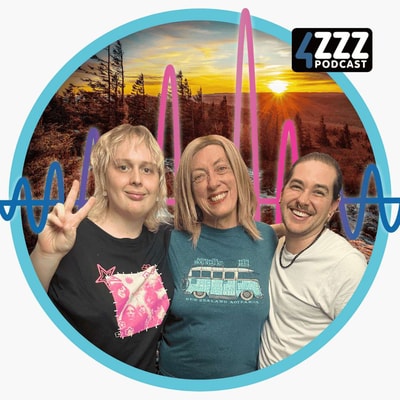
In today's episode Hazel (She/Her), Pheobe (She/Her), and Ez (He/Him) chat all things religion, transness, and the development of self with the kind and lovely Sel AKA Reverend Selina McMahon (She/Her). Crossing through discussions of institutional bigotry to how we can build ourselves as witches, join as we dive deep into what religion means to the trans and gender-diverse community.
Transcript
At 4zzz, we acknowledge the traditional owners of the land on which we broadcast.
Speaker B:We pay our respects to the elders,
Speaker C:past, present and emerging of the Turbul and Jagera people.
Speaker A:We acknowledge that their sovereignty over this
Speaker C:land was never ceded.
Speaker B:And we stand in solidarity with.
Speaker C:Transmission on 4zzz, amplifying the trans and gender diverse community of Meanjin, Brisbane and beyond.
Speaker A:Hello and welcome to Transmission on 4zzZ 102.1 FM. My name is Hazel and in the studio with me today is also the beautiful ez. Hi. And you just. Sorry, yeah, I'm She. Her welcome to the show and we have a wonderful good chunk of content ahead of you today, particularly maybe if you're a bit faith and religion inclined or maybe disinclined. We'll be asking some hard questions, I think.
Speaker C:Ooh, getting spiritual today. I like that.
Speaker A:Yeah. But before, let's stay grounded in the world of real things and let's do some news. So to start off, we have this via the Guardian. The role of far right manosphere in homophobic attacks on men to be investigated in Victoria. The role of far right manosphere influences in fueling homophobic attacks where victims were lured through fake dating app accounts will be investigated by a Victorian Parliamentary inquiry. It follows what Pugielli describes as a disturbing and terrifying series of attacks targeting gay and bisexual men across several straits and territories since 2024. As of October 2024, 35 people have been arrested in relation to such events. Av Puglielli, the Greens Equality spokesman, alleged that some perpetrators, often young men, have been groomed and radicalised by far right manosphere influencers and the committee will be required to deliver the report as of the 1st of September.
Speaker C:Well, that's good. Very good. We need to get answers on this and really do something about this escalation of radicalization of young men.
Speaker A:Definitely.
Speaker C:Also in the news is act passes Australian first legislation banning irreversible medical procedures for young intersex children. Australian first laws banning unnecessary and irreversible medical procedures for intersex people have passed in the Act Legislative Assembly. The Variation in sex characteristics bill 2023 will stop deferable treatments on intersex people's sex characteristics until they are old enough to take part in the decision. Under the new laws, when an intersex child was born, their parent will be given information, advice and psychological and peer support. Then, if treatment is to be pursued, doctors can follow plans put together by a panel of experts, including members with lived experience or for rare and complicated cases, individual medical treatment plans will be prepared. The act laws do not ban emergency medical procedures for intersex children, nor surgery that does not permanently affect a person's sex characteristics. The legislation also allows treatments if the person has the capacity to consent to them.
Speaker A:Yeah, that's fantastic. It's really, really nice to hear that, especially because, I mean, just so many people whose lives are drastically altered by that because the hasty decision made when they were a baby was not the right one for their health in the long term.
Speaker C:And also the amount of intersex people that have these interventions so little and they're now never told by the parents and then they never even knew in the first place.
Speaker A:Yeah. And that's a loss of identity, but also potentially like a huge safety concern.
Speaker C:Massive. Yeah.
Speaker A:And we have a nice bit of good news here. This is the European Parliament passes resolution that says trans women are women. The European Parliament agreed to a resolution that says trans women are women last Wednesday, citing the UN Convention on the Elimination of All Forms of Discrimination Against Women. The Council set a list of recommendations for the EU to pursue, including emphasise the importance of full recognition of trans women as women, noting that their inclusion is essential for the effectiveness of any gender equality and anti violence policies. Call for recognition of and equal access for trans women to protection and support services. It also mentioned LGBTQ people in several other places, including needing comprehensive tools to monitor and counter democratic backsliding and backsliding in women's rights, and citing attacks by anti gender and anti rights movements that undermined democracy and target women's and LGBTIQ rights. The resolution was adopted in a 340 to 141 vote with 68 abstentions. While the European Parliament's recommendations aren't binding, they are expected to have significant influence on the EU's positions in the forum.
Speaker C:That is so good. I like the number of votes on that too.
Speaker A:I know. And just so declarative.
Speaker C:Yeah, yeah. Also some good news. Formal complaint filed against Dr. Hilary Cass following a BBC interview on trans healthcare. A formal complaint has been lodged against British paediatrician Dr. Hillary Cass following a BBC interview about gender affirming care. The complaint, submitted to the UK's General Medical Council by physician Dr. Helen Weberly, alleges Cass misled the public in her comments on transgender healthcare and may have breached professional standards. Cass, who led a major NHS review into youth gender services, has faced criticism from some clinicians and activists who say her statements were were inaccurate and risk harming trans patients. As we know, most of those things have been debunked and they are untrue. The controversy follows a wide, wider debate sparked by Cass's work on gender identity services and her recent media appearances discussing the risks and realities of transitioning for young people. Critics argue her claims were presented without any sufficient evidence or context, while supporters say her review aimed to reform care and and improve safety. The regulator will assess the complaint as discussion over trans healthcare policy and media coverage continues across the uk.
Speaker A:Well, that's really nice to see some pushback.
Speaker C:Yes.
Speaker A:Especially when even our own government is looking to refer to these reports from overseas with absolutely no bearing on our population in the first place.
Speaker C:Yep.
Speaker A:It's really nice to see some people actually, you know, standing up against that.
Speaker C:Yes, I agree.
Speaker A:And to finish off, we just have a nice little event here. Well, I won't call it little. In fact, it might be the world's biggest. This is Transjustice Meanjin's fundraiser for the world's largest trans flag that's going to be coming up this week. 5pm, Thursday, 26 February at the Cave Inn. There's going to be a number of trans artists, including Ash o', Hara, Cloverlove, Lavender Threat, Emi Hour, Asbestos and Nicolain Martin. The flag is to be presented for Trans Day of Visibility. So if you want to be part of something big, that sounds like a great thing to go and attend.
Speaker B:Yeah.
Speaker C:Oh, that's so cool. Love it.
Speaker B:Peter Sterling, the only man in the world who's given birth to a child.
Speaker C:Someone might say you're a bit of a queer,
Speaker A:then they'd be Brian. My name is Hazel, My pronouns are she, her, and if in the studio with me today is of course, ez,
Speaker C:he, him, how you doing?
Speaker A:And we have a wonderful guest today. Look, if you have lived any kind of life at all, especially in a country like Australia, you probably have some relationship with religion. And today's guest is someone who can talk to us at length, at depth about this. It's my pleasure to introduce to you today just Sel.
Speaker B:Hi there, Sel, she, her and Sell.
Speaker A:Would you mind? I don't want to do it for you. Stating why I've called you. Just Sell. Like, what are you in here for? What do you do?
Speaker B:I'm actually an ordained priest in the Anglican Church. That's the old Church of England as it used to be an old money. And I keep getting called Reverend Selena and there's nobody less reverend than me, really. So I keep telling people, just use Selena or Cell. That's much easier.
Speaker A:Wonderful. So your name is Cel and you're a reverend, but you don't like to be called Reverend Sel. I respect that. I just want to know a little bit about who you are. How would you define that, if you can?
Speaker B:I used to define it myself as being the only licenced transgender priest in Australia, but that's made me sound a little bit too much like the only gay in the village. So I've stopped doing that as much nowadays for a number of reasons. But, yes, I'm just soon to be divorced, but four children, outrageous mortgage, couple of dogs, that sort of thing. Just like a normal person? Well, vaguely, yeah.
Speaker A:I mean, it's more about what you do with it, Right. You're a normal person in those ways, but I think you're very unique in a number of other ways. So you're talking about how you are a reverend and in some ways, like you said, a very unique one. When you're doing that work, what does that look like? What's the day to day of your work look like?
Speaker B:Well, it's. I mean, there's a lot. A number of things that are very similar to any other common garden, run of the mill, clergy person, you know, baptisms, weddings, funerals, hatches, matches and dispatches, as we sometimes call them, and visiting. But I tend to get a lot of people coming to me who. They usually come to me because they've heard of me or pointed in my direction, particularly people not necessarily Anglicans either, that can be of any faith or no faith. I have no real problem with either of those, but particularly where they have been told by their church leader or members of their church body that they are going to hell because they are lgbtqia, whatever. And so I see it as one of my main roles is to actually set the record straight on that and give them some support, counsel and let them know that actually, no, they're not, because that's not a sin. It's not separating yourself from God, it's God made you the way you are.
Speaker A:So that's really interesting. I mean, it's like what we expect from your role, right, where you're consoling people, you are giving them opinions, advice, you're helping them to interpret things.
Speaker B:I try not to give them opinions, I try to give advice and I listen. It's important. Sometimes, actually, just listening to somebody is the most important thing, because quite often they haven't been listened to. And when they're allowed to speak, even if they're just speaking one to one, and you're just actually actively listening to their Words telling their storey they quite often work things out for themselves. So it'd be wrong of me to actually give them my opinion because I can only give you an opinion on me. I can't tell you what you think. So it would be wrong of me to do so.
Speaker A:Right. So in a way, considering these people have headed your way after hearing some not nice words from other people in these institutions, you're kind of undoing the hearing of opinions from other religious.
Speaker B:That's a nice way of putting it. But yes, it's particularly opinions that actually, actually run counter to the words that are contained in that holy text. Because a lot of those opinions are human or institution led opinions and are not actually the opinions that we see written down.
Speaker A:Right. And I think that's a really interesting angle to get at as well when we're talking about this is that divide between what is of the faith, what is of the religion and what is of the institution, what is of the individual members. I was curious, how do you go about finding that separation? Because to me that would be a fairly blurry line to identify.
Speaker B:It is a blurry line for me, the way I do it. I mean, you can call it prayer if you wish, you can call it solitude, just listening in and breathing if you like, but just ascertaining for yourself what you believe is right. I think when we're honest with ourselves, we usually do make the right choices. I think that a lot of, and we've certainly seen it over the years, a lot of the hypocrisies that have been in place where people have, you know, castigated other members of their society for being LGBT or whatever, and it turns out that they're actually. You're speaking so loudly, you know, me think they do protest too much sort of thing because they're actually more embarrassed and scared to have found it about themselves. And sometimes it's easier to reflect it onto other people than it is to actually face their own demons. So I think that's the way I deal with it, to actually be honest with yourself and to work out what you actually believe. And I think that's one of the biggest problems with faith is that people in general haven't sat down and thought, what do I believe? They have an idea of where the thoughts generally head, but they haven't actually sat down and spent time with it.
Speaker A:Right.
Speaker B:And by that I don't mean so necessarily intellectually spending time with it, but just actually, if you like meditating on what it is that they are thinking what it is they are actually believing. Because that's part of the secret, I think, to actually finding your path through life through faith.
Speaker A:So not getting lost in all the leaves and the flowers, but more the roots that's all growing from.
Speaker B:Well, not only that, but not getting lost in the leaves, flowers or roots, but actually seeing the forest and the sunset that's going on in the background.
Speaker A:Very nice. Yeah, that's great. And what you were saying before as well, about people expressing those more bigoted opinions and Castiglion getting those who should be close to them. It makes me think of a phrase I've heard tossed around a lot lately, which is oftentimes with these people, accusations are admissions. And it's very easy, I think, like you're saying if. If you haven't had that time to reflect on yourself, if you're not seeing where those feelings are coming from, I imagine surely that can also amplify things like crazy. Right. Because you know, you know you're missing that source of that feeling. Right?
Speaker B:Yeah. And I think that's. I don't want to belittle anything here, but in many ways that's also what we're seeing in some of the news reports that you've just had today about puberty blockers and things like that that are stopping people from actually being able to see themselves, who they are meant to be, because control of politicians who are controlling, in this instance, you know, the control that's being enforced on them, that to actually conform. It's getting very George Orwell 1984 now, isn't it? But, you know, to conform.
Speaker A:Yeah.
Speaker B:You know, the, the. With the picture, the image that somebody else has as to how you should be, which little box you should be. You should be in a red box. You might want a green box.
Speaker A:Yeah, I think I would.
Speaker B:We want you a red. No, red box.
Speaker A:Right.
Speaker B:Give you red fox ideology.
Speaker A:Exactly. And I'm to ignore how much I like those green boxes.
Speaker B:Ignore green. Stay at. Stop at the traffic lights. Never go.
Speaker C:I would. I would think as well that. Linking back to what you said before about being honest with yourself, I feel like people who come to seek your counsel will probably also feel safe in your authenticity as you live as. As much as your true self.
Speaker B:I hope so, because otherwise I'm as guilty as everybody else and being a hypocrite. And I probably am, actually, to be honest. I mean, we all are. We all are guilty in some shape or form. Yeah. Yeah. I'll give you absolution later on, but we do that as well in The Anglican Church. But the. Yeah, I think it's, you know, it is a point that you really have to. To reflect that even. Even when you're absolutely certain of something, you can still be wrong. But I think the likelihood is that when you're thinking about yourself, you're. And you're thinking honestly and deeply about yourself. Can you look in the mirror and say, I like that person that's looking back at me, or are you looking in the mirror thinking, I like about 90% of it, but it's 10% that I'm not letting on to other people and I'd rather keep that hidden away because that's my little secret.
Speaker A:Right.
Speaker B:And I think that's part and parcel of it as well.
Speaker A:And, and you're saying that, you know, you can be wrong when you do that reflection, but those are steps towards.
Speaker B:Yeah, yeah. And there is an element, you know, you've got to be honest with yourself, yourself when you look at that. I mean, for example, for. Oh, good grief. For many years, I looked at the reflection in the mirror and thought, yeah, there's. There's somebody hiding behind that facade, that mask of masculinity.
Speaker A:Yeah.
Speaker B:But what was too scared to actually allow that person to flourish. And it. It took. Well, it took over 50 years before I actually got the courage to actually look in the mirror and say, actually, I can see who's peeking behind there now and I'm going to let her have a look. See, I want to see who that person is.
Speaker A:That's so special. And that hits me really hard because I had a couple mirror revelations, if you will, myself. And like, I remember distinctly still early high school, or maybe late primary school, having a dream. I didn't even really. I'm sure I felt wrong, but I didn't even really know why or what type of wrong it was. I don't think I could even articulate that I did feel wrong, but it was there. And I remember having a dream once where I looked in the mirror and I didn't see a version of me with long hair. I didn't see a version of me that looked a little different. I just saw me as literally a woman on the other side of the mirror. And I remember waking up from that dream feeling heavy, but also feeling like I had felt a happy feeling that I'd never had access to before. And I'm thankful to say that, like, you know, now that I've been on this journey for a while, I was able to look in the mirror recently and see myself there. I Didn't see a bunch of obstacles to get over. I saw a version of myself that I can start to appreciate in that way. So I really like how you've approached it from that idea of looking in the mirror there, because that reflects absolutely how it's been for me on this journey. You spoke before as well about puberty blockers and the CAS report, of course, and all that. That's going over in the UK at the moment. That's where you're from as well, right? How is that feeling for you at the moment?
Speaker B:It's. I'd like. Well, it's distant, but it's only on our doorstep because I think what happens in America today happens in the UK tomorrow and we get it in Australia next week. So, you know, I mean, we've seen that fairly recently. You know, we saw the Trump effect taking place in America that then got reflected through the CASS report in the United K. The United K. United K. Who is she? The United Kingdom. And then we're getting the LNP using the CASS report as ammunition in the argument about puberty blockers, even though, as was mentioned by my colleague on my. Right. That, you know, that it has a lot of different. The evidence in there was not treated correctly, was. Was misrepresented and all of that sort of stuff. And it's. Sorry, go on.
Speaker A:Yeah, sorry, I was. I was just trying to encapsulate it's. It's that importance of identifying how that is reappearing, what's staying the same between those cases.
Speaker B:Yeah, we. We are. We are. Well, if you like, it's a tsunami that started in America, it spread across the Atlantic. It's lost some of its strength in doing so, because tsunamis work like that hit the United Kingdom and now it's come around the bottom of Cape Horn. Cape of Good Hope. Cape Horn, South America. Cape of Good Hope, around the Indian subcontinent is now catching us on the. On the shore. It's lost a lot of its impact, but it's still there nonetheless, and it's still forceful, it's still planting those seeds.
Speaker A:Yeah, absolutely. Well, I think you're right. I think it's certainly true that our cultures are meshed, that there's reverberations, that those things sort of keep kicking down the line. And I think that's why it's important that we, even though it can be heavy, that we're paying attention to these things as they're changing and that we're paying attention to the way that's going to be affecting the ones of Us who are the most susceptible to it, you know, the youngest of us. The versions of us that going through a trans experience that, as hard as it is, is one that a lot of us wish we could have had as well. Right. You know, now being targeted so roughly like that. But I've kind of bookended myself into a rather sad comment here. I feel like I'm kind of getting the proper experience out of you here. Cel, you've started making me open up about myself what I intended to make you open up about yourself.
Speaker B:That's a secret. That's a priest thing. You wouldn't understand.
Speaker A:Hi, we're Worm Girls and you're listening to Transmission. That's right. You are listening to transmission on 102.1 FM. This is 4000Z and my name's Hazel. My pronouns are she, her, hello, I am, Phoebe. My pronouns are she, her, my. God, is that a new voice? That's an intern in here today, folks. Sorry I've interrupted the. The intros. Go ahead.
Speaker C:Oh, my goodness. It's as usual.
Speaker A:He, him, and of course, the wonderful.
Speaker B:Who else has arrived? I can't see anybody. No, I'm here as well. So, Sal, she, her.
Speaker A:I'm glad that you introduced yourself in lieu of anyone exciting or anything like that. But I mean, I'm sorry Sal's been making those jokes, but I just realised it probably sounds really mean of me to have just said that out of nowhere.
Speaker B:Well, we know you. Well, you say that's what it is.
Speaker A:Exactly. It's. We've just. We've just had a big expose of my soul in the last session and why don't we keep it up? So let's keep talking transness and faith. I'm excited to ask you some more questions about that and I really want to get at this. I'm sure the listeners have had this very common experience that when they have had that understanding, they are trans or gender diverse. Obviously, you tend to reject these religions, institutions because there's reputations, there's evidence around you about how they feel about you. You're someone who found your identity and you stuck with your institution. I want to ask about how that happened. Why did you.
Speaker B:Well, a number of things, really. Not sure I'm going to put these in any chronological order or any order that you might make any sense. They're just sort of random things, thinking as you please.
Speaker A:Go for it.
Speaker B:I mean, part. Okay, I'm going to get deep and serious now. Serious face on. Part of the calling to priesthood is a relationship with God. And I never felt that that relationship changed. So I didn't feel that there was any need for me to reject my calling to the priesthood, which is partly sacramental, doing all that mysterious hokery pokery type stuff.
Speaker A:Right.
Speaker B:But it's also partly pastoral, the relation to other people. And I could see that that was something that was. Actually. Could be augmented. Good word. Use it in Scrabble. It could be augmented and used in helping particularly the transgender, but also the full LGBT community. So I, I didn't reject God. I have issues, don't get me wrong, I have issues with the, with the institutions of church, because it's not just one. I mean, I'd love it if you were all united and all actually thought the same. As long as it's what I think and not what they think. That's the problem.
Speaker A:I think they feel the same way.
Speaker B:Yeah, yeah, that. That's the problem, isn't it? You know, we all have our own ideas. It's like. It's like football clubs or soccer clubs. I'm going to talk about proper football, where you kick it with your foot. You know, I'm here for it. Yeah. You know, you can, you can support Manchester United, Liverpool or if you're really sensible, Middlesbrough, which is where I come from, which is my team. And you know, you can be. You can do that. And you've all got your divisions in that, you all. I think this particular play is brilliant. I think that particular place with that move, that goal, that whatever. But there's a love of the sport in general that's there, that's coherent across the whole, you know, the whole divide. And we kind of have that in. I'm going to just talk about Christianity first. Second, sure, in Christianity we do have that unity in your faith in God the Father, Son and Holy Spirit. But you'll get. The Roman Catholics have their flavour of it and the Anglicans have their flavour of the Baptists and all the rest of them. And to an extent that you can actually, I sometimes think to myself as well, actually, when you look. Look at it, you could actually say that many other of the world's great religions, Islam, Hinduism, they all have a belief in a central deity and their take on it is very different to ours, but they've still got the fundamental belief in a central, creator loving, keyword, loving, guiding, being. I'll just use those words for now. And so, you know, in many ways, the actual, you know, whether we're supporting Bournemouth Football Club or whether we're supporting Real Madrid, those of you who are into soccer will know the relevance of those two teams in that they are very differently levelled. But it doesn't really matter because it's the love of football that actually unites.
Speaker A:Right.
Speaker B:And I've lost the train of thought that was going on there. But it's basically what I'm trying to say is that I didn't lose my faith in the divine. The institutions I had a bit more issue with.
Speaker A:Of course, if I can touch on that, I'm sure a lot of our listeners are resonating with that because I spoke to the community, I put a call out and I asked people, at least in the circles I know, to talk to me about how they feel about faith, particularly as trans people and gender diverse people. And one of the things I saw the most was that there's this idea that they still feel a faith. They still feel an idea there might be someone who created us and looked out for us, but they moved away from those institutions. And you've stayed in to sort of operate within that setting.
Speaker B:Yeah, I mean, I suppose it's also an element of fear in my own sense, in that moving away is taking yet another step into the unknown.
Speaker A:It's still a big safety thing for you. It's still a piece of who you are.
Speaker B:Exactly, exactly. And as I've mulled over it, I've decided that this is something that actually is my calling. It's a very specific role with a particular denomination, but I'm quite happy to straddle the boundaries of denominations as well.
Speaker A:Yeah, right. I think that's really interesting. I guess it's kind of just a different form of that same experience. Right.
Speaker B:Yeah.
Speaker A:You felt that pull away from being ironclad to those institutions, but you're not necessarily diving into a complete unknown territory. You're operating with the tools that you have in front of you.
Speaker B:Yeah. And. And at the end of the day, I still believe in a creator God who loves everybody, whether they happen to be agnostic, atheist, Mormon, Seventh Day Adventist, whatever. God doesn't make those distinctions. We do. And we get things wrong all the time.
Speaker A:Right. Yeah. So you're happy to throw your hat in and be part of that reinterpretation, part of figuring out how that we apply these texts to ourselves.
Speaker B:Yeah. And. And I think that that's, you know, that's, that's part of the spirit of faith, really, of faith in a loving creator. I believe in a creator who created us for a good reason.
Speaker A:Right.
Speaker B:For bad reasons. And unfortunately, the, you know, we are not perfect. And that's why we have so much pain and hardship. What have you. And I do hear, you know, that religion is quite often used as an excuse for it and. Yeah, and that has been the case throughout, you know.
Speaker A:Yeah.
Speaker B:I mean, let's be honest, 2,000 years ago, they stuck a guy upon a cross because of what he said.
Speaker A:Absolutely.
Speaker B:What hope have we got now?
Speaker A:Yeah. So it's. It's all these different ways that you can interpret this. And I think absolutely, our audience, given the way that we feel about ourselves, the journeys we take, also believe that if something did make us, it's with kind intent. And so I want to explore that a little bit more. But, ez, I know you've got one that's kind of been burning on your brain.
Speaker C:Yeah, well, mostly just. I'll give you some context. So, like, when I was a. When I was a little kid and I felt very strange about my body and my identity and my image, I remember disclosing this to my dad. And my dad wasn't. Isn't really a particularly religious man, although every now and then he does. He does make reference to God. And on this particular occasion, I was very upset about my image and I was feeling really bad about how I looked. And I probably was like 10 years old. And I remember him comforting me. And he said, God made you exactly as you are meant to be, and you are beautiful. And I think of that moment often at times and how that still impacts me today. But it also reminds me that my body and my transness were always meant to be and always exist. And this is the journey I was meant to have. And I guess, Sal, I wanted to know your thoughts on this, especially when it relates to trans people who identify with the statement of born in the wrong body.
Speaker B:I've got to be honest, I don't like that statement because it implies that there's something wrong with you and who you are. In my mind, you were born in the right body. It just doesn't quite conform with how you should be at the moment. It's like. I mean, I always think. I've had plenty of people question me, why do you think God made a mistake in making you a man and when. Or making you think you're a woman when you're really a man? I sound like Kenny Everett. He wouldn't know who that was now. But, you know, and I say, no, God didn't make us mistake. God made me. Me. I mean, people are born with various medical defects, you know, quite regularly. Cleft palates were, you know, really decide. Disfiguring, that's the word I'm looking for, disfiguring facial feature. But surgery nowadays cannot, you know, they offer it on children at a very young age to correct that. And nobody says, oh, that's a sin, you should leave them with that cleft palate through. Throughout their lives. People wear spectacles to improve their eyesight. I know I do, you know, or hearing aids or whatever, you know, people are. We all have something wrong with us in some way, shape or form. And yet medical intervention can, can and often does alleviate that. And we never think of that as being a sin. But, but certain individuals do get this idea that we are formed perfectly, which is not true. We are perfectly formed in that we are made as God wants us to be. And sometimes I think and this dodgy ground a little bit here. But sometimes the inner strength you need to overcome the adversities that you'll go through in life in becoming physically who you are meant to be or how you are meant to present. I think that can be something that's quite empowering. Doesn't seem as at the time, don't get me wrong, I know it can seem very, very painful, but it is a strength. It's like doing an exercise. You feel at first, oh my God, I've been running, my legs are dead, I can't possibly do another step. But you know, over time you build up strength, you build up resilience and it's a similar thing. I think this is just me. I think that's a similar thing in how we have overcome the nature of our physical bodies to conform with what we believe to be our correct body and what God actually intends for us as well, which is the same thing, our correct body.
Speaker A:Right. So things like, like you said, spectacles or cleft palate surgeries, these things, being trans is another example of identifying that you want to be a different way to the way things are right now.
Speaker B:Yeah, in many ways. And that, you know, and people may even point to that and say, well that's wrong, you know, because you're made that way so you shouldn't be doing people, you know, a hundred years ago, I can see the hand raised over there. People sound like a school teacher, George, don't do that.
Speaker A:It's a well sermon.
Speaker B:But people 100 years ago were, you know, if you were left handed, you were forced to write with your right hand, your left hand would be bound until you learned how to write with your right hand. Left handed. The original word for left Handed people was, they were sinister. It just means left handed. But it's taken on that, that more sepulchral identity now because, you know, because it was wrong, it was shunned, it was something almost blasphemous, almost.
Speaker A:Right.
Speaker B:But nowadays we don't worry about it, we just think they're born left handed. What's the issue? And it's a similar, I think in 100 years time it'll be similar. Oh, yeah, you were, you were born. Yeah, you've got that sorted out and put right and what have you.
Speaker A:Yeah. And yeah, I, I, I see this has also struck something with you as well, Phoebe. You've got other things burning on your mind. Well, I just wanted to say I feel like if you believe in a God, why wouldn't medical improvements be a part of that plan that you believe in? Like, wouldn't that be the improvements? The plan. Right, yeah.
Speaker B:And, you know, I mean, God, at the end of the day, I believe that God has created everything and God has created the ability of certain people to be able to, to correct these things. Surgeons and physicians and osteo, whatever and all that. So, yeah, we've been given that gift, that gift of knowledge, of skill, of technique to make people's lives better, make them more whole. And I think that that's, you know, we shouldn't say, oh, that bit of medicine's good for that. It's not. Which is exactly what the argument is of about puberty blockers at the moment, incidentally. You know, puberty blockers are prescribable if the reason for you is that you're on early onset puberty, we can use puberty blockers to hold it back.
Speaker A:Right.
Speaker B:But if the only reason you want them, and that's perfectly safe and everyone agrees that's safe, even Dr. Cass agrees. But if you're wanting them because you might be transgender and you just want the whole thing, things back until you're sure or until you're old enough to make these decisions, that's wrong. No, that's, that's bobbins. I'm sorry, that's absolutely rubbish. You know, we have been given the skills and judgement to do these things. I don't say we should abuse it, we certainly shouldn't abandon it.
Speaker A:I also just wanted to highlight, we, we got a text in that is quite.
Speaker B:I know, how exciting self be still my beating heart.
Speaker A:But it's, it's very relevant to what you're saying. So thank you for texting in Beck. Beck here says that I Thought I'd add to the chat. I was a minister for a few years and got my masters in theology and found that the longer I explored, the more mystery. When I came out as queer and genderqueer, I found myself drawn towards mystery, not certainty, and it took me away from the church. I identify now as a witch and I find deep fulfilment in helping make space with other queer and genderqueer people to explore our internal work. And I really like what they say here. It's this idea that the mystery of the universe is such a gift of being able to make ourselves. Which is exactly what you're saying there as well. Right. Like the way we're existing, we have these tools and facilities within ourselves to find a life that suits us. And like you said, you can identify what you know inside you is doing wrong by someone else and what isn't. And by living this life when I feel like quite obviously not doing wrong by other people. Yeah, it's really fascinating. And I love seeing this kind of crossover of opinion here. Oh, sorry, not opinion, but this crossover of feeling between someone who identifies as a witch. Phoebe, you said before you identify as agnostic. Yes, and of course, you know, I identify as Yorkshire and other scary, dangerous things like that. Yes, but no, it all comes together. There's, like you said before, there's all these interpretations, but there's those really strong through lines that are connecting all of those things together. Yeah.
Speaker B:I think Bec actually also hit a little. A little nugget there when she's talking about faith and uncertainty, because we always quite often hear people say, oh, the opposite of doubt is faith. Well, that's wrong. You know, faith is. The faith's opposite, is actually certainty. I am certain that if I take an apple and let go of it, it will hit the floor or table if the table happens to be in the way.
Speaker A:Right.
Speaker B:But I don't have to believe in that. That's faith. Certainty is the opposite Faith.
Speaker A:Right.
Speaker B:Doubt is. Well, I'm not sure if it'll hit the floor. It might hit the floor unless somebody catches it.
Speaker A:Right.
Speaker B:Yeah. So I think there's a little nugget
Speaker A:in there that's really nice. I really like that interpretation. How many genders are there? I don't know.
Speaker B:I just got here.
Speaker A:Cel, you're someone who. I mean, I know you because you attended a regional queer festival called Mardi Grasberg, and you attended that as a panel where you could speak educationally to people who had questions that they may not have felt comfortable Asking someone out and about in the wild. I know that you're now also a committee member of that event and a lot of what you do is focused around this idea of reaching out and of talking to people. And so I wanted to ask you, obviously when you're in that position, you encounter people who are hateful and who are bigoted. Is it worth engaging with these people?
Speaker B:It's worth engaging with them. It's not worth trying to convince them that you're right and they're wrong because that would be a very bad stance to take anyway. But, you know, you need to engage with them. If nothing else, the old phrase know your enemy leaps to mind. You know, you need to know what people are seeing, what people are hearing, what people are thinking, because some of them are influencing others and they'll be speaking to people who may not really know and they may not be convinced. And so you've got no opportunity to put a slightly different or very different perspective on things. So yes, yeah, it's important to engage. But I think the, the idea that we can, simply by sitting down discussing it, come to an agreement that we are, you know, one of us changes our mind. I remember years ago in England on, yeah, there's a television programme and it had the then Archbishop of Canterbury, Rowan Williams, who's mind is about the size of a planet, and Dr. Richard Dawkins, who's an out and out atheist. And the two of them were sort of engaged in conversation. I think the BBC, I think, was BBC just basically wanted to see which one of them would lay into the other one hardest.
Speaker A:Yeah. Who can earn the most points.
Speaker B:Yeah, exactly. I mean, whether it made good television or not, it's a. Another matter. Don't yawn on microphone. Whether it made good television or not is by the by. But you know, the whole idea that by sitting these two people down, very different views, sitting them down and hoping that one of them or expecting one of them to change the other one's mind was just ridiculous. And you're never going to do that with people. Over gradual time they may come to realise realisation that their ideas are erroneous or they may come to an idea that they are even more right than they currently are. But it's important, I think, as I said, to actually engage with them, to hear what they're saying, because what they're saying is what other people are only just thinking. And if you can actually nip it in the bud, that's the end of it.
Speaker A:Totally. There's those, those degrees of Understanding that you can get. I think you're right. There's this idea that people kind of change their own mind over time. When they're prepared to. When they're ready to.
Speaker B:Yeah.
Speaker A:And that's something like, clearly you can have. You can be a part of that journey. But I think you're right. It's not something that can happen just sort of through a conversation.
Speaker B:Yeah. It's. I would. I would hate to think I was an influencer.
Speaker A:One of those granfluences.
Speaker B:We heard that say that. But, you know, it's. It's certainly. Yeah, I think that's all you can have is influence. You can't actually force people to make them change their minds.
Speaker A:Totally. Well, I might go over to the other side of that, though. Right. Which is I mentioned before, I reached out to the trans community that I know and I asked people how they felt about religion and one of the things I heard alongside people saying they felt still religious, they felt this pull away from the church, but they felt spiritual. I also saw some people who feel, you know, quite emphatic, quite aggressive about religion. I might quote here, someone said so many people use their faith as an excuse to enforce hatred. It's disgusting. And quote, the church is one of the most bloodied and shameful empires the world has ever known. You hear these kinds of things as well from obviously people who are of your community. Right. I'm interested in how do you react to those types of comments as well?
Speaker B:Well, actually, to be fair, I agree with them. You know, the church is, and has been, as I said earlier on, we stuck a guy on a cross just because he said, love your neighbour and never said love your neighbour, unless they're transgender, in which case it's all right to hate them. He never said that. He said so. That's why it's still coming across. But, you know, so the church has its hands, not so much dipped in blood, but, you know, it's had a bloody good shower in it. Empires, that's how empires work, you know, I mean, the British Empire was certainly not averse to the odd war or two. The Ottoman Empire and the Roman Empire and all. That's how empires are built, through aggression and despotic power. So, yeah, I would agree with the people who've said that. I think that's, as an institution, the churches, churches. Not just not singling anyone out here, but churches in general.
Speaker A:Widespread.
Speaker B:Yeah, guilty of that. I think there are some individuals who call the shots, shall we say? And they also are guilty of that. I Think a lot of others are too scared to do anything else because they're scared to be ostracised themselves. It's the old, you know, I won't say anything because I might get caught into the web with that person.
Speaker A:Yeah, totally.
Speaker B:So I think that's. That the other thing that you mentioned, though, about individuals. Yeah, yeah. I mean, I certainly. I remember I was talking to one person once and they said they had more difficulty going to a group meeting, a self help group meeting here in Brisbane and confessing that they were Christian than they did of going to a group of Christian in their church and confessing they were lgbt.
Speaker A:Right.
Speaker B:Because they would expect resistance to that. Well, they would expect, yes, resistance, but also I think the fact that they were doing it meant that they felt comfortable enough with the people they were talking to to do that. But actually because of this perception people have of the church as being antagonist to the LGBT community, which in a minute is. They were more scared about actually confessing that they were Christians than two members of that community because they felt that actually might ostracise them from their own community. Thankfully, it didn't.
Speaker A:Oh, that's good.
Speaker B:That was their fear. And it said that was actually a stronger fear.
Speaker C:It must be so challenging to identify as both queer and then also a person of faith because you can be rejected from both communities for having those affiliations either way.
Speaker B:Yeah, yeah, you're right. And. And I've got. I mean. Oh, yeah. I mean, that's one of the reasons I put it off for so long was that very reason. But there came a point when I. I said to myself, if I don't do this, I. E. Transition or begin the transition process, then there's a distinct possibility I'm going to do something slightly seriously more serious.
Speaker C:Exactly. Yeah. The same way.
Speaker B:So for my own sort of health, sanity and all the rest of it, I actually started to transition. There was no option in that. And now I find myself, I'm in the position where, because I've done that and I'm still a person of faith, I get invited onto marvellous opportunities such as this one, to talk to good people like yourselves. But also because I can do that, because I've already gone through the stigma, I know I'll get some flack for doing it, but at least if I'm getting the flack, they're leaving half a dozen people who aren't in the position of strength and certainty yet they're leaving them alone. So it's like also little bit of a barrier. If I don't do it. Nobody else is going to be able to do it easily.
Speaker A:So it's kind of like a responsibility for you in that way.
Speaker B:Yeah, yeah. I mean, I hate labels, but you can be lesbian, gay, bisexual and hide it from society. As soon as you transition, that's it, it's obvious, it's in your face. So you might as well use that as a strength then use it as a weakness.
Speaker A:Right, totally.
Speaker B:And that's how I see it. So I think, right, I've been given this, this is an opportunity. This is a God given opportunity. All right, okay. So it would be wrong of me to turn away from that opportunity. Better that I actually stay strong and actually communicate on both, you know, to both groups.
Speaker A:Absolutely.
Speaker C:You're a force to be reckoned with.
Speaker B:Cell. They call me hurricane cell. Cyclone cell. That's a better bit of alliteration, isn't it?
Speaker A:I hear about that almost now.
Speaker B:Psychopath cell. Yes. I'm not a psychopath. I'm a higher functioning sociopath. Go do your research.
Speaker A:Yeah, well, I mean, obviously in that role you're communicating with internally as well, those, those, you know, firmer opinions, how do you engage with those people? Because they're also, you know, your peers, the people you coordinate with as well, I think.
Speaker B:Yeah. And in many ways, I mean, don't, don't get me wrong, you don't go looking for a fight if you don't want it, of course. So, you know, certainly, for example, she says, not wishing to name names or locations, but I'm not going to suddenly hop onto an aircraft and fly down to Sydney and say, I want a job in the church here. Because I know full well that even just as a woman, and I use the word just from their language, not from mine, I wouldn't be accepted as a priest. Because you can't be a priest in the diocese of Sydney. They won't allow it. They think men are right and men have ruled and it says so in the Bible. No, it doesn't. You know, we'll just forget about that. So I wouldn't, I'm not going to go and do that. I'm going to stay somewhere as relatively safe as the Diocese of Brisbane because they are more progressive, more open minded in the main. I mean, there are still some churches that aren't quite as progressive and open minded. And you pick, you pick your friends you find the place to actually use as your base. Accordingly. You don't just say, I'm going to throw caution to the wind, I'm going to go and set up my base in that lion's den over there. No, you're not going to do that.
Speaker A:Of course. Yeah. So it takes a bit of that care as well.
Speaker B:Yeah, yeah.
Speaker A:Right. Well, we've been talking to Cel about religion and we've been covering a lot of themes. We've been covering communication, the heaviness of it all, the lightness of it all. I did want to come down onto one thing, though, Right. Which is that your experience Cell is definitely not an isolated one. The life you're living, I'd say, is a unique one, but it's come from a position that a lot of people have found themselves in. And I was curious if you had an opportunity to talk to a younger Sel who is still maybe not even aware of these feelings. What do you think she'd want to hear from you?
Speaker B:Be authentic to yourself. Don't put off till tomorrow what you should be doing today. Listen to other people, but don't follow them slavishly. Yeah. I think one of my biggest regrets is that I took such a long time before I transitioned, and I had a friend many, many years ago when I was only 30. See, I'm giving my game away now. And she said, don't get to such an age that you regret not doing all the things that you could do now. And I sort of poo pooed it. And that I. I do regret.
Speaker A:Right.
Speaker B:Because I should have listened to her. So, Pauline. Sorry, she won't be listening because she's in. In England, but there you go. But, yeah, I think those things. Yeah, certainly, as Robin Williams, if he could have spoken Latin correctly, would have put it, seized the day.
Speaker A:Yeah, I think that's really sweet. It's. I mean, it's something that I'm glad I heard it when I did. And I think probably, like most trans people, I wish I heard it earlier. It seems like maybe that might be one of the most universal feelings with trans people, is we all kind of wish for something, but I really love that we have the opportunity to live the way we do. And I love that you take your opportunity and you're turning that into a way to build others up. And I love that, like, that lovely text that came in before, you know, you're finding that space, you're preserving that mystery and that love for people within that church setting as well, which I think is really, really beautiful. We're coming up to the end of the episode Cell. Is there anything you'd like to talk about that you're involved with anything you want to.
Speaker C:How can we reach you?
Speaker B:Yeah, how can you reach me? Probably the easiest way to reach me at the moment is via your good selves here at 4zzz. Quick quick. Plug for the radio, folks. Or I am on Facebook because I'm old enough to still think Facebook is cool, but I'm not really on any other form of social media. My email address, I'm sure they'll have it in the office here. That's probably the easiest way. But for those of you who can write it down very quickly, it's Selina. S E l I n a 1345 MacMahon. That is m c m a h o [email protected]. there you go.
Speaker A:Wow.
Speaker B:And I am available for. If there's anybody out there who says, oh, actually I'd love to hear her talk to our group. Our community doesn't have to be a church one, you know, I more than available. And if anybody's got a nice job they'd like to offer me, I'm more than available for that as well. So, yeah, I love this.
Speaker A:Yeah. It's an opportunity for you as well, right?
Speaker B:Oh, yeah. I'm not daft. I might be stupid, but I'm not daft.
Speaker A:There's a difference. Absolutely. Well, at the end of the day, we're a community. We look out for each other and it's these opportunities for us to lift each other up simultaneously. And I think that's one of the most beautiful things we can offer at large as trans people. But Also here at 470 Z, we're coming up to the end of the show. If you. If you like transmission, if you want to listen to more of us, you can listen to us on demand at 4zzz.org au. You can also listen to edited versions of us in podcast format on places like Spotify and all the other lovely places that you'll find your podcasts too. I think we're kind of wrapping up to the end. I also want to say that 4,000Z is a community organisation and if you do want to support us, you can do so monetarily, if you like. It's 4zzz.org au support and that there's a number of price ranges. If you like animals, you can even subscribe your pet for just 25 bucks. My cat's been a subscriber for a number of years now, so maybe you can become as ethical as my cat and support community radio serving your community. We're going to wrap up now. It's been absolutely lovely talking to all of you beautiful people. My name is Hazel. My pronouns have been she, her, and I'm pretty sure they'll stay that way. I am Phoebe. Thank you. I'm she, her.
Speaker C:I'm ez. I've been using he, him, and I suspect that will also carry on forward.
Speaker B:And I'm Sal, she, her, not Reverend, please.
Speaker A:We'll keep the reverend out of it. All right. Well, thank you. You've been listening to 4zz-102.1 FM.
Speaker C:Yeah. And whether you're starting your journey with gender or navigating the world of religion, it's always a leap of faith.
Speaker A:Well, to leaps of faith. This has been Transmission on 470Z.
Speaker C:Thanks for listening to Transmission. Catch us every Monday live on 4zzz from 10am or listen to our podcast on the Community Radio Plus.
Hosts: Hazel (she/her), Ez (he/him), and Pheobe (She/Her) w/ Special Guest Reverend Selina
In today's episode Hazel (She/Her), Pheobe (She/Her), and Ez (He/Him) chat all things religion, transness, and the development of self with the kind and lovely Sel AKA Reverend Selina McMahon (She/Her). Crossing through discussions of institutional bigotry to how we can build ourselves as witches, join as we dive deep into what religion means to the trans and gender-diverse community.
🔗 If you'd like to listen back to the unedited episode - with the music - head to our On Demand website. And don't forget to follow our socials at Facebook and Instagram.
Timestamps and Links:
- 00:00 - Acknowledgement of Country
- 00:20 - Welcome to Tranzmission
- 01:15 - Community News and Events
- 07:14 - Just Sel: Hatches, Matches and Dispatches
- 09:27 - Sel: Listening and Affirmation
- 11:52 - Sel: Religion, Institution, and Meditation,
- 15:00 - Sel: 🟥, Absolution, and Self-Honesty
- 19:32 - Sel: The Cass Tsunami
- 23:25 - Sel: Sticking with God not Institution
- 30:52 - Sel: Perfectly Imperfect and 'The Plan'
- 37:36 - Sel: Mystery, Uncertainty, and Making Ourselves
- 39:48 - Sel: Reaching Out and Engaging
- 43:20 - Sel: The Empire of The Church
- 51:07 - Sel: Advice to your younger self
- 53:13 - Sel: Self Promotion - [email protected]
- 55:00 - Support 4zzz!
Community News and Events
- The Guardian - Role of far-right manosphere in homophobic attacks on men to be investigated in Victoria by Benita Kolovos
- Equality Australia - Bill protecting intersex children from unnecessary medical interventions passes Vic lower house
- LGBTQ Nation - European Parliament passes resolution that says trans women are women by Alex Bollinger
- Pink News - Dr Hilary Cass faces formal complaint over BBC interview
- Trans Justice Project - We’ll unveil the world’s largest trans flag this Trans Day of Visibility 🏳️⚧️: Fundraising Concert @The Cave Inn Thursday, 26 Feb, 6pm AEST
Support Services
- QLife - 1800 184 527
- QC LGBT Mental Health Services
- Open Doors Youth Services Inc.
- LifeLine - 13 11 14
- Beyond Blue - 1300 22 4636
- How to Support Transgender & Gender-questioning Youth
- Transgender Map
Get Involved
4ZZZ's community lives and creates on Turrbal, Yuggera, and Jagera land. Sovereignty was never ceded.
Produced and recorded by Hazel at 4zzz in Fortitude Valley, Meanjin/Brisbane Australia on Turrabul and Jaggera Country and audio and cover image edited by Tobi for podcast distribution for Creative Broadcasters Limited