Kris Kneen: On Making Waves with new book 'Rite of Spring'
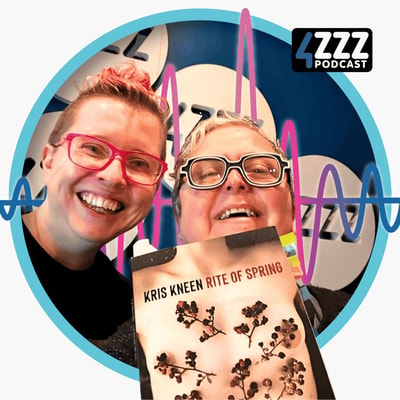
This week Rae (they/them) chats with local non-binary legend and award-winning author Kris Kneen (they/them) about their new book 'Rite of Spring' which ‘fuses place, psychological drama, the primordial nature of the ocean and the personal search for a centre.’ Kris and Rae chat about the book’s trans, gender-messy and speculative themes, and about the upcoming launch at Avid Reader - Friday 10 July at 6pm
Transcript
At 4zzz, we acknowledge the traditional owners of the land on which we broadcast. We pay our respects to the elders, past, present and emerging of the Turbul and Jagera people. We acknowledge that their sovereignty over this land was never ceded.
Speaker B:And we stand in solidarity with.
Speaker A:Transmission on 4zzz, amplifying the trans and gender diverse community of Meanjin, Brisbane and beyond.
Speaker B:That's right.
Speaker C:You are listening to transmission on 4Z Z 102.1 FM. My name is Ray. I use they, them pronouns. I am very excited for today's show. I've got an amazing author in the studio chatting to me about their new book. Chris Neen is with me. Do you want to introduce yourself and your pronouns and.
Speaker A:Yep.
Speaker C:What's. What's happening?
Speaker A:I am Chris Neen and I use they them programme pronouns as well. And I've just released this book, Rite of Spring, which has just come out. It's going to be launched in Brisbane on Friday at Avid Reader Bookshop.
Speaker C:Yes. Which we're really excited about. So, yeah, that's Friday Avid Reader Bookshop. And I think that's six for a 6:30 start.
Speaker A:That's correct.
Speaker C:Amazing. And you've done a couple of launches already, you said so.
Speaker A:Done three launches.
Speaker C:Yeah.
Speaker A:I did Hobart, I did Sydney and I did Melbourne.
Speaker C:Heck. And how did they go?
Speaker A:I looked fantastic. All really, really different. And it's a book that's set in Tasmania, it's set sort of in the south of Tasmania. So it was really fantastic to start in Hobart because there were people who had suggested the idea for me in the first place and people who knew the places I was talking about and it was just a really fantastic kind of community vibe in Hobart and there's so many cool authors down in Hobart at the moment. Oh, which is so many great, you know, and trans and non binary authors down there. So Hobart is a bit of a happening place.
Speaker C:I was like, is Hobart. One of the few things I know about Hobart is like, well, I mean, at the moment, Neil the Seal. But like this.
Speaker A:Yeah.
Speaker C:Beyond that, there's. That's amazing. That's really beautiful.
Speaker A:Well, Erin Riley, who is a trans author, has moved down to Hobart and so it was fantastic to catch up with them, them there. And Keely Jobe is down there as well, who I think still. I'm not quite sure what their pronouns are, but is an amazing author. So it was just really fantastic to be amongst a queer. A really queer vibe down in Hobart.
Speaker C:I feel like it's the new Melbourne. Everyone's moving To Hobart.
Speaker A:It is a little bit like that. And then Sydney was great because Benjamin Law was my interlocular. I don't know how to say that word, but sounds right to me.
Speaker C:Yeah.
Speaker A:Talking to me. Benjamin Law is, you know, like a queer icon, really, and just so, so lovely and fantastic. And so Sydney was all about the sex that's in the book because Ben likes to talk about sex. So it was really fun and very sexy talk in Sydney and in Melbourne, it was at readings and it was with Paul Barclay, who's an ex ABC journer, who did Big Ideas for many, many years, and Paul's of mine. And so it was a lot more intellectual and serious, but really, still really fun to do. It was great.
Speaker C:I love that. And I feel like if someone was like to, I don't know, attend all of them as a groupie, they'd get something different each time, which I think is really beautiful.
Speaker A:It sounded like a different book at each of the launches. It was really fun.
Speaker C:I quite like that. I was like. For listeners who don't know about the book. Yeah. Do you want to give us a lowdown? What's. What it's all about?
Speaker A:Well, it's a book about. The plot is that there's a woman, Miranda, who goes with her husband to a remote island off the coast of Tasmania to care to take the lighthouse island for six months. Nobody else will be seeing them for six months, taking all their food. The weather's incredibly rough and it's very isolated. And so they're there to kind of repair their relationship. But also, Miranda's had a diving accident. She's a marine biologist, and she's no longer allowed to go under the water, which is her happy place. So she's trying to heal from that and also heal a bit of a rift in their relationship that's been had. And so, of course, what would you do if you're having a bad time with your partner? You'd go to a remote island where nobody else can intervene. Nothing could possibly go wrong in that situation.
Speaker C:Yeah, my brain is just like thinking up all these scenarios. I'm like, oh, that sounds like a mistake, y'.
Speaker A:All. Yeah, I think maybe there was a problem with that idea in the first place. But they go. And there's not supposed to be anyone else on. On the island. And then Miranda starts to see somebody on the island and is it a somebody or is it a something? And, you know, there's, you know, it just kind of spirals out to there from there, but it's it really. This is really my trans novel, which is. Which, you know, I was wanting to write a book which was a metaphor for transitioning, and this was the book that I chose to write for that. So it's all about being strange to yourself. I mean, Miranda's menopausal as well, and so comes to the island with this, you know, with. With her body being incredibly out of whack and completely. She's had the accident, she's in menopause. Everything about her body is, you know, she's. She doesn't understand who she is anymore. And this kind of experience on the island kind of helps her to realise that she wasn't who she thought she was in the first place. So it is a book about transitioning and in my head, it's a book about becoming trans. And all the things that I've been going through in the last five years are in this book. And I think if you are trans, you will probably recognise some of the kind of key points that are. That are here in the book.
Speaker C:And I like that as a. Like, as you were saying, like, as a. As an overall metaphor, because it's. I do feel like people change constantly, but there is often a focus on trans people being the ones that are, you know, it's almost like we're. We're villains for changing.
Speaker A:Well, I just. Particularly as someone who's, you know, been through menopause, I really see the kind of parallel between becoming trans and going through menopause because it's a hormonal change, you know, it's like massive. You suddenly don't have the oestrogen that your body has kind of been relying on to kind of, you know, float along and be a particular way. So it changes everything about you. It changes your kind of reactions to the world, your personality, which really is the sort of thing that happens when you start taking hormones if you are trans as well. So it's such a parallel. And so I thought that the. The whole idea of that menopause being the kind of, you know, it's the line between who you were and who you will be after. You just don't know who you're going to be after this change. And that's the same. If you're trans, you're terrified of doing anything about it because you don't know if it's going to be the right thing. And there's no right thing. It's just following who you are and trying to be as true to who you are as you can be.
Speaker C:And I think that's exactly it. Like, there is no, there is no right thing. And I think, like, especially when there's so many narratives against us that are like, oh, you know, transition, you know, I knew when I was young, transition saved my life. And that's wonderful if those narratives resonate with you. But oftentimes those narratives don't resonate with people.
Speaker A:I think that's true. And I think, particularly as a non binary person, I think, you know, I've. I kind of read the trans narratives that are in the kind of mainstream and I think this doesn't fit me, which is why I probably didn't know that I was trans for so long because there was nothing like I was like, there's nothing wrong with me, I am who I am. It's just that I don't quite fit in the box that I've been put in. I felt like I was like a square peg in a round, in a round slot and I just wasn't fitting and I didn't quite know why. And it wasn't until other people around me kind of. Well, it wasn't until people started to say that my first book, a fiction, was a trans narrative and I didn't even know that. But there's going back to it. There's a lot of places where people are saying to me, your relationship to sex is just like a man. You act like a man, you don't act like a woman. My. And all the sex scenes are kind of, you know, there's kind of a mix up of gender kind of roles in the sex scenes in that book. And a lot of young trans people have said, I realised I was trans when I read your book and realised and I'm like, someone should have told me.
Speaker C:You're like, keep it. I didn't realise, mate.
Speaker A:That's saved me, you know, 20 years. Give me, you know, 10 years. Give me a bit of a heads up.
Speaker C:It's like one of those things. Like, people like, they're like, oh, you can't crack an egg too early. And I'm like, look, honestly, sometime I feel like even just like a little tiny hint of, oh, have you thought about it? You know what, you know, you don't have to think about it now, but like, plant that seed.
Speaker A:Yeah, the seed would have been handy at that time in my life, I can tell you, because, you know, there wasn't. I still think there's absolutely nothing. I am. I was born right. It's not like I want to change who I am. I was born in the Right body. I was born the right person. I have been taking testosterone for five years. I've just stopped because very interesting things happen to people who are fat and take testosterone. You suddenly get. It turns into oestrogen in your system. So I was getting an oestrogen boost, which wasn't right for me.
Speaker C:That's not the goal.
Speaker A:Yeah, that was not my goal. It was all good for five years and then it kind of went off the rails. But, you know, I started taking testosterone because my menopausal body was, you know, going through ridiculous hormone kind of shifts and changes. And I thought, oh, well, let's see if this is right for me. And it was right for a little while. Obviously, you know, your body does weird things to those hormones. So, you know, I'm stepping away from it at the moment. But, yeah, look, it's, you know, there's nothing. I've never felt that there's been anything wrong with me. I've always felt that there's something wrong with the world and the world that I've been put into. And so now as soon as I went, oh, I'm non binary, it was like, oh, of course, that's what the problem's been the whole time.
Speaker C:And I feel like there's that incredible sense of just relief of. Of knowing. And I think, like, I'd like to talk. I would like to talk more about the book, but also when you said about there being, you know, something not wrong with us but with society, I'm like, we got to talk about that too.
Speaker A:I think we should talk about the fact that there's a lot of sex in this book.
Speaker C:Amazing. I was like, in that case, content warning. If you want to. If you've got little ears in the car or you're not a fan of sex, tune out for the next maybe 10 minutes and don't read the book and don't.
Speaker A:If you hate sex, don't read this book. It's got a bit of it in
Speaker C:it, but if you. If you are an enthusiast, this book is for you. Tell me more about the sex.
Speaker A:Well, you know, I think that was really important. Like, sex was a big part of transition for my character, Miranda. And so Miranda finds herself through the sex that kind of happens in the book. And the sex is a bit weird. The sex is a bit kind of off centre. It's not very. It maybe starts straight when it starts happening and then it kind of goes off the rails into very, very queer. And, you know, and I kind of didn't want to hold myself Back with this one. I mean, I'm known for writing sex that's kind of challenging and going, you know, just going for it in terms of my focus. And that's, you know, that's where I went in this book. I wanted to kind of. I wanted to enjoy the sex. I want it to be transformative. I wanted it to be a wrestle with sexuality, to find yourself and to transform yourself. And so that's really where I ended up going with it. And that's, you know, that's got me in trouble in the past. So I'm really hoping that. That the people who. Who need this book find it. And also, we don't see menopausal people and sex very often, you know, in the same sentence. And I really wanted to kind of explore the fact that, you know, menopausal people can be sexual. It, you know, there's a. There's a kind of myth that you kind of lose your sexuality at menopause. And that's not true, that it changes and things change because your hormonal profile changes. And that's, you know, that's also the trans experience where you kind of. Your hormonal profile changes. So your sex life changes in. In other ways. So that's kind of what I wanted to talk about in the book and talk about it quite loud and proudly,
Speaker C:which, as you said, I think that is really important because there aren't a lot of. Maybe I just don't read widely enough, but I don't think there's enough out there about that. And, you know, people of all ages and of all genders can have any kind of sex that they want, so long as it's consensual, like, go off. I think you were saying that there was some reviews that weren't super enthusiastic about the sex. There's been a few fascinating reviews that
Speaker A:have kind of mentioned that the sex wasn't necessarily for them. And look, that's like, that's fine if you are a bit prudish, you know, maybe that this is not the book for you, because there is a bit of sex in it. I mean, I've, you know, I was. I started my Ph.D. many, many years ago looking at sex in literature. And this was before 50 Shades of Grey became a phenomenon.
Speaker C:Oh, my goodness.
Speaker A:So it was like two years before Fifty Shades of Grey. I started to look at sex in literature and sexual expression and the kind of line between literature and pornography, which I feel is just arbitrary. And it's really about personal taste. So I wrote a book, Triptych which was a part of that PhD. And I wrote the creative stuff first and then I was going to kind of look at the non fiction part component afterwards. And the university got word of the fact that I'd written something incredibly rude. And I got called up to my supervisor who said, oh, look, I'm getting pressure from above. I've had to kind of pass on the creative to them. So the novel basically got up the ladder and more and more people started reading this book, which was looking at, you know, what is the line? And for me, it was about consent. I wanted it to be consensual at all times. And that's how I write. I write about consensual sex. I don't write about damage, I write about pleasure. And even my supervisor at the time said, if you were writing about rape, there would be no problem because there would be a very clear ethical. This is bad. I can write this rape scene and it's bad. But because I was writing sex that was kind of, you know, challenging, but also was not rape, was actually consensual and was actually pleasurable. It got me kicked out of my PhD programme. They basically worked really hard to remove me. They said that they were going to fail me unless I rewrote my initial document within, like, two days and found a new supervisor. And, like, that was impossible to do. So I just withdrew because I thought, I don't want to fail a PhD just because I've written sexy sex scenes. So it became, you know, it just was. At the time, it was. I was very, very broken by the experience. But the book came out, it got really good reviews.
Speaker C:It's great.
Speaker A:It got banned on a couple of online platforms, so you can't get it on Apple Ibooks or Google Play. It's been banned on those because the sex is a bit too much for them. But, you know, I feel like. I feel like. Well, that was a badge of honour to start with. I was kind of happy when I heard that it got banned because I was like, oh, good. I would have written about that in my PhD. If I had been still, you know, doing it. I would have kind of gone, well, this is the line for these platform online platforms. But it's obviously not the line for the reviewers who kind of actually wrote really good reviews for it. So, yeah, it's really interesting.
Speaker C:And I think that's interesting with all the books. Bannings that are going on.
Speaker A:Yeah.
Speaker C:Like, especially in the us, is that there is often the. The line is simply books by marginalised people. Yeah, and it's not necessarily like it's the excuse. I mean, I'm not, not necessarily saying this was the case with yours. Not, not defaming anyone. However, like, there's often the idea of, you know, the, you know, there's. There's something wrong with the text itself, but often it's to do with the person who's writing. The person who's writing it. Yeah. And what they're writing about.
Speaker A:And I think, you know, family values are such a big thing in our community and the whole idea of heterosexual sex within a heterosexual married context is okay. And that's what we kind of start with as like, this is the centre of our kind of society and anything that's outside of that becomes somehow questionable or confronting. And you know, I don't feel like I have ever had sex inside that context. I feel like even if I've. Even if at the time I was identifying as a woman and I had sex with someone who identifies as a man, it didn't feel like it felt. All the sex I've had has felt very queer. And I don't understand the kind of sex that people want us to start from as a baseline. So I've always challenged that in my work. And this is no different. This is really about using like, it's actually going from that kind of married, heterosexual sex that we see towards the middle of the book, which then kind of goes into this other realm which is more towards, you know, this book flirts with the supernatural. So it starts as a very realist kind of literary novel. And then it goes. It starts to go off the rails into a very surrealist area where it's no longer like you can't trust reality to be what it seems and things are not what they seem and things, you know, there's a kind of gothic edge to things and it's, you know, a little bit creepy. So that's really where the book takes
Speaker C:you, which I think is something that like trans transness does really well. Is that kind of supernatural, that speculative fiction, that kind of fabulism where there's once again, like there's. It's hard to draw lines between sexuality and gender and expression, but also between what is and isn't reality.
Speaker A:Yeah.
Speaker C:And I'm really glad that your. Your book plays with that.
Speaker A:Transness challenges realism. Yes. In the way that people go, you know, there's only two genders and you know, they kind of believe in this kind of. This myth of, of the heterosexual marriage, the two gender thing. But as soon as you have something that's trans. You're pushing against those kind of fundamental myths that people have told themselves. The kind of fairy storeys of their youth start to become the fairy storeys that are more grims, you know, that are more kind of edgy that, that they are frightened of because it challenges their sense of self and who they are and what the world is like. And so I think that's why trans people, most of the trans people that I know are attracted to, you know, like the work of Cronenberg, who kind of talks about body transitions to, you know, the difference between body and machine or body and other. And that becomes, you know, a big theme in Cronenberg's work. And also, you know, David lynch, who looks at reality, sets everything up as this kind of American dream of, you know, like the suburbs and the happy families and then kind of cracks that open and goes, you know, this is not what's real. There is something at the edges that we're trying not to see. And the things at the edges that we're trying not to see are trans people at this point, to be honest, it honestly is.
Speaker C:And I think like, everyone, you know, could look at something in their life, you know, everything that they've fashioned so hard to be straight and CIS and, you know, pure and, you know, regular, and they would see those cracks and the more that you try and push them away, the more that, you know, they'll, they'll keep coming. Yeah, and it comes out in things like, you know, maybe a self realisation that you're trans or it comes out in a, you know, a relative, you know, coming out as queer or something. And it's, you know, we're always going to be here. We just, you know, we're not, we're not, we're not doing anything bad. We're just the world, the world is
Speaker A:just not as black and white as some people would like it to be. I mean, it feels safe if you go, this is how the world is. I have these rules. It's black and white. There's nothing else apart from this. But as soon as you realise that that's not true, it means that you have to be open to other people's realities, that you have to be open to the fact that you didn't really know exactly how the world was in the first place. And a lot of people are very challenged by that, apparently, including universities. So, you know, it's that people, people really want the world to be a particular way and they don't want to see it as complicated and messy. They want it to be a really simple black and white picture and they don't want to see it in colour.
Speaker C:I was gonna say. That's exactly. They don't want to see it in colour. And like, that's. Yeah, I was like, that's a beautiful description of it because I think, like, I. I dress very colourfully and I know that it's something that. Well, look, it definitely upsets some commuters, I gotta say. And I think, I really do hope that this book, you know, finds its readers. Like, I think. I really think it will and that it, you know, I guess gives people that. That hope to kind of colour in their own lives.
Speaker A:Yeah. And I think, you know, it's also a. It's not just a book for the trans community, although that's who I wrote it for. But it's a book for anybody who feels that the way that they saw themselves in their lives wasn't the way they expect, wasn't who they're, not who they think they are. And that's why menopause became such an important touch point for this book, because everyone who goes through. And that's men as well, like, I believe men go through that. Well, they go through massive hormonal changes as well. So I call it menopause, some people call it menopause. But, oh, my goodness, everybody of every gender goes through this kind of weird hormonal change at, you know, 50ish years old. And so everybody is going to experience this point where they become alien to themselves. And this is a book about that moment and what you do with that. Do you kind of push it away and try and pretend it's not real? Or do you embrace. Embrace it and become the person that you're turning into?
Speaker C:And I think that's. That's also. That's such a beautiful sentence. I think that's exactly it, because I think it's. And it intersects so much with, yeah, our, our fear of getting older and our fear of, well, dying and like, you know, who we are as, as people and like what.
Speaker A:Yeah, and that's why this book is called Rite of Spring. You know, spring is a. A time when things start to bloom. And honestly, I think that, you know, a time when you. When you're going through transition, whether it be menopause, whether it be, you know, becoming trans, it's a spring. It's a kind of. We don't know what flowers are going to pop up, but the flowers are coming whether you like it or not.
Speaker C:And that's exactly it. So often we don't know what's going to happen next and there's so much that's unexpected in life. There's so much we can't control. I think that's something really to, to embrace. Yeah, I think. Did you want to chat more about the launch that's happening on Friday?
Speaker A:Yeah. So avid Reader Bookshop, which is at West End, Boundary Street, West End, a place that is near and dear to many of us, is doing the hosting the launch for Writer's Spring. And Caridi Culver, who's the editor, who's a fantastic queer person, who's the editor at Griffith Review, is going to be in conversation with me about the book and the event starts its arrival at 6:00 for a 6:30 start. And yeah, we're just going to chat about the book a bit and celebrate it and launch it into the world. So please do come along. It's all. If you Google it, there are, it's free, but there's tickets available online.
Speaker C:Amazing.
Speaker A:Yeah. So come along.
Speaker C:I'm so, I'm sorry. So excited and I think, yeah. Is there going to be a Q and a portion?
Speaker A:There is going to be a Q and A, yeah. So if you have any questions from this conversation, bring them along.
Speaker C:Yes, yes. I was like, please do. Because we probably didn't answer everything today and to be honest, I could chat for hours. Is there anything else that you want to talk about that we haven't touched on? Because I feel like we. Off air, we were yapping away.
Speaker A:We were yapping away about a lot of stuff. So many things we talked about, you know, we talked about genre and I think that's another thing that people. We did talk a little bit about that on air as well, but the, the idea. I think people have been a bit confused by my work in the past because it never sticks in its lane, similar to me as a person. It does not. Like this book is a literary fiction book. Absolutely. But it does veer into this kind of. I call it the Queer Weird. So it's like slightly gothic, slightly. I think it's surrealism. Like, I think, you know, we've gone into this thing of, you know, where anyone who's writing that's not kind of writing realism, I think we've forgotten that surrealism kind of took us there a long time ago. And I love the fact that dreams, that the line between dreams and reality is not so clear cut and that there's a porous membrane and dreams can come out into the real world. And really it makes reality a metaphor for whatever it is that our subconscious is dealing with. So that's really what this book is. It's about this kind of line between the science and the subconscious, reality and surreality and, you know, what we thought we were and what we are becoming. So really, I think that's all we need to know about the book Rite of Spring. It's published by Transit Lounge.
Speaker B:Yeah.
Speaker A:And yeah, it's, it's. I'm really proud of it.
Speaker C:I'm really proud. I'm so excited. I was just thinking like, the dreams are like a, you know, part of the, like, because people push away dreams as something that's not part of their life and it's just like pushing away a whole bunch of stuff that they don't think is reality. I love it. I love it. There's so many layers. I was like, someone's got to write their PhD on this.
Speaker A:Yeah, that would be great. Please.
Speaker C:Yeah, I was like, yeah, I was like, if you're inspired, happy to be
Speaker A:interviewed about it for your PhD.
Speaker C:I love that so much. Thank you so, so much for joining me. And please come to the launch. I'll be there. The amazing author Chris Neen will be there and we'll be. Yeah.
Speaker A:Hanging out and talking, celebrating queerness.
Speaker C:I'm so, so beautiful. That's, that's what we got to do all day, every day and. Oh, we just have a text. Jody. Oh my goodness. Please mention the author's name and title of the book again. Would you like to do that for us, Chris Neen?
Speaker A:Which is K R I S K N double E N and the title of the book is Rite of Spring.
Speaker C:Amazing. Thank you so, so much. And if there was any questions that we didn't cover in our chat, you can, yeah, have a, have a chat with Chris Neen at the, at the book launch. There'll be a Q and A. It'll be. Yeah, really, really fantastic. I'm looking forward to it. Alrighty, we are going to go to some news now that the Amazing Elliot recorded for us. You're listening to ray on transmission on
Speaker B:4zzz this week for community news on 6 July 2026 Anti trans bill voted down in Senate. Last week the coalition introduced a bill titled sex discrimination amendment Restoring common sense and recognising biological sex which aimed to strictly define biological sexual sex is either man or woman. On Wednesday, July 1, it was voted down with 30 no votes, 21 yes votes and 24 absent. The chair of the women's Legal Services Australia Alina Rosenman stated that the Sex Discrimination act provides critical protection for women, trans and gender diverse people and people who are intersex. This bill would weaken those protections and take Australia backwards by inviting gender policing. No woman should have to prove she is woman enough to be protected from discrimination. This sentiment was echoed by many as representatives of women's organisations and LGBTIQ groups, often pointing to the complexity and diversity of human biology which cannot be accurately reflected in black and white legislation two members voted off Mardi Gras board at extraordinary general meeting Sydney Gay and lesbian Mardi Gras held an EGM on Saturday following a long running internal dispute around trans rights and Priorities political advocacy between members of Pride in Protest and protect Mardi Gras. Among seven motions, four called for the removal of four separate board directors. Two of these were successful, resulting in the removal of Pride in Protests members Luna Chu and Damien Nguyen. This EGM came after Mardi Gras was accused of transphobia and prioritising political neutrality and institutional stability over direct advocacy when they declined to exclude parliamentarians who did not commit to anti discrimination reform, reform or make trans rights a central focus of this year's parade, while Pride in Protest was accused of bullying, harassment and incitement of violence after publicly stating that the Jewish LGBTQ group Todayenu was pro genocide. Despite the outcome of this EGM in removing Pride and protest members from the board, there are ongoing questions about the stability and solidarity of the queer community surrounding Mardi Gras, which has run for almost 50 years. Greens introduced legislation to establish the first LGBTQIA Human Rights Commissioner on June 30, the Greens introduced an amendment to the anti discrimination legislation which if it passes, would create an anti discrimination Commissioner specific to sexual orientation, gender identity and sex characteristics. These attributes have been protected in the Sex Discrimination act since 2013, but remain the only ones in our main anti discrimination laws that do not have a commissioner already attached to them. This Commissioner would work within the Australian Human Rights Commission to protect and promote the human rights of LGBTQIA Australians. This bill also aims to replace all instances of intersex status found in the Sex Discrimination act with innate variations of sex characteristics. Greene's Senator McKim states in the reading of the bill that the original language ignores the diverse range of people and sex characteristics that were supposed to be represented and who may not identify as intersex. My name is Elliot and that's all for this week in Community News.
Speaker C:My name is Rae, I use they them pronouns and you're listening to transmission on 4ZZZ 102.1 FM I'm excited to chat a little bit about a gig that we have coming up called Together in Transition, otherwise known as tit, which is a very fun word to say. And that's happening on Thursday 23rd July at 6pm at the Cave in. And you can grab tickets on Humanitix. But if you want to know a bit more about it, TIT Together in Transition is going to be a high energy fundraiser bringing together community noise and solidarity. And as I said, that's at the Cave Inn. We've got a stacked lineup featuring the Snouts and Softcunts and Emmy Hour. So that's three trans and gender diverse bands delivering raw, unapologetic sound and also raising money for the community which is extremely important especially during these turbulent times that we find ourselves in. So the event will be raising funds for Project 491, which supports trans kids accessing vital gender affirming care. And on the night MC will be the Amazing ez, of course from four Triple Z's Transmission is who is just the most amazing person and I'm so glad that he is emceeing that gig. He is the, I don't know, cornerstone, the founding person of our beautiful Transmission here and I'm very excited to hopefully attend that gig as well so that we can all all be there, the Transmission crew, and hopefully you as well, to get our TIT together and show up for a night that has a good cause and also for some accessibility information. The Cave in has non gendered toilets as well as a fully accessible toilet which is located on the bottom floor which is fantastic and it will be an AT plus event. So that is the 23rd of July at 6pm together in transition. You're listening to Transmission on 4zzz.
Speaker A:Thanks for listening to Transmission. Catch us every Monday live on 4 Triple Z from 10am or listen to our podcast on the Community Radio plus app. It.
Hosted by Rae (they/them) w/ Special Guest Kris Kneen (they/them)
Recorded Live on 4zzz every Tuesday morning. Tranzmission brings you the latest in trans community news, events and discussion. Tranzmission's mission is to amplify the trans and gender non-conforming voices of Meanjin/Brisbane and is brought to you by a diverse team of transqueers.
This week Rae (they/them) chats with local non-binary legend and award-winning author Kris Kneen (they/them) about their new book Rite of Spring which ‘fuses place, psychological drama, the primordial nature of the ocean and the personal search for a centre.’ Kris and Rae chat about the book’s trans, gender-messy and speculative themes, and about the upcoming launch at Avid Reader on Friday 10 July at 6pm.
🎟️ Tranzmission Event 🎟️
- Join us at T.I.T. – Together in Tranzition a Project 491 fundraiser. Get tickets here >>> https://events.humanitix.com/t-i-t-together-in-transition <<<
🔗 If you'd like to listen back to the unedited episode - with the music - head to our On Demand website. And don't forget to follow our socials at Facebook and Instagram.
Timestamps and Links:
- 00:00 - Acknowledgement of Country
- 00:20 - Welcome to Tranzmission
- 00:57 - Interview w/ Kris Kneen (@kkneen) - Rite of Spring
- 03:56 - Rite of Spring
- 06:15 - Narrative of Change
- 10:55 - 'Content' of Rite of Spring
- 16:22 - The Baseline: Censorship and Transness
- 18:00 - Flirting w/ Reality and Realism - Cronenberg and Lynch
- 21:36 - Seeing In Colour and The Changing Self
- 23:55 - Rite of Spring Book Launch @Avid Reader, Friday 10 July, 6pm
- 25:14 - Rite of Spring: Surrealism and The Queer Weird
- 28:19 - Community News and Events - Links in notes
- 31:16 - T.I.T. Together In Transition @The Cave Inn, Thursday 23 July, 6 - 10pm
Community News and Events Links
News
- Q News: Coalition’s anti-trans Bill called out for undermining the safety of all women - by Dean Arcuri
- Q News: Pride in Protest members voted off Mardi Gras Board at EGM by Jordan Hirst
- Star Observer: EXCLUSIVE: Greens To Introduce Bill for Australia’s First LGBTIQA+ Human Rights Commissioner by Chloe Sargeant
Events:
- Rite of Spring Book Launch @Avid Reader, Friday 10 July, 6pm
- T.I.T. Together In Transition @The Cave Inn, Thursday 23 July, 6 - 10pm
Support Services
- QLife - 1800 184 527
- QC LGBT Mental Health Services
- Open Doors Youth Services Inc.
- LifeLine - 13 11 14
- Beyond Blue - 1300 22 4636
- How to Support Transgender & Gender-questioning Youth
- Transgender Map
Get Involved
4ZZZ's community lives and creates on Turrbal, Yuggera, and Jagera land. Sovereignty was never ceded.
Produced and recorded by Rae at 4zzz in Fortitude Valley, Meanjin/Brisbane Australia on Turrabul and Jaggera Country and audio and cover image edited by Tobi for podcast distribution for Creative Broadcasters Limited.