Fascism, Capitalism, and Culture Wars
Transcript
At 4ZZZ, we acknowledge the traditional owners of the land on which we broadcast. We pay our respects to the elders past, present, and emerging of the Turrbal and Jagera people. We acknowledge that their sovereignty over this land was never ceded,
and we stand in solidarity with them.
This is Transmission on 4ZZZ, amplifying the trans and gender diverse community of Meanjin, Brisbane and beyond.
EzHello, hello, Meanjin, Brisbane. I have missed you so much. My name is Ez, I use he/him pronouns. We are going to be talking about some pretty hectic stuff, but before we get into all that, there's obviously the week in community news, which will be brought to you by Ray. Thank you so much, Ray, for preparing this, but also I'm back, and a few people I know have been asking, where has Es been? I'm gonna tell you. I'm gonna tell you. And I want to thank Sophie, Ray, Hazel, Elliot, and anyone else who's been filling in on the show while I've been away. It has been kind of a weird time having a break. I've been very intentional about not listening, not being involved, trying to step back entirely because Transmission has been on air for about 5 years. And in that 5 years, I've had zero times off. Uh, and so, uh, basically what happened is why I took some time, uh, was because about a year ago, a bit over a year ago, uh, my mum passed away suddenly, um, which was pretty awful. Um, and that kind of threw me into a bit of a spin. Um, but then exactly a year later, so only about 4 months ago, my father passed away. So I've had both my parents, uh, pass away in the last 18 months. And so, uh, when dad passed, I went, I just need to step away from everything because I needed to sort of collect myself. And I gave the show over to the team and they did an amazing job. So I'm really grateful that they were filling the space and that transmission was still running. And I'm feeling a lot better. However, I have learned that apparently grief can actually impact your immune system. So I have been just having constant back-to-back immuno things. And if I sound a little nasally today, it's because I have recurring sinusitis. Oh no. Isn't that fun? It sounds a hell of a lot worse than it is, and I'm not contagious, so I feel comfortable to be in studio. And fortunately, where all you're listening from, you are very, very much safe from me, if that was not the case anyway. So yeah, if I sound a bit nasally, that's why. But yeah, I'm still getting through it, and it's just so wonderful to be back. And in typical Ez fashion, although I wasn't in the studio and I wasn't producing shows, I was ruminating in the background and reading lots of books and writing poetry and doing other creative things that I haven't really had a lot of time for. And I was super inspired by a few things that are some media that I was listening to that have inspired the episode that is today. So you're just getting me all solo as on the mic, and we're going to be talking about fascism, capitalism, and culture wars. Now, the reason we're talking about these things is because I do notice that there seems to be a lot of people very confused about why trans people are being so targeted and why is it so relentless in the media and it's global and it's, and it's nasty, uh, and I want to piece the whole picture for you, uh, and so that's what we're going to be doing this episode, um, and we'll dive more into that later. But I also want to thank everyone who came to TIT. Um, if you remember TIT, if you were a TIT attendee, uh, TIT was Together in Transition, which was all about raising money, uh, for Project 491, getting some more money in their hands to help trans young people access life-saving gender-affirming medical care. And Thank you to everyone who attended that night back in July. We raised over $2,000, which is epic. So I'm very, very, very happy. And thanks again to everyone who showed up for that. Also, just how wonderful is the 4ZZZ Radio community and just community radio in general? I, I haven't been here for a few months, and it's probably one of the longest stints that I've been away from the station, and I miss it all the time. But this place is like a second home to me. And so I knew that after some time away from the broadcast that I have to come back because it's just outrageous for me to not be here. And it's been over a third of my life that I've spent in this space. So I keep on coming back. And while I was away, there was the Community Radio Australia actually produced a report on the social value of community radio. And the CBAA, which is the Community Broadcasting Association of Australia, And if you're a bit of a community radio nut like I am, you may have heard some of these stats already. But essentially, 62% of Australian music is not heard elsewhere. And so people are tuning in to community radio more so now than they have in previous years. There seems to be an uptick in people's interest in this, in community radio, which is amazing. If you want to fight fascism, listening to community radio is a sensational way to do that. And a current breakdown of like, currently there are some age breakdowns for Australian community radio listeners. And I thought this was quite interesting. So ages 55 and up is 28%. Ages 40 to 54 is 23%. And the largest sector of people listening is aged 25 to 39 with 30%, which is making up 1.54 million people. So that's amazing. Thank you so much for listening. uh, Zillennials and, uh, Gen Zers. But also Alpha, you're in there, you're coming in, I know you're coming in. Uh, 15 to 24, uh, is 19% of listenership as well. That's a lot more people than I thought. And I'm so thrilled that young people are tuning into community radio because this is, this is unfiltered radio, man. Like, this is, this is real people talking about your community, the city that you literally live in. None of this American stuff, none of this UK stuff, none of this big pop culture stuff. This is literally the, the micro, I don't know, ecosystem that you live in of culture. And so I'm just so thrilled that you're, you're tuning in. Mostly, most, most of you want to listen because you want to find new music or hear music that isn't pop music. And that's also wicked because, you know, I spend hours researching my music every week because I just love finding trans and gender diverse artists. with extraordinary talent who produce amazing stuff. So you're definitely going to hear a lot more of that. And also, Melt Festival is coming up. Holy moly, Melt, you have outdone yourself. I was going through the catalog of all the events that are on. And so I've made a bit of a shortlist and I'm just going to rattle off some names of events. So if you're a Brisbane local, a Meanjin local, or if you're visiting during the time of Melt, then these are some exceptional, I think, events worth checking out. And Melt is running from the 21st of October to the 8th of November. And so an event that I recommend you check out is Swamp Dogs. Remember that one? Swamp Dogs at Warehouse 25 on the 23rd of October. There's also Wet on Deck, which is a party hosted by what looks like Holly and Dara from Quiver on October 24th. Those two are just absolutely fantastic. So if you want to get onto that party, you should. There's also a Queer PowerPoint at the Powerhouse, which is a bit of a comedy on the 28th of October. That'll be worth seeing as well. I'm also from the generation of loving The L Word. So if you were— if you're an L Word fan, if you're a big L Word fan, there's actually L Word trivia from October 22nd, also at Quiver. So you can check that one out. No Tears for Queers. This is sort of like a comedy mix with a bunch of incredible local talent on October 29th. Looks fantastic. Fantastic. No tears for queers. There's also Guava Fest, which is on November 7th, which is more of like a— it's like a queer underground party, DJs. It looks really just thirsty and fantastic. I love it. So there's Guava, and on the same night, on the 7th, there's also Tropical Fruits Melted. So you have 2 epic parties. We've got one at Quiver and then one with Guava at Melting Pot at the Powerhouse. So you'll have to toss up between those 2. But then on November 8th, The day after, if you've still got energy, Saddle Club. Saddle Club is in town also at Brisbane Powerhouse on November 8th. So, oh my gosh, I don't know if you want to be like partying for that long, but you totally should. And then there's also yours truly, Transmission. We are live, literally, for a live Radio Spirit onstage performance at Studio 188 in Ipswich on November 5th. There will be tickets. We will talk a little bit more about that throughout the episode today. But yeah, there's a whole bunch happening with Melt. Get in amongst it. And yeah, I'm just so thrilled to be here. I'm so glad to be back. If you haven't subscribed to Community Radio, you should. And this month, you know, Thrillhouse are actually, you know, they're our monthly subscriber. And you could, you know, go into the draw for a $250 tattoo voucher. And I think you should. I think you should do it. I think you should subscribe. And you can do that by heading to 4zzz.org.au/support. and keep community radio alive, get a tattoo voucher, and yeah, fight fascism by literally listening to 4ZZZ. And we're about to dive into the week in community news, brought to you by Rae.
RaeThis week in community news and events for October the 19th, brought to you by Gender Health Australia. In international news, Hungary repeats Viktor Orbán's anti-LGBT laws. Hungary's parliament has voted to scrap Prime Minister Viktor Orbán's controversial anti-LGBT laws, reversing measures that had banned gender-affirming care for trans people and restricted legal gender recognition. The repeal follows years of international pressure, EU legal action, and strong criticism from human rights groups who argued the laws violated fundamental rights and targeted trans and queer communities for political gain. While advocates have welcomed the decision as a significant step forward, they caution that Hungary's broader record on LGBTQIA+ rights remains deeply concerning and that meaningful change will require sustained commitment to equality, safety, and legal protections. For now, the repeal marks a rare retreat from Orbán's anti-LGBT agenda and a moment of relief for Hungary's trans community. In national news, Catherine Deves to run for One Nation in 2027 New South Wales election. Anti-trans activist and failed former Liberal candidate Catherine Deves will run for One Nation in the 2027 New South Wales election, with the party expected to preselect her for an Upper House seat. Deves previously withdrew from her 2022 Liberal campaign for Warringah after widespread backlash over her transphobic comments, including describing trans children as, quote, surgically mutilated and comparing her activism to resisting the Holocaust— remarks condemned by fellow Liberals and community leaders. She has continued to target LGBTQ+ communities misgendering athletes and labelling Wear It Purple Day as, quote, a grooming tactic. Commentators say her move to One Nation aligns with the party's long record of vilifying queer and trans people as it seeks to capitalise on outrage-driven politics ahead of 2027. South Australian Parliament rejects bill to criminalise trans youth healthcare. Last month, South Australia's Parliament defeated a One Nation bill introduced by Cory Bernardi that sought to criminalize gender-affirming healthcare for trans and gender-diverse young people. The proposed amendment would have imposed up to 5 years imprisonment on health practitioners for prescribing puberty blockers, gender-affirming hormones, or related medication to anyone under 18 for the treatment of gender dysphoria. The bill was decisively rejected following strong opposition from South Australia Labor and the Greens. Meaning gender-affirming care for young people in South Australia remains legal, clinically supervised, and unchanged. Advocacy groups say the outcome protects safe, evidence-based care and prevents the criminalisation of families, clinicians, and trans youth. In local news, community notice: QCAT representative complaint on gender-affirming care for minors. A representative complaint is now before the Queensland Civil and Administrative Administrative Tribunal, QCAT, concerning the suspension of gender-affirming care for minors in Queensland. The case covers all young people under 18 diagnosed with gender dysphoria who had not started puberty blockers or hormone therapy before the 28th of January 2025. If you fall within this group, you are automatically part of the class. The complaint argues that Queensland Health's directive to stop providing puberty blockers and hormone therapy to new patients was unlawful discrimination and breached the Human Rights Act. The applicant is seeking orders to reinstate access to treatment, require both private and public apologies, and secure compensation of $50,000 per affected young person. If you are in the class, you do not need to take any action. You will be bound by QCAT's final decision and benefit from any orders made. If you do not want to be part of the class, You must opt out by emailing [email protected] before 4 PM on the 22nd of October, 2026. Updates on the case will be posted on the LGBTI Legal Service website and social media channels. Gold Coast Pride launches first free Pride formal for LGBTQIA+ youth. Gold Coast Pride has announced its first ever free Pride formal for LGBTQIA+ young people, creating an inclusive alternative to school formals where queer and trans teens often face discrimination or feel unsafe. The event, open to youth aged up to 21, will offer a welcoming space with music, dancing, and community support, giving young people the chance to celebrate authentically with friends and chosen family. Organisers say the formal is designed to remove financial barriers, and ensure every LGBTQIA+ teen can enjoy a milestone event without fear of judgment or exclusion. The Pride Formal is part of Gold Coast Pride's broader commitment to building safe, joyful spaces for queer youth across the region. The inaugural Gold Coast Pride Formal will be held at QT Gold Coast on Saturday, November 21st, from 6 PM till 10 PM. Free registrations and community donations are available through Eventbrite. In events, Cocky Horror, a drag king cabaret floor show, is happening on Friday the 23rd of October from 6 PM. Pioneers of the drag king renaissance, the kings of chaos, and some very legendary guests are gathering at the Frankenstein Place for one of the master's affairs. Cocky Horror is a high-voltage floor show cabaret, a reclamation of the cult classic spirit, and a tribute to generations of queer audiences finding family in chaotic and camp revelries. This sapphic-heavy, queer, trans, and disability-led cabaret parody reimagines a cult classic through drag, sideshow, burlesque, live vocal performances, and multimedia film projection. Give yourself over to absolute pleasure. Happening on Friday the 23rd of October at 186 Given Terrace, Paddington. Transmission Live: The Antidote at Studio 188 at the Ipswich Civic Centre, Thursday the 5th of November from 7:30 PM. Transmission's Ez and Hazel team up with Studio 188 presenting The Antidote to Fascism is Community. 4ZZZ's Transmission brings its community radio spirit to the stage for a live seated event celebrating trans joy across Brisbane, Meanjin, and Ipswich, Tullamar. Featuring live music from Two Mouth and Stoolful from Lunch, a community panel with artists and creators, as well as conversations about solidarity and togetherness. The Antidote is a night of joy, resistance, storytelling, and connection. Together we gather to celebrate the power of community. Part of MELT Festival 2026. Happening at Studio 188, Thursday the 5th of November. Transmission Live: The Antidote. That's all in this week's news and community events. My name is Rae, I use they/them pronouns, And you're listening to Transmission on 4ZZZ.
EzOh my goodness, how good. Oh, you're listening to Transmission on 4ZZZ. My name is Ez, I use he/him pronouns. Thank you so much to David from Durack for subscribing to 4ZZZ during the month of October. David, I bet you've got a pretty good chance of winning a $250 gift voucher for Thrillhouse Tattoo, uh, so good job on that one. If anyone else wants a chance, you've got till the end of October to do so. You can subscribe at 4ZZZ .org.au/support. Keep community radio alive and fight fascism. That's what we're about here. Oh, Transmission, amplifying the voices of trans and genderverse community here in Meanjin and beyond. And today we're talking about capitalism, fascism, culture wars. Now, why am I doing that on the trans show? Because we are part of the culture war. Trans people are probably the most disproportionately attacked 1%, the incorrect 1%, to be focusing on. So I wanted to do something that would sort of break everything down. And yeah, I guess today's episode is all about making sense of the world we're living in, because a lot of people, and not just trans people, are confused, overwhelmed, or just trying to understand how everything fits together. So we're going to break everything down as much as I can in plain English, in plain language. And the reason we're doing this is simple. Right now, it feels like the world is falling apart. Climate change is accelerating. Economic instability everywhere. Vive la France! AI agents are gathering to have private chat rooms. Right-wing extremism is rising across the globe. And somehow trans people who make up such a small percentage, like I said, have become a main focus of media outrage and political debate. So I want to ask, how the hell did we get here? Why are these the issues dominating public conversation? And what do these patterns tell us about the systems that we are living in? So to start, I want to talk about what inspired this episode. And there's a YouTuber, podcaster, and political commentator that I follow in the US. His name is David Pakman, and I read a book of his called The Echo Machine: How Right-Wing Extremism Created a Post-Truth America. Just some light reading in between my time off of the show. And in one section, he talks about how due to educational cuts in the US, Many people now don't understand the difference between facts versus opinions, and that is alarming. David sort of points out that governments, especially in the United States, have reduced access to education in areas like philosophy, critical race theory, and just accurate historical teachings. And when people don't have access to those tools, it becomes harder to tell the difference between fact and an opinion, particularly when you don't know the literal definitions of what those 2 things are. And when that happens, it becomes much easier for misinformation, culture wars, and political manipulation to take hold. So the propaganda, right? Additionally, people naturally want simple answers to complex problems, but unfortunately that is not how life works, especially not when it comes to politics, economics, or just social movements. So I'm going to do my best today to break down these ideas so you can feel a little bit more empowered to act and more comfortable to just also celebrate the parts of life that bring joy and connection. Another piece of media that has also inspired today's episode is a podcast called The Triploi Podcast, particularly an episode called What Is Fascism? This podcast was so epic for me. It, it kind of like, it's just a great resource because it just breaks down complex political ideas in accessible terms. And I encourage you to check it out if you want a deeper context. Much of what you'll hear today has been inspired by that particular podcast episode. The Triploi Podcast, I'll spell it for you. T- R-I-P-L-O-I. Yeah, have a listen. They're free on a bunch of services. They're also on paid streaming platforms as well. Like if you're wherever you listen to your podcasts, this is designed to be an accessible podcast. And I'm a very big fan. And maybe, maybe the presenter will hear this and I'll fan out a little bit, but fantastic podcast. You should have a listen. So yeah, here's what we're going to be talking about today. First, What is capitalism? What is late-stage capitalism where we are right now? After that is what is fascism and why is it rising? Then we'll look at how culture wars feeds into both fascism and capital. And after that, we'll discuss two different types of activism. And then finally, at the end, I want to talk about socialism and community care as the antidote to a lot of these things.
Protest SpeakerWhen trans lives are under attack, what do we do?
EzStand up for facts! If you're a frequent Zedder, if you're a frequent Zed listener, you'll be like, Ez, I know some of these concepts. Well, great, good, good for you. But there are a lot of people who don't, and I've been having conversations with younger people who are still sort of trying to get their head around why are trans people being targeted and what's that got to do with everything. And so that's kind of what this episode's inspired for. So let's just talk about some basics. What the heck is capitalism? Well, capitalism is a system where people or companies own things. like businesses, factories, and maybe land. They get to decide how these things are used, and the main goal is money. That's pretty much it. That's the basic concept of capitalism. And I always find it weird when humans make systems based around things that don't actually exist. Money does not exist. So that's the whole premise of capitalism, is that we run the world on this economic system, and it shapes pretty much every part of our daily lives. It shapes how we work, where we live, our access to healthcare, education, and it also shapes who gets opportunities and who doesn't. Capitalism is often marketed to you as, or us, as like a system that creates innovation. And yeah, innovation can happen under capitalism, but the reality is that capitalism mainly creates inequality. It creates— it concentrates wealth and power into the hands of a very small group of people, while everyone else competes for what's left. And if you're in a car right now on your way to work, that's you competing for what's left. Now, under late-stage capitalism, we see more and more privatization. So, you know, public services being sold off or outsourced to private companies. We also see the merging of things like state and corporate power. So, you know, governments outsourcing services, deregulating industries, which ultimately gives more power to private companies. Or allowing corporate interests to heavily influence public policy. The US is probably like such a great example of that, its current situation. And under capitalism, there are only really 2 classes that it cares about. There's the ruling class and the working class. Anyone in the non-working classes, you know, children, the elderly, people living with disability, are a strain. on the ruling class because they're basically money pits, right? They're not generating profit unless you can, in which case you privatize hospitals, you privatize aged care, and then you can generate money off people who are essentially quote unquote doing nothing for capital. So now when privatization happens like this, that's when democratic oversight shrinks. That's when the people get less control or the governments or states get less control over things. And Power then concentrates itself in fewer hands, and ordinary people like you and me lose control over the systems that actually affect our lives. So that's capitalism. Now, we're in a particular kind of capitalism. We're in a type of capitalism called late-stage, and this is a term used to describe what's currently happening, a moment where wealth is extremely concentrated disproportionately Essential services are commodified and corporations hold enormous power. Tesla, Meta, Bezos, these people, right? You can see it literally everywhere. We've got housing crisis, we've got gig economy instability. People are working like 7 different jobs. I have friends who like work Uber and then like 2 part-time gigs and then a nighttime shift. And like, it's just wild. We also have healthcare inequality. Costs of living pressures that literally never seem to ease. Vive la France, by the way. Right now, 63% of global wealth is owned by 1% of people. And in case you're wondering where I got that statistic from, I got that from an Oxfam— Oxfam did a study in 2023. So this study is from 2023. I can't even imagine how much more percentage that is since then. But yeah. So workers are basically treated like mines. You and I, you know, if we're not in that 1%, if we're not the ruling class, we are like a mine. And the ruling class extract the labor from us as if we were a natural resource. And so late-stage capitalism is defined by the idea that there are actually no more resources left to extract. Environmentally, socially, or even like humanly. Everything has just been squeezed. And if you look at Generation Z or Zillennials, like young millennials, Gen Z, Alpha, you know, these generations are often described as having nothing to gain from participating in these traditional capitalist structures. Wages don't match cost of living. Housing is virtually inaccessible. Job security barely exists. AI, microtransactions, whatever. You know, the future feels blocked. And what has a generation got to gain from something that literally they can't get? Well, you riot, right? So some commentators are also describing this late-stage capitalism as the death throes of capitalism, because it's a system that literally can't sustain itself anymore. And so I actually had a typo when I was writing this and typed last-stage capitalism, and I think that's actually kind of accurate. So last-stage capitalism, people, that's where we are. And so what's capitalism got to do with fascism? Well, a hell of a lot. So let's talk about that. So fascism is a far-right authoritarian ideology that promotes nationalism, hierarchy, and the suppression of dissent. Another way of saying this is fascism is when a small group of people controls everything, tells people what to do, and punishes anyone who disagrees. It also teaches people to follow strict rules about who is better or more important in a country or globally, really. Fascism thrives in moments of economic instability. It uses fear, scapegoating, and culture wars to build power. It positions itself as the quote-unquote solution to crises literally created by capitalism, but in actual fact, it only strengthens oppression. And fascism isn't just historical, as you are aware. Looking around the world today, we see fascism through rhetoric, policies, and just global movement. Now, when we come to talk about fascism, we have to talk about Benito Mussolini. The OG fascist. And he is credited with coining the term fascism, because when he founded the Fascisti Italiani di Combattimento in 1919, which later became the National Fascist Party, um, the term itself is actually derived from the Italian word fascio, uh, which means bundle of sticks. I wonder if anyone else knows what a bundle of sticks are. And that symbolizes Strength through unity, according to Mussolini. But the origin of another word— language and content warning for this— the origin of fascio means bundle of sticks is also the origin of the slur faggot. Originally was a derogatory term for fascist. So you can piece together where that came from, but I know who the original bundle of sticks are now. So Mussolini is often considered the very first fascist leader because he founded the Fascist Party, right, and established a totalitarian regime that emphasized nationalism and authoritarianism. His regime served as a model for other fascist movements all throughout history. And so that also includes Adolf Hitler, right? So Adolf was like modeled his whole thing off of Mussolini. Another descriptor is fascism is capitalism in decay. So Capitalism doesn't exist without fascism and vice versa. So fascism is imperialism turned inward, is another description as well. I'm not going to go into imperialism right now, but fascism is not irrational. I want to be really clear about this. It's not irrational, it's not mindless hatred. It has a very, very clear purpose. Fascism has one job, and that is to save and protect capitalism at all costs. Costs. It relies entirely on class division to sustain itself. The main— to maintain power, fascism uses things like scapegoats to distract from class conflict. Hence why the term middle class was coined by capitalists, to create the illusion that there is some way to climb out of this ladder of wealth and privilege. I'm telling you right now, there is no such thing as a middle class. You are working class or ruling class. It is that simple. Trans people, immigrants, and other marginalised groups become targets not because they are the cause of any crisis, but because they are a convenient distraction from economic inequality and to make sure that the class divide continues. They need us to be left and right-wing so that we keep doing that and not doing what we should be doing, which is eat the rich, right? So fascism is reactionary. It responds to crisis rather than solving it. And it is a completely unsustainable model because it needs an endless threat to justify its existence. What's a great threat we can pivot to? Oh no, trans people, immigrants, black people. I don't know, anything that isn't class and anything that isn't the rich. That is literally what fascism does. And by the way, you're eventually going to get over hearing about trans people being a threat, because as you continue to live your everyday life, you will see that trans people are not actually threatening. And then fascism goes, uh-oh, they've figured out trans people are actually totally not a problem. Let's pivot. And every time fascism does that, it starts to die. So, without a constant enemy, fascism loses its power. It's like a cyclone hitting landfall. It is short-lived once the people realize the threat is actually not a threat. Fascism needs to think quickly to create a new enemy to regain its power. It's a completely unsustainable model, and ultimately it collapses into civil uprising and revolution. Vive la France, right? So I think of it like this: capitalism is like a chronic illness, and fascism is a flare-up. If you want to treat the symptoms of fascism, you actually have to treat the underlying condition—capitalism—and the thing that actually addresses those problems created by capitalism is socialism.
Protest SpeakerWhen trans lives are under attack, what do we do? Stand up, fight back!
EzWe talked about capitalism and fascism. Now let's talk about culture wars, because they're everywhere right now and they play a huge role in how fascism and capitalism maintain power. So culture wars are basically political fights over identity, values, or like social norms. Their arguments are always about who belongs, who doesn't, what's normal, what's acceptable, and who gets to decide. But here's the important part: culture wars are used to distract us from class war. They want you to focus on each other and fight each other instead of fighting the people who are just literally profiting from you warring each other, right? So when people are encouraged to fight over identity issues, they're less likely to challenge economic systems, particularly the ones that benefit the ruling class. Instead of asking why housing is unaffordable, why wages are stagnant, or why billionaires even exist at all, people get pulled into arguments about bathrooms. pronouns, drag queens, migrants, or, you know, whatever the outrage of the week is. And by the way, there is almost always a new outrage. Um, and, and this is where fascism comes in, right? Fascism— fascist movements use culture wars to divide communities. They frame marginalized communities as, as threats to tradition or order. They rely on fear, distraction, and emotional manipulation. Like, literally emotional manipulation. You are in an abusive relationship. Capitalism also benefits from culture wars. When people are fighting each other, they're not fighting economic inequality. Culture wars protect corporate and political interests by shifting attention away from structural problems like wealth concentration, privatisation, and exploitation. Culture wars keep us busy, they keep us angry, which is important, and they keep us divided. And division is exactly what fascism and capitalism need to survive. That's why you live in a house with fences. Every time I stare at fences, I'm like, why do we need fences? Like, indigenous people lived for thousands, tens of thousands of years without fences. Only white people, we got fences. What the hell's going on, y'all? So that's division. They want you to be an individualist. They want you to have one of everything so that way you focus on generating your own individual wealth instead of shaking hands with your neighbor and having a barbecue and sharing things. They love you do not talk to your neighbor. They love that you look at your phone and you are fed emotional manipulation propaganda all the time. And they love the algorithms because they really can get you into your own echo chamber. Like, they just— it just feeds off this thing. So when we're fighting each other, we're not fighting that economic inequality. Culture wars protect corporate and political interests by shifting attention away. And, you know, division is exactly what fascism and capitalism need to survive. But culture wars are a big part of that capitalist toolkit. So something else I wanted to mention is types of activism. So we're gonna talk a little bit about a couple types of activism here, uh, that I was reading about in David Pakman's book, uh, The Echo Machine. Uh, and, uh, he talked about earlier I mentioned, uh, you know, people actually genuinely don't know the difference between facts and opinions because they're not taught these things in schools. And so it's really hard to use facts as a way to prove or help someone change their mind when they literally think that facts are opinions? Like, it's not— you're not going to win a conversation. And the thing is, we shouldn't be having these kinds of things anyway. But, you know, he talked about, yeah, facts versus opinions. But also he talked about 2 different types of activism. So there's this first type of activism I'll mention is called accelerationist or accelerationism theory, right? Which is the idea that pushing systems to their breaking point so they collapse, Forcing radical change. Look at France right now. The French are like phenomenal at revolution and civil uprising. I'm familiar. When I was living over there many years ago, I was part of a protest in Paris. They were going to increase the age for retirement by like five years, and people were absolutely livid. And I went out on the streets of Paris, and I was out there doing things as well. Can't talk too much about that on air. But I know how Parisians say hell no, and they're doing it right now. And that's an accelerationist thing. This is, let's push this system. The system's already failing, so let's make it fail faster. And accelerationist activism is also like large-scale revolution. However, accelerationism does come with some risks. It can harm vulnerable communities who are already struggling at times, and it can be co-opted by far-right movements who want to use that instability for very different reasons. So So the pros: rapid transformation, you know, aims to hasten the collapse of capitalism, potentially leading to swift and radical social change. It also, you know, um, amplification of contradictions, you know. So, you know, by intensifying existing social contradictions, it seeks to create conditions for revolutionary change, which is awesome. The cons are is that you have a risk of chaos, not anarchy. Anarchy does not mean chaos. They are actually very different things. Um, that's fascism telling you that anarchists is chaos is not the case. So a con of like accelerationism is chaos, because, you know, the push for rapid change can also lead to that instability and disorder, making it difficult to sort of manage consequences, but also instill new systems. So also, you know, accelerationism can also be a bit unpredictable. So the approach may result in like, you know, unintended negative consequences and stuff like that, complicating the path of desired change, so to speak. So that's accelerationistic activism. Then there's another form called incrementalist activism. Now, incrementalist activism is the opposite approach, which is it's all about gradual change, reforms, policy shifts, community organizing, and building power step by step. Incrementalism is slower, and it is also much more sustainable. It's community-driven, and it reduces harm while still moving us towards long-term goals, right? So the pros for incrementalist here is stability, you know, focuses on, you know, gradual reforms. And then you've got, you know, it's also achievable goals because it's incremental. The goals feel a lot more manageable and lead to more tangible improvement over time. But the con is it's slow. The gradual nature of this approach, you know, is probably too slow for a lot of urgent social issues. In my opinion, climate change is absolutely urgent. Right? And then you've got other cons as well, you know. So it's, it's, it's got a limited impact. Incremental change means that it's generally very specific targeted areas that you're working towards, and that may not be sufficient to challenge or dismantle, like, you know, really entrenched systems of power, right? So you've got 2 types of— 2 types here. You've got accelerationist, making things happen real fast, vive la France, and then you've got incrementalism. which is a bit like what happened with the plebiscite in Australian gay marriage. I use that as an example. Very targeted, very focused. Queer people want liberation, but a big part of liberation is working towards a very specific goal. So like gay marriage, for example. So incrementalist activism is slower, but it's sustainable. It's community-driven, and it reduces harm while still moving us towards long-term goals. And here's the thing, incrementalism and accelerationism do not need to be enemies. We do not need to have a them and us, a black and white, and this and that. We can actually you know, work together. Some movements actually use them together as like a 2-track strategy. So, you know, you can push for practical reforms right now while also building pressure for deeper change over time. And you could say that's what's happening in France too, because there's no way they're just, you know, having organized protests the way they are without also, you know, a multi-pronged attack. And that's how you do this stuff. That's how revolution happens. It's multi-pronged, many angles, from the inside, the outside, do it every angle you can. fast and incremental. It's all good, you know. So yeah, both approaches can work, uh, provided that they're connected by a shared purpose, right? So one way to do this is to set long-term goals everyone can agree on, like stronger labor rights, safer housing, cleaner energy, without, you know, needing everyone to agree on every single tactic along the way. This is where we've come unstuck, people, is we have to feel like we've got to agree with everything. So incrementalists help— incrementalism, sorry, helps us improve people's lives in the present. It lets us win real reforms, show the alternatives are possible, and build organisations, skills, and just public trust that actually lasts. Accelerationist pressure, when it's careful and organised, like what's happening in France, can raise the political cost of doing nothing. Mass organising, strikes, boycotts, legal challenges, or peaceful and disruptive protests can make ignored problems impossible for governments. or corporations to avoid. But pressure only works when it's connected to clear demands. So that's important, right? You need to know what you're asking for. You can't just be mindlessly going out there because then it does kind of look like chaos, right? So every campaign needs achievable goals and a path to implementation. Pressure without a plan can create backlash or instability, and it can actually harm a movement. So you've got to know what you're signing up for. And when a crisis or a shift in public opinion opens a door, movements need to be ready. Policies need to be there, coalitions and community institutions that can actually carry these reforms through. So it's important to review and adjust as well. So when you're starting a movement, when you're starting a group, when you're starting something, your framework for what you're doing and the policies and things that you're asking for, the change that you're demanding, the version 1 of what that looks like, the version 1 of any policy or procedure, Is not going to be nearly as good as like version 6 of that same process. And it takes a while to get to version 6, right? So you've always got to review and adjust. You can't just, you know, get to version 6 where everything is actually even better than the first version without first going through 1, 2, 3, 4, 5, right? So just because something's not perfect to begin with doesn't mean it's not something to begin with. Just begin, damn it. Don't get so caught up in all the little details straight away. It's actually so much more important to get started, and then you can, you can review and adjust as you go. So movements should track what you're working, protect vulnerable communities while doing so— that's an absolute imperative— and avoid tactics that put people at risk or undermine any of the legitimacy of that cause. So in short, incremental gains build power and proof. Organized pressure speeds up change that institutions would otherwise delay. The combination works best when the pressure is deliberate, widely supported, and tied to practical next steps, not when it depends on society collapsing. That is not how this is going to work. So we don't want to be infighting anymore. We don't want to be doing like any more culture wars with ourselves, like targeting trans people, disabled people, children. God, they really hate kids in this state right now. So, you know, why infighting is just harmful, right? So particularly in the trans community, and that's, that's sort of what's most relevant to me. So Whichever strategy people choose, whether it's incrementalism, accelerationist, or a combination, whatever, the most important thing is actually how we treat each other. Infighting, particularly within the trans community— and this happens for any of our cis allies listening— especially when it becomes public, hostile, or personalized, actually weakens our collective power. Fascism and culture war politics rely on that division, remember? So they thrive when marginalized communities are fractured or distracted. Capitalism also benefits from fragmentation. So when communities are busy fighting internally, they have less capacity to challenge structural inequality. Human rights movements succeed when communities act together, even when they don't agree on everything, right? So that's, that's what we need to focus on. Unity doesn't mean uniformity. Unity means recognizing shared goals and refusing to let external forces pit us against each other. When we fight each other, we make ourselves more vulnerable to fascism and capitalism. Literally. So culture wars thrive when marginalized groups are divided, and solidarity is absolutely essential for the human rights movement right now. I cannot stress this enough. I am tired of being online and seeing trans women point fingers at trans men, and trans men shy away, or this or that. It's like, yo, like, you, you're completely— Tuck. Like, your energy is so much better spent on boycotting Amazon, or, you know, like, there are so many other things that you could do than harming yourself. It's unnecessary. So, and another, you know, a way that you can have collective power is unionizing. You know, this is where unionizing comes in. Unionizing is one of the most effective tools for working-class power. It is a way of saying we are stronger together than we are alone. And it connects directly to one of the most important historical examples of community-led governments, which is, um, The Paris Commune of 1871, and I'm going to talk about that.
Protest SpeakerWhen trans lives are under attack, what do we do? Stand up for that!
EzSo I've chosen to use the Paris Commune as an example of like because they you know this commune was a socialist commune, right? And outside of the Paris Commune in 1871, indigenous people have been living with socialism and many great structures for many tens of thousands of years long before. The Paris Commune, but I like to use the Paris Commune because, you know, Paris is pretty topical right now. So I want to talk about some of the history of the city in context for what's going on. So the Paris Commune is often cited as the very first documented socialist community outside of indigenous communities, right? It was a short-lived revolutionary government that ruled Paris from March to May 1871, and, you know, it was created by working-class Parisians during a movement, you know, of moment of national crisis, which is kind of what's happening right now. France had just lost the Franco-Prussian War and the government was completely unstable. People had endured starvation, bombardment, and like political betrayal during the war. Parisians actually raised their own money to buy hundreds of cannons to defend the city. So like regular folk, these cannons were seen as, you know, the people's property, a symbol of collective protection and like working-class pride. But when the war ended, the national government now based in Versailles, feared the radical mood in Paris. Like, they were getting a little like, ugh. And they wanted to disarm the city and weaken the National Guard, which was made up of mostly, like, working-class folk. And so on the 18th of March in 1871, government troops entered Paris at dawn to seize the cannons stored, you know, in local neighborhoods. But the operation failed. Local residents, especially working-class women, confronted the soldiers, blocked the streets, and refused to let the cannons be taken. The soldiers actually hesitated, and many of them refused to fire on civilians, and some even joined the crowd. 2 generals were killed after ordering troops to shoot, and the government panicked and like literally fled Paris. With the city abandoned by any kind of rulers, the National Guard and neighborhood councils organized elections. The results— the result was the Paris Commune, a government run by workers, artisans, radicals, feminists, and socialists. The Commune governed Paris for just over 2 months and introduced progressive policies literally decades ahead of its time. You know, there was a separation of church and state, there was abolition of child labor, uh, rent relief for the poor, worker control of abandoned workplaces, closure of religious schools, expansions of like women in politics. They had like political— like women's had— women had like politics clubs that they could meet up. There was democratic neighborhood meetings, so You know, it wasn't just one ideology. These are like coalitions of like socialists and communists and anarchists, radical Republicans, and like some of the members of the First International, which was a, you know, a federation of workers groups that was founded back in 1864. And it sort of aimed to unite left-wing groups and trade unions around working-class interests and like class struggle. So that was like, you know, they're having meetings with all these different kinds of people intersecting. And they shared a belief that ordinary people should run their own city. But the national government saw the Commune as a threat. Of course, it's a threat to capital. So they assembled a large army and launched a full assault on Paris. And it's actually quite sad. So, you know, it was called Bloody Week from, you know, the 21st to the 28th of May, 1871. The government troops fought their way through the city. Barricades went up across working-class neighborhoods, and the fighting was totally brutal. 10,000 to 30,000 Communards were killed. And thousands of people were arrested, many people were executed without trial, and there was lots of people that were deported and exiled. The Commune was ultimately crushed. However, its legacy endured. It still remains a powerful example of working-class self-governance, a real-world demonstration of socialist and anarchist principles, a moment where ordinary people ran a city collectively, and it was a symbol of how strong community organizing can be, a reminder of how violently ruling classes respond when their power is threatened. That's what's happening, you know. Marx and Engels actually later described the commune as the first example of a workers' government. So, you know, understanding activism means understanding solidarity, people. Strong community bonds are a direct counter to fascist organizing and cultural war manipulation. And that leads us into this next segment. So socialism and community. So what is socialism? All right, so I hear people sometimes being like, oh, I'm not into communism or socialism, I just believe people should, you know, all have some food. I'm like, That's socialism. Um, so yeah, what is socialism? Well, and why does it matter? So socialism is an economic and social system where resources and services are collectively owned or managed for the benefit of everyone. It's built on community cooperation and meeting human needs rather than chasing profit. It— if capitalism is a chronic illness and fascism is the flare-up, socialism is the treatment. Socialism doesn't just deal with symptoms, it addresses the root causes of inequality. It asks you people, What do you want and what do you need to live well? How do we make sure everyone has access to those things? And how do we organize a society so that power is shared and not hoarded? That's what socialism does. To understand socialism, you have to understand community. Community radio is part of that, including this station. It is an example of collective care and shared power. We're run by the people, for the people. We tell stories that commercial media ignores. We lift each other up. Mutual aid networks— we've got so many networks here— grassroots organizing, and solidarity movements are all essential expressions of socialism in practice. They center people, not profit. They show what cooperation looks like when it's lived, not just theorized. And here at 4ZZZ, we have a value statement that captures this perfectly: agitate, educate, organize. That is socialism in action. Socialism emphasizes cooperation over competition. It says that community-led structures, mutual aid, and unionizing are not just political tools. They're ways of caring for each other. They're ways of building a world where everyone has what they need. Socialism is the antidote to fascism. Community is the antidote to fascism. So how does socialism respond to this fascist stuff, right? Capitalism and fascism isolate people. Socialism connects them. Capitalism and fascism divide communities. Socialism brings them together. Capitalism and fascism rely on hierarchy, on the idea that some people deserve more power than others, whereas socialism relies on shared responsibility. Capitalism and fascism need enemies to survive. They need someone to blame. They need someone to fear. Socialism builds community instead. Culture wars Weaken communities. Community care strengthens resistance. Fascism protects capital. Socialism challenges it. When we look at the world right now, it's easy to feel super overwhelmed. Capitalism is in its final stretch, a system that has extracted everything it can from workers, communities, and from the literal planet herself. Fascism rises in these moments because it feeds on fear, on scarcity, on the illusion that there's no alternative. But here's the truth: this is not the end of the world. This is the end of a system. And that is something to be hopeful for. Revolution is not a fantasy. It's not a distant dream. It is a natural response to systems that can no longer sustain themselves. Every time in history when equality reached breaking point, people rose up. They organized. They imagined something better. better. They built new worlds out of ashes of the old. And we will do it again. Not through chaos, but through community, solidarity, and collective care. Fascism cannot last. It is completely unsustainable. It isolates people, it divides communities, and relies on endless enemies to survive. No society can function like that forever. And capitalism cannot last either, because there is nothing left to extract Not from the earth, not from the workers, not even from the future. When a system has exhausted everything, what comes next is not collapse, but transformation. That might sound a little bleak, but I assure you it isn't. It's hope. It's possibility. It's the reminder that everything we've talked about today— solidarity, mutual aid, unionizing, community radio, grassroots organizing— these are the seeds of the world we can build. A world where people care for one another. A world where power is shared. A world where no one, no one is disposable. And things will get better. Not because capitalism can be saved, but because we can build something new. Revolution is inevitable because people will always, always choose dignity over despair. They will always choose Community over cruelty, and when we choose each other, we survive. We literally survive, guys. Yeah, you're listening to Transmission on four triple Z. My name's Ez. I've been here. I've been away for a few months, so I'm letting out a lot of steam today. But we've got this. We've got this. Thank you so much for your time. We'll look forward to being back soon. And yeah, vive la France! Vive la Révolution! 4ZZZ, see you later.
EzThanks for listening to Transmission. Catch us every Monday live on 4ZZZ from 10 AM, or listen to our podcast on the Community Radio Plus app.
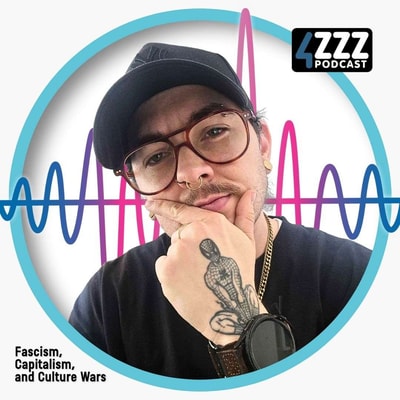
This week, Ez (he/him) is back and hitting the ground running,and flying solo he breaks down the systems shaping our world such as capitalism, fascism, culture wars, activism, and socialism. From understanding why trans people have become targets in political distraction campaigns, to exploring how “last‑stage” capitalism fuels instability and how fascism exploits that chaos, this episode offers a guide to making sense of the moment we’re living through. Drawing inspiration from The Triploi Podcast and David Pakman’s The Echo Machine, we unpack complex ideas, trace the roots of inequality, and highlight the power of solidarity, unionising, and collective care. Ultimately, this is a hopeful conversation about why revolution is inevitable, why community is the antidote, and how we can build a new world together.
Ez also discusses the week in community news, MELT festival events - including Tranzmission Live: The Antidote, the importance of community radio plus a bunch of interesting stats from the CBAA, as well as recapping T.I.T. Together In Transition Event from July where Tranzmission raised over $2000 for Project 491.
Tickets to: The Antidote: Tranzmission Live Show @ Studio188
🔗 If you'd like to listen back to the unedited episode - with the music - head to our On Demand website. And don't forget to follow our socials at Facebook and Instagram.
Timestamps and Links:
- 00:00 - Acknowledgement of Country
- 00:20 - Welcome to Tranzmission
- 00:58 - Where/Why Did Ez Go? All the answers
- 0424 - Community Radio Report
- 06:29 - Ez's Melt Moment - List and links in notes
- 09:29 - Gender Health Australia's: Community News and Events - Links in podcast notes
- 17:47 - Fascism, Capitalism, and Culture Wars: An Introduction
- 21:41 - Capitalism, Late(last)-Stage Capitalism, and Fascism - The 1% Oxfam Study
- 31:58 - Culture Wars, Activism, and Why Community Unity Matters
- 48:56 - Socialism and Community as the Antidote
Community News and Events Links: brought to you by Gender Health Australia
- News
- Q News: Hungary scraps Viktor Orban’s anti-LGBTQ+ laws by Dean Arcuri
- Star Observer: Anti-Trans Activist & Failed Liberal Katherine Deves To Run For One Nation In 2027 by Jacques Nieuwoudt
- Cory Bernadi's Bill Banning puberty-blockers defeated by South Australian Rainbow Advocacy Alliance
- LGBTI Legal Service Inc.: Annexure A - Notice to Class Members by Queensland Civil and Administrative Tribunal
- Star Observer: Gold Coast Pride Announces Their First Ever Free Pride Formal For LGBTQIA+ Youth by Michael James
- Events
- Cocky Horror: A Drag King Cabaret Floorshow @The Sit Down Comedy Club, Fri 23 October - 6pm, Sat 31 Oct - 2pm, Fri 6 Nov - 6pm
- Tranzmission Live: THE ANTIDOTE @Studio 188, Thu 5 Nov - 7:30pm
Ez's Melt Moment List
- SWAMPDOGS Oct 23
- QUIVR's Wet on Deck Oct 24
- Queer PowerPoint Oct 28
- L Word Trivia Oct 22 and Nov 5
- No tears for queers Oct 29
- Guava FEST Nov 07
- Tropical Fruits: Melted Nov 07
- Saddle Club Nov 08
Support Services
- QLife - 1800 184 527
- QC LGBT Mental Health Services
- Open Doors Youth Services Inc.
- LifeLine - 13 11 14
- Beyond Blue - 1300 22 4636
- How to Support Transgender & Gender-questioning Youth
- Transgender Map
Get Involved
💿 This week's playlist:
- ISIS (@isis_music_bne) - Beautiful Thing
- Cygnette (@cygnettemusic) - Sorry I Left The Party
- CLAY PIGEONS (@claypigeons.band) - Probabilities
- Worm Girlz (@wormgirlz) - Funeral
- Alex The Astronaut (@alex.the.astronaut) - Business Man
- Laura Jane Grace (@laurajanegrace) - Free Cigarettes
- Cheap Perfume (@cheapperfumeband) - Probably It's Capitalism
- Talon (@talon_forever) - Britney Spears
- Lambrini Girls (@lambrinigirlz) - Bang Bang Bang
- Dog Park Dissidents (@dogparkdissidents) - Class Struggle
- OMEGA TRIBE (@omegatribeofficial) - ESSENTIAL WORKERS
- Boyswitch (@boyswitch_band) - The Dispossessed
- Dead Pioneers (@dead.pioneers) - No Kings
- Sister Wife Sex Strike (@sisterwifesexstrike) - Mad World (Cover)
- Salt & Steel (@saltandsteelmusic) - The Rules of The River
4ZZZ's community lives and creates on Turrbal, Yuggera, and Jagera land. Sovereignty was never ceded.
Produced and recorded by Ez for Tranzmission at 4zzz in Fortitude Valley, Meanjin/Brisbane Australia on Turrabul and Jaggera Country and audio and cover image edited by Tobi for podcast distribution via 4zzz Podcasts (@4zzzpodcasts) for Creative Broadcasters Limited.