Gimuy/Cairns Controversy
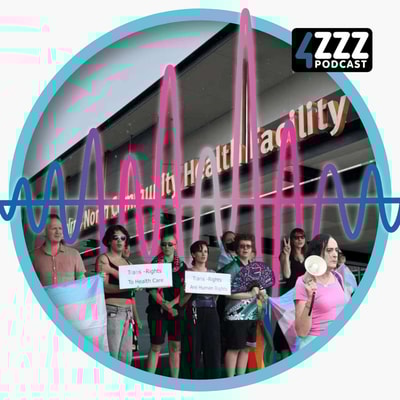
This week Bette (she/they) and Ez (he/him) welcome Charlie (they/them), who joins them from a Barber’s chair in Gimuy/Cairns. Together they break down the government’s review into paediatric gender care at the Cairns Sexual Health Service and discuss Charlie’s work in community with Gimuy Queer Collective. Do buckets and black mould justify the statewide ban on essential healthcare? The government’s case seems shaky at best.
Transcript
At 4zzz, we acknowledge the traditional owners
Speaker B:of the land on which we broadcast.
Speaker A:We pay our respects to the elders, past, present and emerging of the Turbul and Jagera people.
Speaker B:We acknowledge that their sovereignty over this
Speaker A:land was never ceded.
Speaker C:And we stand in solidarity with.
Speaker A:Transmission on 4zzz, amplifying the trans and gender diverse community of Meanjin, Brisbane and beyond.
Speaker C:Hello?
Speaker A:Hello, Meanjin. You're listening to Transmission on 4zzz. My name is Ez, I use he, him, pronouns.
Speaker C:My name's Bet. I use she, they, pronouns. I just want to do a little reset here because people on the phone lately through my job have been calling me Brett.
Speaker A:Brett?
Speaker C:Yeah, like. Cause I mostly deal with trans, young trans folks and they're cool. They get my pronouns straight away. I think they know I'm trans fem, but their parents and their social workers every now and then hear my voice and think I'm Brett or Ben or something. So everyone, the name's Bet. B, E, double T, E. Pronouns. She, they, I'm super femme to look at. If you met me, you wouldn't make the mistake. But it's just my voice, so yeah, I'm coping.
Speaker A:You can bet on that.
Speaker C:Gets better with age. Anyway, sorry to derail everything.
Speaker A:No, no derailing at all.
Speaker C:My rant. My gender rant.
Speaker A:Gender rant. Oh, well that's, that's great that you're on a gender rant because that's what transmission is for, gender ranting power.
Speaker C:Yeah. We've got a guest today to rant with us. Yeah.
Speaker A:Do you want to tell listeners a little bit about that?
Speaker C:Yeah. So Charlie from. Now, am I saying this right? Gimoy.
Speaker A:Gimoy.
Speaker C:Yeah, yeah, Gimoy can. So Charlie's, as I understand it, the. Well, the spokesperson anyway, for the Gimoy Queer Collective. They were featured in the ABC recently in response to some of the, I guess, accusations that the ABC had towards the Cairns Sexual Health Service that was providing gender care for young trans people, based on the report into the Cairns Sexual Health Service. So Charlie's going to help us break down that report. Both Charlie and I have read it and Charlie's very active in the Gimoy queer scene. So they can tell us how that's kind of what effect that's had in Gimoy cans. And I gather it has not been a good effect at all. Yeah, trans folks are feeling stigmatised and without recourse to suitable health care unless they. They link in with the QCGs. But then they, if they're under 18, they can't get hormone therapy anyway as new patients, so they're kind of stuck unless they've got a shed load of money and they can travel, I imagine.
Speaker A:Yeah, well, and that's not the most accessible option for many. So we'll be chatting a little bit later in the episode today to Charl about how things are up north. But before we do, we do have some week in community news and events. Bet. Do you feel like reading anything EU
Speaker C:blocks US push to redefine gender at the United Nations Forum the European Union has blocked a United States proposal to define gender strictly as biological men and women at a major United nations women's forum. The move came during the latest session of the UN Commission on the Status of Women, where the US introduced a resolution aimed at anchoring gender in biological sex. However, EU member states, led by Belgium, used a procedural motion to stop the proposal from even reaching a vote, arguing it was rushed and misrepresented existing international agreements. The decision highlights growing global divisions over how gender is defined in international policy. Current UN frameworks based on the 1995 Beijing Declaration do not set a fixed definition and instead allow for evolving and more inclusive interpretations. While US officials criticised the moves as shutting down debate, European representatives said any changes to established language must involve broad consultation. The outcome reflects ongoing tensions over gender, human rights and the direction of global equivalent quality policy.
Speaker A:So that's happening on internationally there as well. Internationally Transgender women banned from female Olympic events under new IOC policy the International Olympic Committee has announced that transgender women and some athletes with differences in sex development will be barred from competing in the female category at the 2028 Los Angeles Olympics and future Games. Under the new policy, all athletes entering women's events will be required to undergo a one time genetic screening to confirm biological sex, with officials saying the decision is aimed at, quote, unquote, protecting fairness and safety in elite sport. IOC President Christy Coventry said the move was based on scientific evidence that athletes who have undergone undergone male puberty retain performance advantages, despite a plethora of scientific evidence that shows the contrary, including a major study published in the British Journal of Sports Medicine, which found there was no significant athletic advantage for trans women compared with CIS women after hormone therapy. The decision marks a major shift for the IOC's previous approach, which allowed individual sports to set their own inclusion rules and follow years of global debate over transgender participation in sport. While some groups have welcomed the change as a step forward fairer competition, human rights organisations and advocates have strongly criticised the policy of warning it could be discriminatory and harmful to trans and intersex athletes. The new rules apply to elite Olympic competition only and expected to further intensify international debate around gender, sport and inclusion.
Speaker C:And I'm sure everyone, most people listening have heard this too, but apparently they used to have that rule in the past in the Olympics, but it led to too many CIS women finding out that they had differences of sexual development and then having their careers ruined. So they got rid of it.
Speaker A:Yes, and it was quite a high percentage. It wasn't insignificant.
Speaker C:Yeah, well, men meanwhile, I hear, although I'm not going to state this as gospel, because I know that these things can just become Chinese whispers, but I hear that there's only ever been one trans woman that's competed in the Olympics. But I don't know if that's true. I have to look that up.
Speaker A:Yeah, there's a few trans athletes varied but, you know, not always necessarily like hyper focused on because it wasn't such a major issue until the last 10 years when it's been like, you know, amplified in the media as we know. So some fun news.
Speaker C:UK bookshop fundraiser sparks controversy over defaced Harry Potter books the Humanity, a trans owned bookshop in Leeds has drawn international attention. After inviting customers to deface copies of Harry Potter as part of a fundraising campaign, the store, known as the Bookish Type, encouraged visitors to donate a small amount, around 25p to write messages inside the books, with proceeds going towards transgender healthcare. Support Organisers described the initiative as a cathartic and community driven way to raise funds, saying it aimed to help local trans people while offering an emotional outlet in a difficult political climate. The campaign has sparked strong reactions, with critics labelling the initiative inappropriate and disrespectful. While supporters say it reflects frustration with author J.K. rowling's wildly transphobic views on gender identity. The bookshop says it has received widespread support and donations from both local and international communities, with people contributing books and funds to the effort. If you'd like to support their cause, you can head to their Instagram page. He bookish type leads.
Speaker A:I like that.
Speaker C:Wonderful.
Speaker A:It is wonderful. It's so good. And it's a wonderful time to be trans and defacing Harry Potter books, I can tell you, because it is in fact that time where of the year where trans people are no longer invisible, we become visible.
Speaker C:Oh, do we?
Speaker A:Apparently. And this week, Trans Day Visibility, held annually on March 31, is a vital moment to celebrate the lives, contributions and resilience of trans and gender diverse people, while also raising awareness of the discrimination and barriers many of us continue to face. TDOVE shifts the focus from narratives of struggle alone to ones of joy, creativity, community and pride, highlighting the importance of representation in everyday life, from media and workplaces to families and public spaces. At the same time, it serves as a call to action, encouraging institutions, governments and you, dear listener, as well as allies alike to listen, learn and commit to meaningful change so that trans people can live safely, authentically and and with dignity. Supporting trans voices can also be as tangible as backing platforms that amplify them, such as subscribing to your community radio for Triple Z help sustain programmes such as transmission, ensuring trans storeys, perspectives and culture continue to be heard and celebrated. Head to 4zzz.org ausupport to keep transmission on air and support Trans Joy. Yay. Yay. And something you can do if you're looking to get a bit more invested in the Trans Day visibility vibes. Tomorrow, Tuesday 31st of March from 3pm at Davies park in West End is Trans Days of Visibility. Trans Travaganza, which is the world's largest Trans Flag event, is completely free to attend and Transjustice Meanjin are putting it on alongside Community and they will unveil the world's largest trans flag. So go cheque it out. There's also going to be a few bands playing. There's Clover Love as well as Wormgirls. And then further into the Future on Thursday, April 22 sorry, April 2 from 6pm at the Cave In, Pink Noise Easter is your invitation to kick back, kick off the Easter long weekend in style. Celebrate the diverse voices of our local queer community alongside sets from the Margaret six of the Sun Emmy Hour Music and as well as the Cave in being just a freaking awesome venue with great pizza and completely fully disable friendly venue.
Speaker C:Do you think they'll play some experimental transfem synth sounds if you're going? Yeah, but that's what I need. Experimental transfer synth.
Speaker A:Well, you know what? I think you've got a chance.
Speaker C:Yeah, I think so.
Speaker A:Yeah.
Speaker C:Pink Noise certainly sounds like that.
Speaker A:Yeah, I'd say there's a chance. And Pink Noise, I believe, put on more than one event. I've definitely seen him do some other things too. Yeah. So cave in on Thursday, April 2, cheque that out. And we've got a special guest phoning into the studio today. Bet. Would you like to introduce our guest?
Speaker C:Sure. We're talking to Charlie from Gimoy. I think I'm saying that right.
Speaker B:Charlie, hi, how are you going?
Speaker C:Hey, can you hear us?
Speaker B:I can bet you're a little bit quiet, but apart from that.
Speaker C:Okay, so you're from Gimoy Queer Collective, is that correct?
Speaker B:Yeah, that's right. So I organise alongside community here in Gimoy. An organiser and. Yeah, that's me. So the Queer Collective is. Yeah, a group up here that sort of formed in the response to the initial ban to gender affirming care.
Speaker C:Alright, so it's that young, the group. It's been around for a year and a bit, is that right?
Speaker B:Yeah, we're fresh, we're babies. We're still finding our feet a bit together, but it's been really great. Actually we had a meeting yesterday, brought a lot of energy about.
Speaker C:Yeah, I kind of started a group or a couple of groups since then and I feel like the government did us a favour in one way, which is that it brought us together and made us a bit more proactive.
Speaker B:Yeah, I agree. There's nothing like a senseless piece of policy to bring people together.
Speaker C:Senseless is a good word for it.
Speaker B:I've been thinking about that.
Speaker C:Charlie, did you tell us your pronouns tell the listeners your pronouns?
Speaker B:I did not. I missed a lot of my pronouns. They, them and I'm a trans person. Cool, thanks.
Speaker C:I understand you've read the CHHHHS Review as well. The review into the Hinterland. Hang on, it's called Health Service Investigation into Paediatric Gender Health Services at Cairns and Hinterland Hospital and Health Service.
Speaker A:Oh, wow.
Speaker C:Catch your name.
Speaker A:Say that three times first.
Speaker C:So I've been calling it the CSHS Review, the Cairns Sexual Health Service Review. So that's probably how I'll refer to it.
Speaker B:I think you're in the name. Okay.
Speaker C:Yeah, so I had. I've got some questions about that. Do you want to talk about that first or do you want to tell us a bit more about what's happening in Cairns for trans folks since the ban and since the. The kind of. What would you say the, the controversy surrounding the. The Cairns Sexual Health Service?
Speaker B:Yeah. So where do you start? I guess so. It's been a long year and a bit. I suppose, like you said, that one good thing that's come out of it is it's brought community together to look at this and sort of push for change.
Speaker C:But how is the kind of cultural climate. How's the cultural climate like the. For trans people on the ground in Gimoy? Like has it changed?
Speaker B:Yeah, I would say so. From my own personal experience and you know, the people that I do talk to, there is a sense of fear. We're Seeing, you know, an increase in numbers attending our health services and support services, we're seeing, from my own observations and from other observations as well, people are keeping to themselves. They're not wanting to step into these spaces. Because what the review has done is it's instilled fear, which is exactly what it wanted to do. It was a punchy headline to bring about fear. But the substance of it, and I think what people were worried about, is that they have put people in harm's way by attending these services. But actually the substance of it is that the services needs a great hold and the care itself needs to be there. So our community, I feel, are confused, are frightened, and we are trying to bring us together and bring about the education of what this review really is, in hopes that we can all stand together and go, this isn't good enough. That is nonsense.
Speaker C:Yeah, so that's a good point about. So you feel like the problem was that the service was underfunded, I presume?
Speaker B:Yeah, the service itself was. So the effort that went into keeping it up and running was huge. The people that were behind it were so passionate and cared so much. And when we're thinking about, and we're looking at this review as well, most of it predates 2018. Like, there's been so much work that's been done between then and now to bring things back up to scratch. And the thing is, we don't need health care cut like, we need funding to support the health care. I was thinking about, I don't know what came into my head to remember this ad, but the ad from Piracy back in the early 2000s, you wouldn't steal a car or like, you wouldn't take away any other form of health care because the service wasn't running it correctly. You provide the health care because some care is better than nothing, and you put money into it to bring it back up to scratch so that the people accessing it are getting the care that they are entitled to and that leaves a human. Right.
Speaker C:Charlie, did you feel, or did anyone there feel that the Cairns Sexual Health Service, in particular, the paediatric part of it, was even less well funded and resourced than most regional health services, or do you feel it's all much of a muchness?
Speaker B:Yeah, I believe so. From what I understand is that it wasn't actually fully funded up here, and this is my understanding, but that it was. They found the funding to make it work because there was a need in our community.
Speaker C:Yeah, and that's the thing I wanted to get into that, the, that the review says, well, maybe I'll just do a quick timeline of, of how that clinic grew up according to the review. So the director of Sexual Health at the Cairns Hinterland Hospital started seeing adult trans folks. Adult trans folks. And the word they use is they saw adult trans folks. So I don't know if they provided gender affirming care or not, but they started seeing them from 1993. The first under 18 client was recorded in 2008 and at that time, as I understand it, there were very few places in Australia that were providing this care for under 18s at all. So the Cairns service was actually a trailblazer in this field and was referred to as the gold standard in the late 2000 and tens by the then Human Rights Commissioner, according to the review. Then in 2011-2015 there was what they call a significant increase, not just in under 18 patients, but in adult patients as well. Yeah. So there were very few gender clinics operating in Australia by 2014 and the QCGs, even the Queensland Children's Gender Service here, here in Meanin, had not yet been established. So this was like a trailblazing service. But the bit that I find really interesting and kind of not believable was it says that so they'd been treating trans clients and young trans clients for that long. But the board members claim to have been to have had no direct knowledge that the Cairns Sexual Health Service was providing paediatric gender health service. And the reason the review, it claims that that's so is because the board. Hang on, the board members didn't come on until later after the service had been established. So it follows therefore that they didn't know about it. That doesn't make any sense at all to me.
Speaker B:Yeah, that doesn't make. Yeah, it doesn't make sense because it was a public service that every. That was public knowledge and so it should have been within something they would have had to have read before starting.
Speaker C:So back on the board and the kind of rumour. I'll call it a rumour, it's anecdotal. The anecdote that I've heard about this is that the board and the hospital just didn't want to fund it and were resistant to it all along. And then later in the late 2010s there was kind of this conflict between who was going to take it over. Was it going to be the QCGs or was it going to remain with the Kents Sexual Health Service and get some funding from the hospital, but it never did. So there was just this sense that no one wanted to take responsibility for it outside of the physicians that were actually on the front line.
Speaker B:Yeah. And I wonder if that, you know, a little bit that points towards transphobia within the health service and not wanting to fund the care that was clearly needed.
Speaker C:It does seem.
Speaker B:And then what happens after the kind of funding. Funding's cut? We end up with services that can't perform all of their duties.
Speaker C:Yeah.
Speaker B:Duties that they've not performed. Detailed in these reports, and particularly in the Cairns report, is a lot of clerical errors, which we know happen when services are underfunded, under resourced and just trying to do what they can to provide the service that they're supposed to.
Speaker C:Yeah, yeah. When you go through the review and you look at in what way did they fall short in the reviewers estimations? Most of it is paperwork. Right. Most of it is leaving a paper trail to prove that they had ticked the boxes in the, in the various forms of assessment and the Gillick competence and so on. And then there's a couple of accusations from actual staff that things like Gillick competency weren't actually tested at all in some cases, but they're not corroborated that we don't actually know about that, as far as I can tell. Is that your reading?
Speaker B:Yeah. No, we don't actually know. There's, I guess, you know, whispers in community that people speculate it might be X, Y or Z person, that is, and. But no one actually knows. So it's these cases in the report, but they're not, as far as we know. And as far as the talk has gone, we don't actually know if people are being told that that's been discussed and from what we can hear and what we think is they're mostly 17 and around that age. And so is a Gallic competency test necessary at that age?
Speaker C:Yeah. So my reading is that. So in the review they split it into two sections. When they talk about this, they have a section on so called stage one treatment, which is puberty blockers, and then they have a section on stage two. Now, again, this is anecdotal, but my understanding is that there were two clients that were getting gender affirming hormone treatment, so stage two treatment and they were 16 to 17 and they didn't have Gillick competence tests. But, you know, I think it's generally understood that if you're 16 to 17, failing some brain injury or something like that, you are going to have Gillick competence. Right.
Speaker B:Yeah.
Speaker C:So that's, that's a Clerical oversight. But it's not necessarily like a lapse of. Of ethics or anything like that. Or poor. Doesn't necessarily represent poor treatment, I would say, but.
Speaker B:Yeah, exactly.
Speaker C:They also talk about puberty blockers and they complain that there wasn't a record of Gillick competence being tested for some of those patients. And those patients were as young as 12. 12. But the thing is that in my mind, I mean, do we test for. For Gillick competence when giving puberty blockers to precocious puberty patients? I have never heard that. So why is that suddenly important when they're trans patients?
Speaker B:Exactly. And do we Gillet competence test kids before we give them antidepressants that do alter their brain chemistry? No, we don't. No, because sometimes the adult in that situation is the caregiver and can have those discussions and conversations with their kid. Yeah, that's what it's supposed to be. It's a team effort, you know, with your parents, with the doctors, with psychologists. These things don't just happen overnight. There's so many conversations that happen before a kid is ever prescribed acute. I think that's what people miss when they're talking about this.
Speaker C:Yeah. And actually that, I mean, I'm jumping all around in my notes here, but that touches on something about that I only just noticed when I looked again at the review yesterday, and that is that on the one hand, they're saying that there wasn't enough engagement with, around Gilick competence, for example, and informed consent. But on the other hand, they're saying that they gave. In many cases, young people got way more time with a psychologist to just discuss their state of mind than patients in the qcgs did. So to me, this comes down to, to a discussion of. Which is more helpful in this situation. Is it helpful to. I mean, I have a parent told me what the Gillick competence, or, sorry, the informed consent process entails at the QCGs, and they weren't complaining about the physicians there. They thought the physicians were great. But it's six sessions that spread out over months. Six sessions to discuss the risks of, of treatment. And it includes things like a discussion of sex and sex toys with a, A young person who in this case was. That was incredibly anxiety provoking for that young person. And that young person would shut down when they, when they heard that. Right.
Speaker B:Gave me chills, actually.
Speaker C:That's like, it's, it's. It's a gauntlet of like six sessions. Six sessions to discuss the risks of a treatment that's pretty intense for a young person. And it takes months while their biological clock is ticking. Whereas in Cairns, from what I read in the review, young people were often getting sick sessions with psychologists, but they were discussing other stuff, presumably, which I think is way. Probably way more constructive and more holistic.
Speaker A:Right, That's a more holistic approach.
Speaker B:Approach, yeah, yeah, absolutely. And I, I think, like, I got chills when you explained that process because.
Speaker C:Yeah, what's that about? Right.
Speaker B:Trying to convince someone out of it. Yeah, not trying to convince, but if you're just talking about the fears, the successions, and not actually exploring what that person wants and needs to feel happy, healthy and safe.
Speaker C:Yeah. Now, I'm sure there is some discussion of that, but I question how much discussion of that there is where they have to be put that much resources into doing this consent thing. Right. And. And then in the, The Cairns review, it complains that. That psychologists in Cairns would. Or that young people would sometimes progress from psychology to being prescribed treatment within six weeks or within a number of weeks. And it's like, yeah, well, they were seeing a psychologist once every week, it says. So like, okay, six sessions with a psychologist, that. That's pretty reasonable in my mind.
Speaker B:Yeah. And isn't that amazing access, like, we should all be afforded that to be able to figure out what we need in a timely manner rather than spread it out over, you know, the usual two to five to six years that we usually get in the public system. Like, it was such a beautiful service and it was stripped of all that. It was like you said, the. Seems like someone came in that didn't like it and didn't want the funding there and they tried for so long to keep it going and they have really, like, they've done an amazing service for our community.
Speaker C:So apparently it's still going, Right. The Cairns Sexual Health Service is still there and they can see young trans people, they just can't prescribe for them, is that correct?
Speaker B:That's right. So still have access to psychology and support. However, I don't know what the, what the uptake is like at the moment, and if there was, there has been a hit to confidence lost, I guess, with the review coming out, which was tough, but they've been really engaged in wanting to do better and wanting to know how to improve. From what I can tell and what I can see, I think it's a matter of, right, they're doing the things, so give us our funding back so they can have a shot at ticking these boxes that you're asking.
Speaker C:Yeah. But the only thing is that even The QCGS doesn't have the fund. Well, I mean, they have the funding, but they don't have the ability to prescribe now, so. So we're all kind of stuck. But I imagine. Are there any other options for young people in North Queensland? I mean, there must be a private clinic somewhere. Is there that will prescribe or is there not?
Speaker B:There is, and my understanding is that there's one. I don't know if there's others that are quieter, but from what I actually can, what I have heard and what I understand is that there's a lot of doctors that are actually scared to even be supportive of here.
Speaker C:Totally. Well, that. I mean, that's the same down here to a degree.
Speaker B:Yeah. But we do have one amazing doctor who has spoken out, concealed and works with us a lot. Dr. Katie at Kaleidoscope, who looks after a lot of patients privately and works with Project491 as well to get funding where needed.
Speaker C:Oh, that's fantastic. Yeah. Well, okay, so Dr. Katie, did you say?
Speaker B:Yeah, that's right.
Speaker C:So they are a local hero, I gather?
Speaker B:Oh, God, yeah. She's incredible. She's done a lot for our community and is holding it down to a lot of us at the moment.
Speaker C:Holding it down. That's great. Let's. Let's go. So I just had a member of the 4zzz staff ask me where Gimoy is. So not everyone knows. It's Cairns folks.
Speaker B:That's the white fellow names Gimui, Far North Queensland. So Gimoy, Wallaburra, Yadinji that all sort of have ownership of the same overlapping areas up here. Yeah.
Speaker C:And I understand that you do some work up there in solidarity with the local first nations folks.
Speaker B:Yeah, so we do what we can whenever we can. There's a group called Blackisation up here, which is an amazing group of young and emerging leaders working to build solidarity in community up here for first nations activism.
Speaker A:And yeah, I'm looking it up right now. Looks great.
Speaker C:Yeah. So I've got a few points I want to hit on with this review. So I'm just going to bombard you a bit, Charlie. Yeah. So apparently says in the review that following that attitudes to consent for adolescence changed in Queensland after a lawsuit called Re A in 2022. And while other states continued to operate under Reimagin 2020, Queensland actually became more permissive for a while there because under reimaging, which the other states were operating under, if a child is found to have consent capacity, both parents must also consent or dissent. They can't just assent so they can't be neutral on it and the child just get treatment. The parents have to weigh in under reimaging. But in Queensland under Re A, a Gillick competent consenting young person is sufficient to confirm consent. And so because of this, and because not many people knew that the Cairns Clinic was offering this service, they were able to prescribe for young people without consent of the parents. Now, we're not talking about 12 year olds or whatever, we're talking about Gilic competent young people. And as you and I said, in most cases, if not all that was 16, 17, 18 year olds. I hear 17 and 18 year olds, but that's actually pretty progressive and something that most of us in the community would think was actually pretty great. Right?
Speaker B:Yeah. And I think like that word really resonates with what Cairns Sexual Health Clinic was doing. It was really brave. Like you said earlier, it was the trailblazer in service and that, you know, it brought other people up to scratch. And you can see that if the services, you know, brought a cultural change about, maybe that is the first place that someone's going to try and shoot down if they want to get rid of that and to say what's been going on there wasn't. Sorry, I think I've lost my train of thought. Actually, you're right.
Speaker C:You're sitting in a hairdresser right now.
Speaker B:I am doing my best, but I can hear my hair being shaved.
Speaker A:You're like, I got to get this mullet right.
Speaker C:You know, your hair is being shaved. I wish I could hear that.
Speaker A:The trans mask buzzes in the background.
Speaker C:Are you going skinhead?
Speaker B:Sorry?
Speaker C:Are you going skinhead?
Speaker B:Not today. Done that. Been there, done that. That was my first step towards the gender journey.
Speaker C:Oh, awesome. That's a good first step. Okay, well, look, I'll bring up something else I wanted to bring up. So we have the record of some complaints that were made by clients and their families and. Or their families. Now, interestingly, there seems to. This is part nine of a review, apparently, and there's apparently a part six as well, but that doesn't look like ever being released. And they claim that it's been included in part nine, but I question that. So what we do have is the review record of how complaints were handled after 2022, but we don't know what the complaints were then. We have anecdotal descriptions of complaints that were made prior to 2022 and these descriptions come from staff members and we don't know what these staff members, political affiliations were. So we have to take them at their word. That's all we've really got. And these complaints stem from several years ago in some cases. So there were informal complaints made by patients who felt pressured to join trans support groups. That doesn't sound like a very serious complaint to me. A staff member noted that parents who objected to aspects of care had their concerns dismissed. So this is a staff member who felt that this was the case. Case. And then the staff member said, I don't know the details of the complaints, but, you know, I would imagine they're valid because one of the issues was with the culture was that if a parent had any objection related to their diagnosis of gender dysphoria or the pathway towards puberty blockers, they were basically alienated. Now, I feel like reading between the lines, you know, we're in Far north, we're in North Queensland. Parents are not always going to be very educated on trans care and they're having disagreements with doctors and probably with their own children or their own young people around this type of care, and they go away feeling alienated. I feel like I've heard this storey a million times online. And it doesn't necessarily mean that there was anything wrong with the care or the assessment being offered.
Speaker B:Right, yeah. It's that not understanding fully what's happening and the emotional. I guess you can imagine as a parent, you're not able to understand what your child's going through and, you know, facing all these huge medical questions and someone's telling you something that you don't understand, either you're going to go away and research it or you're going to get your backup and shut it down. It's exactly, yeah. Like what you sort of said, it sounds more like people's own views that are being challenged and not that their valid concerns were not being heard. But. Yeah, who's to say as well. I guess that that's my take of it as well. Yeah.
Speaker C:To be fair, I mean, there's accusations in here that the staff were very kind of, or could be, not all of them, but the staff were very kind of keyed in with the local queer community. And that. That. So the Cairns executive, I think that stands for, observed that the service had, quote, pushed patients forward, families away, raising questions about whether decisions were driven more by a philosophical than a clinical approach. But I don't think that's a fair question. Like, they may have inadvertently pushed families away because they believed that the care, that the clinical approach was the correct one and the families didn't it doesn't have to be philosophical.
Speaker B:Yeah, exactly. And if we're not detailing exactly what happened, how can we use that. That as evidence? Stop care.
Speaker C:Yeah.
Speaker B:Like if we're just going to vaguely go, oh, someone had a thought about this once upon a time and never finished that thought. But we're going to use that as evidence to cancel everything. It's like, well there's something wrong with the process. Like maybe that's more philosophical than it is clinical and evidence based.
Speaker C:Do you know of any anecdotes coming from community up there about parents being in conflict with the CSHs?
Speaker B:Not me personally. I haven't spoken to anyone and I. Yeah. In my community, in my circles, I haven't spoken to anyone that knows anyone personally that has had a conflict with. I know that there's parents that reading this fear mongering have gone, wait a minute, was that care I thought was great for my kids actually as great as it says. And then there's doubt sowed.
Speaker C:Yeah.
Speaker B:But I have not heard anybody. I haven't heard the parents.
Speaker C:Yeah, yeah. I mean it's hard because parents are very rarely in touch with the queer community and especially non supportive parents.
Speaker B:Yeah.
Speaker C:I thought maybe a young person might have had a storey about that, but. Sounds like normal.
Speaker B:Yeah. And I think every like from what I can tell at the moment as well, parents are doing what they can to protect their kids and so, you know, they are just focusing on their families at the moment and we're not hearing the wider conversation because there is that fear and it might not be of like they might be very accepting but there is that fear of what the conversations that are happening and their child becoming in a position of harm just through the narrative that's being taught through these policy changes.
Speaker C:Totally. Well, I mean I work with parents down here and obviously the parents I work with are generally very accepting. Every now and then I will engage with a more sceptical parent. But I imagine up in Cairns there are parents who think that the physicians at the Cairns Sexual Health Service were heroes.
Speaker B:Yeah. And there's lots of people in our community that feel that. And my own experience played, you know, I strangely came from Victoria to the far north to come out as trans, but that's another conversation altogether.
Speaker A:You got things in a good order there.
Speaker B:Yeah, yeah.
Speaker C:You like a challenge.
Speaker B:I only interacted with the service once and thankfully I could access other care that I needed. But my one interaction was beautiful and it was the most affirmed I've ever felt. And this was at a point in time when the funds had been almost completely cut and staff were being pushed out and like there was no money left in the service almost. And we were sat in a back room that had two holes in the roof. There was black mould in the room and water dripping into buckets. And that staff member still made me. That was the most asound I've ever felt.
Speaker C:Wow. Okay, thank you for that bit of detail.
Speaker B:Like it's about it sort of in a nutshell encapsulates. It wasn't the staff, it wasn't how people were doing this. It was the funding had been completely stripped to a point where they didn't have the resources they needed and that ends in clerical errors.
Speaker C:And according to the review, by 2023, 2024 the QCGs had just kind of washed their hands of it. They couldn't cope with their own patient load, let alone Cairns patient load. But Cairns clinicians were officially not allowed to keep offering this care. So there was just like a black hole of no care.
Speaker B:Yep. Yeah, pretty much.
Speaker A:It's almost like it was set up to fail in a way.
Speaker B:Yep.
Speaker C:It does sound like it was starved of resources by possibly the people at the hospital. I won't go. I mean just in a nutshell, the other complaints were two parents complaining about inadequate assessment and being excluded from the care process. And I did want to mention like a lot of this review comes down to assessment processes and I will admit sounds like once the Australian standards of care for trans young people came in, once the Auspath standards of care came in, that physicians in the Cairns clinic were not always coming up to those standards, they weren't necessarily following those standards. But I question personally about how necessary some of those standards are are and I want to cite a study Florence Ashley et al 2023 and a follow up study they did in 2025 just for listeners out there and we'll put this in the show notes for the podcast do gender assessments prevent regret in transgender health Care? A narrative review by Ashley et al. 2023 and they say the article concludes that there is no evidence that gender assessment can reliably predict or prevent regret better than self reported gender identity and embodiment goals. This conclusion provides additional support for informed consent models of care with de emphasis of gender assessments in favour of supporting patient decision making. And I had a follow up study gatekeeping Gender affirming care is detrimental to detrans people. Assessments appear to be detrimental to d trans people because they disincentivise honesty and authenticity, inhibit gender exploration, increase Shame and anger associated with detransition foster transnormativity, hinder the development of a strong therapeutic alliance, which I think is key, and diminish the quality of informational disclosure. I'm like, take that. TERFs like, wham, wham. That's so good. But to me, I mean, I, I guess what I'm saying here, and sorry if I'm just babbling at you, Charlie, but I guess what I'm saying is we could look at this Cairns review as something negative and it certainly has had some negative effects and obviously you're feeling the stigma associated with it there and the fallout of it there. There is something positive about it, which is it's bringing up this question of is all this multi disciplinary team assessment process really necessary? Like the government say they're going to follow up on the, the young people who went there between 2022 and 24. I think it is. I may have those dates wrong. So I'm curious to hear if those young people cooperate with that process. Well, what was their experience like, given that? And I'd be curious to hear from the other young people that went through years, years earlier in Cairns. I mean, we haven't, I mean this service has been going longer than the QCGs and we've never heard of any regrets from anyone who went through the service in Cairns. So I, I think this raises interesting and important questions, I think as well,
Speaker B:like just on another note, like searching for people that regret is such a. Like, are we doing that in any other service that overrun, underfunded, not operating as it should? No, we're not, we're not looking at those, like, regret rates in elective surgeries. Like, we're not going and trying to find people to confirm our narrative of the storey that we want to tell. And like you said, this can be a positive thing if we take this review as a positive thing and we use it to improve the service that we have to actually give the care that we deserve. Like, it could be amazing. But that, that's not what they're doing with this review. They're using this review to try and it's transphobic. Like, you can't call it anything else. It's not about care because care is best practise. It's been proven time and time again. This review shows that our service needs extra funding, needs extra support and like, it's just ridiculous. It's discrimination that care is not best practise. And we wouldn't do this to any other service.
Speaker A:No, no, exactly.
Speaker B:For example, like, and I think it points more to the fact that regional communities are not funded well enough. I've been on a wait list for a heart specialist at the hospital for nearly two years now. I'm meant to be seeing within three months. Do you think they'd ever just one day go, oh, no, they're not doing it right there. We're going to cancel it? Yeah, of course they would never. You'd continue providing care because care is. And you do a review and that's what they've done. Great. So implement changes, funding, give us what we need to do this properly and acknowledge that funding has been slowly but surely just stripped from this service.
Speaker C:Yeah. I think it's important to note that this review doesn't ever suggest ceasing providing the service. It suggests ways to improve the service. Now, I question whether some of those improvements are necessary and whether we need to put funding into multidisciplinary teams and biopsychosocial assessments that take months. But that's what the review wants them to do and that is not what they've done.
Speaker B:Anyway, they're just fishing around for more evidence for their narrative.
Speaker A:Yeah, that's it.
Speaker C:And there isn't really any here.
Speaker B:Yeah, definitely.
Speaker A:Well, we're gonna go to some music and have a bit of a break. And as we. You roll that around your mind, dear listener, what we're gonna do when we come back, we'll have a chat with Charlie again and get some ideas of resources and if you're living in Gamoy or that area and you're looking for support, where you can go to get some support as well as. Yeah, I don't know. More vibes from Charlie. We're having a good time.
Speaker B:So what is April Atonement? It's hard to label, but it's a way you, your art, your band and your business can support 4zzz. Brisbane, Logan, Ipswich or the Sunny Coast. You're a part of the 4zz circle. Let's work together to keep community and culture strong in our city.
Speaker A:So cheque your sub status, join for the first time or renew your subscription this April Atonement.
Speaker B:You can win some great prizes. It's easy.
Speaker A:Go to 4zzz.org au you're listening to Transmission on 4zzz. My name is Ez. I use he, him, pronouns.
Speaker C:My name is Bet. I use she, they, pronouns.
Speaker B:And we also have Charlie, they Yay.
Speaker C:Calling in from Gimoy, Cairns, North Queensland. Keeping it real.
Speaker B:From the barber chair.
Speaker C:From the barber chair. Direct from the barber chair.
Speaker A:Direct from the mullet acquisition chair.
Speaker B:Levelling up my career experience.
Speaker C:Always.
Speaker A:It's a day off. Better sort out that mullet.
Speaker C:Yeah, Mullet takes maintenance.
Speaker A:Mullet maintenance.
Speaker C:So we're talking about the Cairns Sexual Health Service and the Paediatric gender service that it provided there and how there was black mould and a hole in the skin ceiling when Charlie went the one time that they went to the Cairns Sexual Health Service. That's very illuminating. Thanks for that fact, Charlie. I feel like that's quite symbolic of. Of what was going on up there. They were being starved of resources and the government ultimately swept in and said, oh, you're not doing a good enough job because we didn't give you any money and therefore the care sucks and we're going to close you down.
Speaker A:Look, it's a problem we created.
Speaker B:We just push that under the carpet.
Speaker C:So that's the feeling up there, right? In community. Would that be right?
Speaker B:Yeah, yeah. Frustrated.
Speaker A:I had a question, which was, what does the future look like? What are you building as a community? What's happening out there?
Speaker B:We want to bring people together, we want to work together to just illuminate how ridiculous this is and how it's a local voice on the ground, a powerful local voice on the ground to say, this isn't good enough. So we've. Yeah, we've started meeting more regularly if anyone's interested in listening from the far north, where the Gimoy Queer Collective can find us on Facebook and Instagram and shoot us a message and can add you to our mailing list so that we can keep you updated on events and meetings.
Speaker A:Great.
Speaker B:Yeah, we basically. We just want to talk to more people. We want to get more people involved from all professions and actually have some real conversations up here with community from community.
Speaker C:Awesome. Are there any places where young trans folks can go and have a safe conversation with each other? You know, like a moderated conversation?
Speaker B:Yeah, absolutely. So there's yeti, which is a youth Empowered Towards Independence up here. Yeah, they're amazing, actually. And they have a programme on a Wednesday called say it, which is the Queer Youth Support group up here. They run movie nights, sometimes they do karaoke and different things. And we ran a drag workshop out of it for their masquerade ball last year, which was so much fun.
Speaker A:That's cool.
Speaker B:So there's a big cohort of people and support there for our young folk and for people. Yeah. Wanting to get a bit more active. There's us as well.
Speaker C:Yeah, I guess. When I hear you talk, Charlie, I feel like, okay, so if this is the situation in Guillermoy Cairns, then what's it like further out? What's it like in more isolated communities for trans folks? And honestly, I don't like to think about it.
Speaker B:Yeah, it is quite concerning to, I guess, the things that we do here. And there's actually going to be. On that note, there will be a LGBTQIA sector forum in Cairns, which is amazing and just incredible for our region, but it does mean that there'll be people from all across Far North Queensland, the Torres Strait and the Cape coming down to talk about our struggles within the community and what they're seeing and, you know, what services they're running further out and how that looks. So I'm really looking forward to that and hearing some more voices. But I guess what I have heard from the conversations I've had is that it is even more difficult. You can't have these conversations openly in community. People don't feel safe enough to have them within their families. And then the services again, like cairn services and cans, Sexual Health serviced the whole of the far north. Almost like.
Speaker A:Yeah.
Speaker C:So when is that happening? Do you know that forum?
Speaker B:June or July.
Speaker C:Is it. Is it just invite only or can I get on a plane and come up there?
Speaker B:Yeah, absolutely. I think there's. So tickets are free, they're on sale now. It's run through the LGBTI alliance.
Speaker C:Hang on, is that the LGBTQIA alliance or is it a different thing?
Speaker B:I think. Yes, lgbtqa, sorry, statewide peak body. Yes.
Speaker C:Yeah. Okay.
Speaker B:Yes, they've sort of gone out and.
Speaker C:Yeah, interesting.
Speaker B:Okay, run one up here for us in our sector so that we can hear more voices from outside of just Cairns as well. Because you can imagine if we're struggling to access care here, just gets worse the further out you go.
Speaker C:Yeah. Okay. Well, power to them for organising that.
Speaker A:Yeah.
Speaker C:I wanted to point out something that jumped out at me from the review. It's just a single line and it says, staff could not recall any adolescent who suicided who went through the Cairns Sexual Health Service. Now that, to me, that should be highlighted and have a bunch of asterisks behind it. Yeah, I mean, that's like cause for celebration.
Speaker B:Right.
Speaker C:We've got a 40% suicide attempt rate in this cohort and they couldn't recall anyone who suicide.
Speaker B:Yeah.
Speaker C:Over like 20 plus years of care or 20 years.
Speaker B:Something I was thinking about when we were talking about this care before Beth, is that this care is trailblazing. It's person centred. And what happens when you have Person centred care and you listen to the person in front of you about what they need is a. Reduces adverse mental health and it means that you aren't suicidal and that you're being listened to and that you can be yourself. And that's when we see a drop in mental health. Right.
Speaker C:100%.
Speaker B:There's so much evidence here that actually is in support of this. Care is best practise.
Speaker C:Yeah, for sure.
Speaker B:And it is a change in attitude that needs to happen in so many ways, from healthcare services, from person centred to the transphobia that exists in medicine.
Speaker C:For sure. There's a last thing I wanted to touch on too, which is you were in that abc. There were two articles that came out.
Speaker B:Yeah. I think it was around the review release, wasn't it?
Speaker C:Yeah. So the first article, I think you can agree with me, was pretty problematic. Came out in the ABC and it said the review found that young patients were on medication despite lacking the capacity to understand treatment. But actually that's not true. What it is is that investigators outlined state staff reports about young people being on medication, quote, despite lacking capacity to understand treatment information. So in other words, and I've quoted that from the review, in other words, the staff said that these young people lacked capacity to understand the treatment. But how do they know? Did they perform a Gillick competence test on those young people and determine that they weren't competent? That seems unlikely. If Gillick competence tests weren't routinely being performed or we don't have a record of them, then this is just a staff member asserting this. And yet the ABC acts like it's a finding. And when I, When I complained to the ABC about this, they gave me and I complained about so much in that article, it was longer than the article, my complaint. They. They got all semantic about the meaning of the word find and whether it was an official finding or just a colloquial use of the word fine, it was just a complete nonsense response. And then you came along in the second article and you were talking, I think, mostly about the negative effects on Community up there and how people are angry about this. So was it a good experience talking to ABC about that? Did you feel like you were heard?
Speaker B:I'll be honest, I don't really like reading articles after I've been in them. I think I avoid it. And I did feel heard by them, but I. When I saw them. But the article itself. Yeah. Feels like they missed the point a lot.
Speaker C:Yeah. How did you feel about the article when it came out? Were you at all angry?
Speaker B:I Think. Yeah. Disappointed. A lot of the time. I. And it was a bit similar with the SBS documentary or not documentary. Sorry, the. That came out semi recently. The inside episode.
Speaker C:Oh, God.
Speaker B:They just. They miss the point. They're not listed. They're uneducated and don't understand. And it feels.
Speaker C:You know what, Charlie? They're not uneducated because I spoke to the producer of SBS's Insight for literally three and a half to four hours now. I didn't provide links for everything I said because I didn't want to put that much time in. It would have been another three and a half to four hours to do that. And probably I should have done that. But she knew. She knew a lot of that stuff and I'm gonna bring that up with her. They just chose to have that take.
Speaker B:Yeah.
Speaker C:The same way the ABC did. And it really worries me. I don't know if we can. I don't think we can trust them. I mean, I like the producer of SBS's Insight and I quite like Janelle Miles and Emma, whose last name I've forgotten. Who were the journalists that spoke to you on. In the abc. And I believe that they want to do the right thing, but I don't know if they're capable of it.
Speaker B:Yeah. And I guess when we think about the ABC as well, and they're reporting on the last few years of world events, they're not exactly unbiased in their opinions sometimes. And I guess what I'm hearing you saying as well is that it's not miseducation, is it? It is somewhat. I do think that people's opinions are looking into journalism more and more, particularly in the abc and.
Speaker A:Yeah.
Speaker B:And I think something that underpins all of this is I don't think we as trans people are being heard.
Speaker A:No.
Speaker B:And gender diversity shows up in all of these spaces and in the interviews, and it's people's inability to hear us that keeps being repeated and it keeps being filtered.
Speaker A:So, you know, like. Yeah, and that's the thing. And, you know, I'm just gonna plug the show. You're listening. It was in a transmission. This is by trans people, people for trans people. We don't have, you know, someone editing us, filtering us, cutting us. This is our lived experience and this is what's really happening. And as much as, you know, people listen to these big broadcasters and these big media outlets, these mainstream ones, they are not actually in fact, real people in that they are going through filters of other people's opinions and political agendas and all these different voices in everyone's ear making a lot of mainstream journalism corrupt.
Speaker B:Yeah. And we've got Tim Nichols calling all these huge shots that there's no lived experience with. He's got no knowledge and understanding on and he doesn't have, like, the education. He needs to call those. Not only that, make those shots.
Speaker C:Like, he hasn't even spoken to the people affected by the ban. He has refused to. I know, because I've had a. I know a number of parents of trans young people who've requested to.
Speaker B:Yeah, he's refused to speak to a lot of people. Hey, like, almost everybody.
Speaker A:That's because this is not actually about trans kids or trans healthcare. This is a political. This is a political agenda. It's. It's to distract mainstream. To distract your average Joe from paying attention to real, real issues. Trans people are such a tiny percentage of the population. We're like 2, 3% at most. We are not your threat. We are not your enemy.
Speaker B:Exactly. And if we wind, like, the clock back to when this was announced, just before, you know, we were having the elections in Queensland just before that. He tried to. Or not. He. But the Liberal Party tried to announce that they were thinking about banning abortion. And remember how badly that went?
Speaker A:Yeah, yeah.
Speaker B:And then their next point of call was trans folk. And what do they say? First they go to the trans people. Like it is.
Speaker A:They can poke.
Speaker B:That was a terrible, like, snapshot of that quote. Sorry.
Speaker A:But yeah, no, yeah, it's still relevant.
Speaker C:Yeah, well, I mean, obviously. So they tried for abortion. Oh, no, we can't do that. So we'll take a step on the back foot. We'll go for trans people. And if we. If, by doing that, we can accept that we can take people's bodily autonomy away. If people will accept that, maybe they'll accept the abortion thing later on.
Speaker B:Exactly, exactly.
Speaker C:Anyhow, we need to.
Speaker A:We do. We do need to go.
Speaker C:I feel like I could talk a lot more about this, Charlie, so let's stay in touch.
Speaker B:Yeah, me too.
Speaker A:Thank you so much, Charlie, and for your contributions and everything that you're doing at the front, on the front line up there. We're so honoured that you've come to join us today to talk about what's been going on.
Speaker C:Real.
Speaker B:Yeah. Thank you so much. It's really great. And while this is my experience of the far north and there's so many more voices up here to be heard, I'm just so grateful that our community gets a chance to be heard by the rest of Queensland. But also, I just. If any of the young people are listening, like, I just want you to know that this policy is ridiculous. It's. Don't question yourself. Keep being you. Yeah, screw this guy. We will come back. Don't let this man make you question.
Speaker C:Yeah.
Speaker A:And we'll keep fighting for you guys.
Speaker B:Oh, yeah.
Speaker A:Yeah.
Speaker B:Always.
Speaker A:Thank you so much, Charlie. And we'll see you all next week.
Speaker C:Love you, Charlie.
Speaker B:Thank you so much. Take care. Appreciate it.
Speaker A:Thanks for listening to Transmission. Catch us every Monday live on 4zzz from 10am or listen to our podcast on the community radio plus.
Hosts: Ez (he/him) and Bette (she/her) w/ Special Guest Charlie (they/them)
This week Bette (she/they) and Ez (he/him) welcome Charlie (they/them), who joins them from a Barber’s chair in Gimuy/Cairns. Together they break down the government’s review into paediatric gender care at the Cairns Sexual Health Service and discuss Charlie’s work in community with Gimuy Queer Collective. Do buckets and black mould justify the statewide ban on essential healthcare? The government’s case seems shaky at best.
🔗 If you'd like to listen back to the unedited episode - with the music - head to our On Demand website. And don't forget to follow our socials at Facebook and Instagram.
Timestamps and Links:
- 00:00 - Acknowledgement of Country
- 00:20 - Welcome to Tranzmission
- 03:03 - Community News and Events
- 08:05 - CNaE: Trans Day of Visibility
- 11:01 - Charlie: Gimuy Queer Collective
- 12:25 - Charlie: Cairns Sexual Health Review and Cultural Climate
- 16:05 - Charlie: Clinical Timeline and Meeting Community Needs - Reviews linked below
- 19:38 - Charlie: Falling Short - Paperwork and Gillick competence
- 25:50 - Charlie: Current Operations - Dr. Katie
- 28:20 - BLACKtivation
- 28:53 - Cairns Sexual Health Review: Re A [2022]
- 31:24 - Cairns Sexual Health Review: Complaints and Funding
- 39:12 - Cairns Sexual Health Review: Standards of Care - Links in notes
- 44:22 - April Atonement
- 45:33 - Cairns Sexual Health Review: Black Mould and Maintenance
- 46:27 - Charlie: The Future - Gimuy Queer Collective, SSAYIT
- 50:12 - Cairns Sexual Health Review: Person Centred Care -21:27 - Charlie: Being Heard
Community News and Events Links
- Pink News: UN overwhelmingly votes against US proposal limiting definition of gender by Poppy-Jay St. Palmer
- Olympics: International Olympic Committee announces new Policy on the Protection of the Female (Women’s) Category in Olympic Sport
- Pink News: Queer Bookshop Raises Money for Trans Healthcare by Letting Customers 'deface' Harry Potter Books
- 2026 LGBTQIA+ Sector Forum @Pullman Cairns International Tue, 16 Jun, 8:30am - 4:30pm AEST
TDoV Links
- Trans Day of Visibility
- Support 4zzz this April Atonement
- TDoV Transtravaganza @Davies Park Tues 31 Mar, 3pm AEST
- Q News: Brisbane unveils world’s largest trans flag, a symbol of trans joy and resistance by Dean Arcuri
- pinkNOISE Easter @The Cave Inn Thurs 2 Apr, 6-9pm AEST
Journal Articles:
- Ashley et al (2023), Do gender assessments prevent regret in transgender healthcare? A narrative review
- Ashley et al (2025), Gatekeeping gender-affirming care is detrimental to detrans people
Support Services
- QLife - 1800 184 527
- QC LGBT Mental Health Services
- Open Doors Youth Services Inc.
- LifeLine - 13 11 14
- Beyond Blue - 1300 22 4636
- How to Support Transgender & Gender-questioning Youth
- Transgender Map
Get Involved
Produced and recorded by Ez and Bette at 4zzz in Fortitude Valley, Meanjin/Brisbane Australia on Turrabul and Jaggera Country and audio and cover image edited by Tobi for podcast distribution for Creative Broadcasters Limited.