Tranz for trains!
Today Brody (they/them) and Rae (they/them) chatted to Imogen Buckley (she/her), lead founder of South East Queensland Transport Association (SEQTA) about public transport advocacy and community, including how members of the public can get involved in campaigning for improvements. Brody and Rae also report on international, national and local news, including a @lemkininstitute Red Flag alert for anti-trans genocide in the USA, the NHS in the UK 'capitulating' to anti-trans lobbying, Sydney Gay and Lesbian
Transcript
At 4zzz, we acknowledge the traditional owners of the land on which we broadcast. We pay our respects to the elders, past, present and emerging of the Turbul and Jagera people. We acknowledge that their sovereignty over this land was never ceded.
Speaker B:And we stand in solidarity with.
Speaker C:Transmission on 4zzz, amplifying the trans and gender diverse community of Mean, Brisbane and beyond.
Speaker A:You're listening to Transmission on 4 Triple Z. I'm Brody.
Speaker B:I.
Speaker A:My pronouns are they, them and it's the morning and I'm very discombobulated because I'm not used to this. And today on the show I. We have a bit planned, but I am joined in the studio by the incredible Ray White. Hello, how are you today, Ray?
Speaker B:Also discombobulated, even though I'm here like in the mornings normally, but I'm just, I just don't like daytime, just time.
Speaker A:I'm not a person.
Speaker B:I am not a person. Yes. But when I am a person, I use they, them, pronouns, same.
Speaker A:And so today on the show we have a few things planned. Do you want to tell us about them?
Speaker B:Right, yes. So we have some news items that we get to later in the show as well as some events that are happening within the next couple of weeks. And we also have an incredible guest with us today who is going to chat with us about public transport and kind of like the, the intersections between transness and public transport and all that cool jazz. So to our amazing guest, would you like to introduce yourself your like your name and your pronouns?
Speaker C:My name is Imogen Buckley. She her. I run the Emmy on Board social media page as well as the Southeast Queensland Transport Association. I'm also discombobulated because I've been up since five.
Speaker A:Oh my gosh. You poor thing.
Speaker B:Oh my gosh. Why?
Speaker C:I wanted time to prepare for this interview and maybe allocated myself a little bit too much time to prepare for this interview. And I probably could have gotten up at like 7:30 and been just as fine.
Speaker B:That's. I was like, that's relatable content. I got up at like about 6 because I was like, you know what? I've got to do radio. I've got to do my physio exercises. And then I had all this time and I was like, oh, well, what am I gonna do now?
Speaker A:I had many alarms set this morning, but I did turn all of them off and in that my phone off the bed. So I had that planned. But it didn't happen because it never does.
Speaker B:At least it didn't happen where I threw my Phone off the bed and it went into a glass of water.
Speaker A:Oh, dear.
Speaker B:So just absolute classic, classic Ray. But anyway, it's lovely to have you on the show, Imogen. Thank you so much for joining us today. Do you want to tell us a bit more about the Southeast Queensland Transport Association?
Speaker C:So it's, it's the long name for sector, where essentially we're trying to bridge the gap between the transport community and public discourse. Back when I started it in 2025, I was looking at Victoria and like New South Wales forgot the name of the state for a second. That's terrible.
Speaker B:That's really bad. So I'll never listen.
Speaker C:Exactly, exactly. They've got massive, vibrant transport communities that were all active on Twitter or X, if you want to call it that, and like Instagram, other social medias. Whereas Queensland had a few, I guess, not particularly nice people posting rail content every so often. There wasn't, there wasn't a very. There wasn't a very like connected community. And the community had a bit of a reputation for being like, racist and like, not particularly friendly. And so I thought, I'm a friendly autistic. I can, I can start something. And so sector was formed to essentially first of all be a, like a hangout club for a lot, because I know a lot of. I had no transit enthused friends. I know a lot of people with like ASD and similar stuff struggle with making friends. So how do we make a little hangout club? We're not really as much of a hangout club anymore as we sort of blew up a little bit too much for that to be the safest thing for me to be doing. But we obviously people make friends. That's really great to see. We also want to advocate for better transport. You know, we've got this little thing called the Olympics in like, was it six years? So we want to make sure that by the time the Olympics comes, we have the best possible transport network we can feasibly do. We want to steer public discourse to be positive for transit, as all I was seeing was anti transit discourse coming from some really big names on the Gold coast and around southeast Queensland because they have money and they have a lot of followers. You know how old people get when they start talking, they don't stop. Real.
Speaker A:So real.
Speaker C:So, yeah, influence public discourse, advocate for stuff, but also like young people, queer people and like, especially women, just women in general have been buried out of transport discourse consistently in Queensland over the past 30 years. So we want to better elevate that and be like you know, women can have an opinion too, which seems basic, but you ask a lot of people and they're like, I know like a friend of mine told a school teacher that like they had a friend, which was me, that was into trance, that I was a woman and the teacher was like, I thought that was for guys. And that is a surprisingly common sentiment, which is really unfortunate.
Speaker A:Yeah.
Speaker C:So my work with sector has been trying to get women and queer people to actually, you know, have a, have a seat at the table. Our representative team, I think all but like two of them are LGBT identifying. That's great. We've got multiple women that are actually serving like administrative roles at sector and are like spokespeople for the community. And that does, that does upset some people that were traditionally in the, especially rail foamers. But you know, I also don't care and their opinions don't change and I'm
Speaker B:very, I feel like that's a good attitude to have for like basically everything. But yeah, sorry, carry on.
Speaker C:I'm very, I'm very proud to have done that. I've also been able to get the transport community sort of like, like mainstream. I know I get spotted on the street tonnes by like regular people that aren't transport enthusiasts, but tell me that they're, they're kind of super into transit now seeing my videos come up on their page. And I love that this is regular everyday people that are interested in public transport thanks to my work and the work of my wonderful team at sector.
Speaker B:And I think that's really interesting, like people are spotting you and like making that connection because like I think people often, you know, they catch public transport, you know, maybe for their commute or whatever and it's just an accepted thing of, oh, there's nothing that I can do to change this, even though X, Y, Z pisses me off or whatever it is. Whereas like you're, you know, you know, as you said, like advocating for giving them that, that space, especially like women and queer people to be able to like actually, you know, say what they want when it comes to public transport, which is, is extremely key and I think also really key and like, you know, for, for disabled people as well. Like there's a lot of, of stuff that I would like to see, you know, public transport in, in Southeast Queensland, you know, do for, for disabled people as well. Yeah.
Speaker C:We're also special in that we are non partisan so we're not backed by any political group and we have good working relationships with pretty much all of council. We're good With Labour, good with the lnp, good with the Greens. And we're very proud of that. We're very proud of that. Because whilst obviously politics infects everyone's life and especially now in the age of certain divisive political figures overseas, everyone has an opinion but all political sides should be considered and all opinions should be brought to the table so you can do the best possible, like advocacy for better transport. And I'm just, I'm just glad, I'm just glad of what we've been able to achieve at sector and it's really exciting to think of where we will be in a couple years and hopefully where the city will be for the Brisbane 2032 Olympic and Paralympic Games.
Speaker B:Yeah, absolutely. And I think, yeah, if anyone wants to, to join the like there's a discord for sector as well that like when I joined that I was thrilled that there was questions or like information about how this was a safe space for, for queer and trans people and for women and stuff. Like it was very, it made me happy to see because I was like, oh, I'm going to be going into a space that is not. Yeah, like a lot of trans enthusiasts, space spaces that I've, I've witnessed before which are a very male dominated, very, you know, cishet kind of spaces. Very, you know. Yeah. Racist. Weirdly so. Yeah. Do you want to tell me a bit more about like I guess the community and how, how people can sort of get involved if they want to.
Speaker C:So if you look at like, if you look at transport groups in Sydney and Melbourne, not like the big advocacy ones, they're usually fine. Sydney doesn't really have one I can name but like Victoria's got the PTUA and I don't think the PTUA is that bad. They're just old people. But a lot of enthusiast discord servers are really racist and like really like not a nice place to be in. So when I started sector I actually had a different approach where rather than trying to be hands off, we hyper moderate, we're called strict by a lot of people. There are a lot of people that have been removed from the space because well, they call us woke for not allowing an offensive joke. But like I understand jokes but like there's a point where it's just either straight up bullying someone or just simply not funny and rude.
Speaker B:Yeah.
Speaker C:So we take moderation very seriously. If you are attacking someone based on their religion, identity preferences, like that's, that's, that's, that's, that's not a joke. That's not funny. Yeah, that's just, it's, it's just not okay. And we are known, we're known to remove them. We also do light background cheques on all joins and obviously there's not as much you can pull up. But we have been able to identify potential threats before. They've potentially caused issues before, which means that we are protecting queer, gender diverse and young people in our space. But we primarily operate on the social platform Discord. Discord does have a lot of problems. We sort of sidestep that by our moderation system, making sure our moderators are always alert, always communicating. We have a very lovely team. I know I've went out for dinner with like the team before and I love that. I love them. Their work is just as important as my work as we come together to build what is the best transport community in Queensland.
Speaker B:I love that and I love the, as you said, like, about the moderation. Like, I know, I mean, weirdly, like this kind of like hostility and stuff comes up in crocheting groups that I'm in and I'm just like, these need to be more heavily moderated as well. Like it's incredibly surprising. Like some are really lovely and inclusive and other ones are like, y' all could have vetted some of these people who are coming in and just. I don't understand how you can take something that is. And especially like with, with crocheting, I don't know how that becomes racist. But like with, with public transport it's a, you know, it's a public good and I don't understand how people are doing that. But you know, I'm very glad that sector exists and that, you know, people, as you said, like, can, can join the discord and get in on the discourse. Yeah, it's, it's really, really fantastic. Yeah. I'm interested to chat about, I guess the intersection of like public transport and, and transness because I know that, like, I'm personally a public transport enthusiast and I know a lot of trans people who are. And a lot of people who, you know, who are of marginalised identities who are, yeah, public transport enthusiasts. I was wondering if you had any like, kind of thoughts on, on why those, those kind of intersections, like Venn diagram kind of happens.
Speaker C:Okay. So a lot, a lot of, a lot of like queer people are autistic or other forms of neurodiverse. And a lot of neurodiverse people love
Speaker A:transit and the intersections are huge. The Venn diagram of those three is just massive. And there's actually Like I told you not to open this can of worms with me.
Speaker B:I.
Speaker A:There's, there's like I was reading a research study last week about how the like public transport end within like trans communities and obviously the intersections of like neurodivergent folks and other marginalised and chronic illnesses. And there is like a research study happening at the moment on how, on why trains and public transport in itself is such a like important thing within that community. And so it's very, very interesting and I'm a nerd because I did research and read a lot about it like it's going through one of the unis or whatnot for it. So I think that's really like a good thing to highlight is like the intersections are huge and so many of us. I know myself personally, I don't drive public transport is the way that is, is how I get around. It's, you know, and the love of trains does run in my family, so I think it's quite an interesting one and I think what you're doing with sector Imogen is really, really amazing because it's creating a community in a way that what may not have been there before and I think that's really important especially within our marginalised communities as well.
Speaker B:And, and considering like, yeah, how much we access public transport. Like a lot of, yeah, like a lot of marginalised people, you know, they don't, you know, they might not have access to a car they can't drive, they, you know, can't afford lessons, whatever the case may be. And it's just like if you're, you know, able to, to catch public transport, you're obviously more invested in, in public transport and yeah, what it kind of looks like where you live.
Speaker A:That's it.
Speaker B:Yeah.
Speaker A:And I'm, I think we kind of touched on this before Imogen, but why is within. I know you've been advocating for Sunflower lanyards and things like that within Queensland rail and public transport around South East Queensland in itself. But why is disability access so important but not just for public transport but for the community in a whole? Because obviously highlighting the public transport aspect of access but also being able to access public transport creates accessibility and why is that so important and what do you think that we could do as a community to increase the disability access within that?
Speaker C:First of all, education is very important regarding disabilities sector. Sector in my personal main campaign has been trying to get hidden disabilities recognised across the Translink network and subsequently the Queensland government. We had a tremendous success last year when Brisbane City Council helped us get the Metro ramps extending for people who, quote, don't look disabled.
Speaker A:Exactly. Yeah.
Speaker C:This was a tremendous success after months of, like, pushing for that. But one thing I noticed in the comments of my videos and I, I got a lot of comments. You scroll through the five, like 6,000 plus comments I got, so you'll notice, I mean, first of all, the most blatant ableism anyone's ever seen. But you'll see something consistent, which is that people simply don't understand what a hidden disability is.
Speaker A:That's it. Yeah.
Speaker C:All education materials regarding disabilities for the past multiple decades has been entirely surrounding wheelchairs.
Speaker A:Yeah.
Speaker C:And that's great because wheelchair users are, like, marginalised as well. They're not adequately supported by our systems either. But there are other disabilities, such as, like, you know, hidden disabilities or other physical ones.
Speaker A:That's it.
Speaker C:Especially physical ones that may not be quite visible.
Speaker A:Exactly. And one of this is one of my big passions in life, like advocating for invisible disabilities. And same as, like. Because I use a walking stick when I need to as well. And people won't know that if you're not looking at me. And I always have my. My sunflower lanyard on my carabiner because I'm a good big old queer lesbian with, you know, a carabiner in my sunflower lanyard. But I think it's so important because even myself, I have faced ableism from the community when, say, I have my walking stick or I'm struggling to walk, getting onto public transport and things like that. Even just like onto the Metro when those ramps, people don't realise how important they are as well. Same as when you're on a train going, you know, and you get. I've been with a friend and we were getting off at a certain station, we had mentioned that, but they forgot about us. So therefore we ended up having to. I had to jump off and then nearly miss the train going back, going, like to get off or whatever. So we ended up having to do a round trip. And so it's so important to even focus on the invisible disabilities and accessibility because it's so no one knows if you have an invisible disability.
Speaker C:My mother, for example, has Ms. Yes, but you wouldn't know that by looking at it.
Speaker B:Exactly.
Speaker C:And someday she would need that ramp, but under the previous policy, she would be denied. She would be denied the ramp because she doesn't qualify for it. Thanks to our advocacy work, it is now like, drivers have to put the ramps down, not only on Metro but on regular buses if a passenger requests it no matter what, they have to deploy the ramp.
Speaker A:And you think that just would be general requirement as it is, before the advocacy, you know, it was, it was,
Speaker C:it fell down to training.
Speaker A:Right.
Speaker C:And also teenagers like to take advantage of things. And you know how.
Speaker A:Yes.
Speaker C:Certain schools.
Speaker A:Yeah.
Speaker C:Because of that, bus operators would train each other to be like, well, if. All right, cheque the camera. Is there a wheelchair? Nova's not a wheelchair.
Speaker B:All right.
Speaker C:It's probably a 13 year old boy. Yeah. Problem with that is that 13 year old could also actually genuinely need it. And also there's a bunch of other people that need it.
Speaker A:Yeah.
Speaker C:Pretty sure, like most disabilities are hidden disabilities.
Speaker A:Exactly. And it does, like, and up until fairly recently it was very forgotten about and there was nothing to show that. And I like that how there's been a focus on invisible, invisible disabilities and ways to show that. Do you want to go to the next question, Ray? That was one.
Speaker B:Yeah, Yeah. I think, like, as you were saying, like, it's really. I was thinking about this. When you, like sit in the, the chairs up the, the front of like public transport that are reserved, I often feel guilty. Like if I'm having a bad day, I'm like, oh, I shouldn't sit here. And then I'm like, no, no, it's, it's fine. But also, I don't fall into the categories of the. I guess, like the little images that they have, like the, you know, disabled people, a pregnant person. I'm like, oh, that's not me.
Speaker A:Yeah.
Speaker B:I was like, I am.
Speaker C:But we've heard numerous storeys of people with hidden disabilities who do need to sit in the priority seats that have been yelled at by other customers and in some, in some instances bus operators themselves for, quote, not being disabled, usually by old, old Karen's. But still, what we want is adequate training for all station staff and bus operators that interact with passengers. And we want a little sunflower added to the priority seats. The sunflower lanyard, to be clear, doesn't fix the issue entirely. Most people with hidden disabilities do not want to wear the sunflower because they do not want to be identified as that. But it's at least something. And we're hoping that by normalising the sunflower in our society, it tries to remove the stigma and like, unfortunate shame that our systems have sort of put into people.
Speaker B:Yeah, I think that's really important. And I, I think you're adding that would, would kind of. It would. It would make me feel less like, hesitant. Like, I always feel like I have to quote Unquote look sick.
Speaker A:Yeah, that's it.
Speaker B:Ludicrous. And exactly what we're. Yeah.
Speaker A:What we're advocating against.
Speaker C:No one should have to feel shame for a disability. And hopefully educating the public would do great moves to try and get people like get that stigma and shame down.
Speaker B:Is there any other like advocacy work that sector has done that kind of you'd like to mention and talk about?
Speaker C:It's usually just general things. Obviously negotiating big transport projects isn't something that's like really easy to do. There's stuff I can say in public and then there's the stuff I've been told in meetings. Obviously when something is shared to the public it's because either we think that even though it's secret, this needs to be found out, such as previous things we have leaked in the past. But usually there's a lot. There's a lot that I know that the public doesn't that I'm sort of pushing to move away from. But this stuff takes time. Sector is fighting for better transport. The other Queensland transport group, Better Transport Queensland is also fighting for better transport. And there's obviously stuff that we both know is maybe going to happen and it's just. It's a hard subject. What I will say is there has been a lot of pushback from certain stakeholders in transportation projects that don't necessarily align with sector's values or my values and follow us throughout the budgets this year as I am without revealing too much, suspecting there's going to be some stuff announced.
Speaker B:Interesting and I think, yeah, definitely follow you on. On Instagram, which is Immy on board.
Speaker C:There is a sector Instagram account but it's not particularly managed very well because I don't have infinite time. I do have a job. I don't make money from sector, which is the other thing. I'm trying to keep sector non financial. There's obviously not going to be a profitability model anyways. But we're also currently the only big transport group I think in the country that doesn't charge a membership. Obviously other transport groups you can join for free but becoming a member, we don't charge for that. Problem with that is that means right to information requests. I think it's freedom of information requests. We don't actually have capacity to do that outside of channelling it through certain politicians that do it on our behalf. But even that's very limited and not something that we can do because ideally if I was a. If I was a billionaire, if I was a billionaire I'd fund The transport projects myself. If I had a lot of money, my ideal, what I would like to be doing was obviously I'd go quit my job, better focus on it full time. But information request after information request after information request, keep submitting them, find out and immediately push them to the public so the public can have an adequate response to that. Realistically, if I was a billionaire, you know how like other, you know how like other in other spaces groups will fund politicians to get their way. I'll start a transport pack.
Speaker A:Yes. I love it.
Speaker C:Well, we'll buy you fancy dinners if you build train lines.
Speaker B:Yeah, sounds good.
Speaker C:Yeah, yeah.
Speaker B:I was like. And honestly there's. I have opinions. There's a lot of train lines that we, that we need.
Speaker C:Quick side tangent.
Speaker B:Listen, listen. Look, I just want to get out to get to Toowoomba.
Speaker C:Ah yeah. My ideal list. My ideal list. This isn't the topic of the not podcast the show at all. Off the top of my head we are a bus city so I'm also advocating for metro expansions. Our metro expansion plan is to Castledyne, Capalaba, Capalba outwards to Redland Bay Marina, which is sort of similar to the council plan except council plan stops at Capalaba, Indra Pilly, which is not the council plan. I think INDRA Pilly through UQ St Lucia, UQ lakes and stuff like that would be great.
Speaker B:Yes.
Speaker C:Talking train lines first of all, all the way up to the Sunshine coast airport. I know why. I do know why the Sunshine coast rail line has been capped at Botania in place of a Metro. I'd half agree with it, half think that I'd rather you not build it anyways than cap it Toowoomba, obviously I'd love to see either a city rail or even as an interim step. I don't want to recommend against eco friendly stuff, but a diesel multiple unit, even just running a DMU to Toowoomba on the current track is better than nothing because at the moment I don't want to do anything until inline rail maybe happens. Building a train line over the Northwest transit corridor. If you don't know where that is, it's a giant line of green space. It's been reserved for a potential future transport option. Whether it's a road, a tunnel or a train line. There's been. Council's tried to erode it before but for some reason it's been resisted. I believe the entire corridor is state government land. Building a train line over that to not suffer to supply rail service to. To like Western Chermside, Western, Stafford, Stafford Height, stuff like that would be great. Beau Desert rail line, whilst it's not needed currently, it is. It is potentially going to be a like a major PDA in the next few years. Building a rail line to Beaudesert would be great and for the most part the corridor is currently like there, so get on that. And also this is a bit of a stretch. Maybe just like jaw gauging some of the XPT line to go down to the border but that's probably not as needed. Rail to the airport on the Gold coast, stuff like that.
Speaker A:I think one for me is definitely like around public transport around Ipswich as it is and I know you've been out there a few times.
Speaker B:Yes.
Speaker C:Oh yeah, i2s.
Speaker A:I2s and Ipswich is very. It always has. It's not changed in. I moved out of. I moved out of Ipswich about. I think it was like at least over 10 years ago and it's hard. The buses there have hardly changed and the trains like have always been the same timetable and things like that.
Speaker C:There's two things to that. There was a small bus upgrade last year with the potential promise to expand it based on rider usage. I don't think the rider usage is particularly high.
Speaker A:So that's it.
Speaker C:I'm losing confidence. But also there is a business case ongoing. I think it's completed. We'll see when it gets released. Regarding a train line extension from Springfield Central back into Ipswich via Red Bank Play and stuff like that.
Speaker A:And that would be ideal because currently if you want to get from Ipswich to Springfield you can either get a bus from Goodna or you can go to Dara and get onto the Springfield line.
Speaker C:I think there is a new bus service that does that but it's like not particularly good.
Speaker A:That's it.
Speaker C:I will say I think it's basically public knowledge though that the i2s train lines are not happening. Yes. Ipswich is not designated as that important for the Brisbane 2032 Olympics and we're not like as a. As a state. I'm not gonna say it's fair or not fair, but we're not really investing in regions that aren't beneficial to the Olympics. It does kind of. It does kind of suck. And again, nothing, nothing I say holds any weight until it's actually public from.
Speaker A:Exactly.
Speaker C:Because yes, like obviously I'm just a. I'm just a private. A private citizen from the Redlands. I'll report on that properly when the government comes out.
Speaker B:Yeah, I'm so glad that we're able to get you on the show today. I'm really, really very excited.
Speaker C:Yeah.
Speaker B:Is there anything else that you'd like to. To chat about before we let you go do important things with your day?
Speaker C:I'm never doing important things with my day. We can have that on the radio if you want. I mean, I could talk for hours about which train lines are the worst in Brisbane, but.
Speaker B:Oh, I was like your faves.
Speaker C:Keep it positive when they keep a fave.
Speaker A:Yes. What is your favourite train or bus or metro line?
Speaker C:None of them.
Speaker A:None.
Speaker C:I know. So the m. The Metro 1 route is my favourite route. If we're restricting access to naming metro routes, we're gonna jump to trains. What's my favourite train route? I want to say the Cleveland line as I, I have very happy memories of the Cleveland line, but the Cleveland line is terrible. It needs to have like major sections of it rebuilt. So I'm not gonna say the Cleveland Line. Okay. So I'm never gonna go up to Namble. I say that. And then there'll be like a video on Mud later in Nambour. But if you ignore, if you ignore stigma surrounding Nambour. The Nambour Line is a very beautiful train line.
Speaker B:Really lovely.
Speaker C:Especially while going past Glass House Mountains where they've cleared. They've cleared like trees in like a little section where you get like this beautiful, beautiful photo of Glass House Mountains and you see like a lot of people on the train as you're coming up to that will hold their foes against the phones are getting the. Against the window and it's like, that's fair, it's fair.
Speaker B:It's like that is me. I do that all the time.
Speaker C:Especially during sunrise or sunsets if you're lucky enough to travel through that period. Absolutely stunning. If we're not including the Nambour Line, I'm not going to say the Gimpy Line. Cuz I hate the Gimpy Line. Except Traverston Station. Not Ipswich, not Rosewood, not Springfields, not Gold Coastline. We'll say the Gold Coastline.
Speaker B:Love the Gold Coast Line. And yeah, I got. When you said about the Glass House Mountains, I do, I do love the, the Nambola and being able to like, yeah, just I don't know, see that. It's beautiful. Like when you get further out on various different lines and get to see like more. More country and like less, less city, it's really beautiful.
Speaker C:The Queensland Rail Twitter account has dared me to travel from Gimpy north to Varsity Lakes. And so there will be a video on that at some point that is Incredible.
Speaker A:I will be looking forward to that. I think mine would have to be the Ipswich line purely because I grew up there and I spent. I would work when I worked full time in the city. I would like transit. Like, I would catch it, the train there and back. But I do have, like, puns and jokes for every station along the line. And I think intuitively I also know when I'm nearly home just by having caught that line so many times.
Speaker B:Unhinged and beautiful thing I've ever heard.
Speaker A:It's the most Brody thing in the world. And Imogen, if people want to find out more about Sector, I know we've kind of mentioned it previously, but I think it's good just to mention towards the end as well. How can they find out about it and how can they join?
Speaker C:So we've got a terrible website, sector.org where you can find out bits and pieces that are probably not up to date, but you can find our press releases if you want. And that's sort of up to date. Like the entire, like, list of members on the page is terrible and, like, hasn't updated in months. I'm terrible. I can't build websites.
Speaker B:You're busy. You got stuff going on.
Speaker C:Sector.org join will give you the link to our Discord community where you're more. You're more likely to find some actually useful information about us. But a lot of people don't use Discord and that's fine. I hate Discord. I've been moderating communities since I was 12 years old.
Speaker A:I love it.
Speaker C:I've been around. I've been around. So cheque out our Instagram sectorofficial. I'm gonna hope I got that username right. I'm gonna cry. We post every so often there. But also my personal social media is very intertwined with Sector. I am a public figure on my own outside of Sector, but I try to link everything I do back to Sector because you know what? Politicians love interacting with the group.
Speaker A:Oh, they do. And I'm a huge fan of your Instagrams, I have to admit myself.
Speaker C:So me on board on Instagram, Instagram and Tick Tock and sort of YouTube. But I don't really. I don't really use YouTube. YouTube's a bit. They YouTube doesn't have a locational algorithm and Americans watching my video has videos have no use to me.
Speaker B:True.
Speaker C:Mainly Instagram storeys go on Instagram and if you want the latest updates, my Instagram storey usually will have various transit news that don't make it onto Video videos. So obviously I edit. I, I do my own subtitles without using AI. I think I'm like for the only Brisbane creator that actually still does manual subtitles. Everyone else, just like artificial intelligence, will subtitle them for them. It's important for me because I wear a mask to actually do manual subtitles. Because yes, if I, if I, if I get a word incorrect and the AI doesn't get the word done properly, that's. You can't lip read.
Speaker B:Yeah.
Speaker C:So someone who doesn't. Who might be hard of hearing or deaf, just can't actually watch my videos at all. And it completely buries them out. So I will spend hours, word by word subtitling with my little animation, little pop effect. And it gives me customizability, but it keeps things accessible in a. In a world where you can't see my mouth at all.
Speaker B:No, I think that's fantastic. Like, I. Yeah, I appreciate that. Was like. I appreciate that so, so much. And we'll link to all of the. Those details in the show, notes and stuff as well.
Speaker C:It does mean video. Getting videos out is very difficult because obviously there's a filming process and there's multiple hours of editing. It's exhausting. But it means I can't get videos out quickly.
Speaker B:Yeah.
Speaker C:Unless I like scrap my entire day. And that's just because obviously I've got adhd. Does it look like I can stay focused on things?
Speaker A:Absolutely.
Speaker C:I'm like, I would never start a podcast or do live streaming because I would just be unhinged. You wouldn't, it's. You wouldn't hear a concise opinion. I'm off the rails.
Speaker A:That was a really good pun and I just got it then.
Speaker B:Thank you so much for joining us. It's been, it's been fantastic. And we'll. Yeah, we'll link all of those details in the show notes and tag you on all the different things when the podcast comes out.
Speaker C:It is just so important that sector's work will hopefully be able to get Queensland back on track and get all of our transport ready for the Olympics so we can show ourselves as the best city in the world come 2032.
Speaker B:I love that. Thank you so much for joining us.
Speaker A:Thank you so much, Imogen.
Speaker B:Peter Sterling, the only man in the world who's given birth to.
Speaker C:To a child.
Speaker A:Someone might say you're a bit of a queer. Then they'd be right.
Speaker B:My name is Ray and you are listening to transmission on 4 triple Z.
Speaker A:And we had Imogen from Sector to talk to us. About trans and trains.
Speaker B:I do like as a as a trans I also do love trains.
Speaker A:Same same.
Speaker B:And yeah I'm so glad that we got to to chat to Emmy and yeah if anyone's interested in knowing more about sector or joining them then we will be linking to a bunch of that info in the show notes but we're gonna read out some news and events now. Yes, that's happening. So for a lot of this news news I'm definitely going to give a big trigger warning for transphobia which I feel like is the thing that we say every every dang week but sure do be like that. But we definitely have some positive news to round out the segment as well. So in international news, there is a Red Flag Alert for Anti Trans Genocide in the USA the Lemkin Institute for Genocide Prevention and Human Security has released a third red flag alert for the USA related to the Trump administration's anti trans initiatives, which have continued to expand nationwide since their last red flag alert on this subject. To quote the Lemkin Institute, over the eight months since the second RFA's publication, the Republican Party's anti trans agenda has radicalised and continued to intensify. 2025 was the sixth consecutive record breaking year for the number of anti trans bills considered across the country. There was a 45% increase in bills between 2024 and 2025. Between 2021 and 2025 the number of bills in consideration has increased by 668%. The administration has moved from identifying transgender people as a threat to the family and to the nation's military prowess to claiming that transgender people constitute a cosmic threat to the spiritual health of the nation and the greatest direct threat to US national security in the world. Given these ideological developments, especially coupled with the increasingly hostile and draconian legislation against transgender identities, the Lemkin Institute believes that the United States is squarely within the early stages of a genocidal process against trans people, the goal of which is to completely erase transgender people not only from public life but also from existence in the US and globally. If you want to read more of that red flag alert, you can go to www.lemkinlemkin institute.com in also international news, the NHS is capitulating to anti trans lobbies, Policy expert says the NHS in England is capitulating to anti trans rhetoric with its decision on gender affirming care. According to policy expert for one of the UK's leading trans rights organisation, Trans led non profit Transactual said the Public Health Services recent decision on trans Health care has been quote unquote driven by bigotry after it announced a ban on new hormone prescriptions for transgender teenagers earlier last week. Officials confirmed on Monday 9th March that 16 to 17 year olds would no longer be able to access masculinizing and feminising hormone prescriptions through its services, claiming the evidence regarding the treatment's benefits remain, quote, really weak. Responding to the wave of announcements, Trans Actual policy leader Tammy Himas accused NHS England of ignoring, quote, decades of evidence and experience that show gender affirming care is safe and effective. She told Pink. Whether you want to transition, access contraception or have an abortion, everyone has the absolute, absolute right to bodily autonomy. It is concerning that in recent years the NHS is increasingly capitulating to a small group of well funded anti trans campaigners. A transactional report published earlier this month found that a staggering 97% of trans people in the UK say they have been treated differently by their GPs because of their gender identity. Nearly three quarters say they avoid their GPS all together. So not a good time and not not having a great time in the US and the uk. We also have some national news that's not very positive as well, but we will be reading some more positive news, including some more positive local news as well. Yes, so for national news once again I will give a content warning for transphobia 2 Sydney Mardi Gras board members have been stood down the Sydney Gay and Lesbian Mardi Gras board have temporarily stood down board directors Damien Nguyen and Luna Chu for a period of 28 days, effective from 4 March. The board alleged the action has been taken as an interim government governance measure to support the continued functioning while a structured process takes place to address current issues and a space for constructive mediation and resolution processes can be created. On 2 February, Chu and Nguyen were formally censured for affirming their personal support of a Pride in Protest trans Rights campaign and Chu, the only trans woman on the board, was repeatedly misgendered in the process, nguyen said in a statement. Mardi Gras is about uniting over common goals such as standing up to ongoing transphobia, police brutality and genocide complicity. These are popular positions within the LGBTQIA community. I'm concerned about the future of the organisation. Who would we be as a community led organisation without the community? In more positive national news, a new online queer bookshop has opened in Sydney. Obsidian Bookshop is a queer and trans small run, self funded online bookshop that recently opened in Sydney. Along with selling online and markets, the bookshop founders Billy Hambidges who uses he him, Archer Knox, they them and and Bowen Halkett they them want to move into doing community events like film screenings and panel discussions with the team of three ultimately dreaming of having their own physical bookshop. Librarian Billy and artist partner Archer have been together for 19 years and say that it was a no brainer to work as a team with their friend Bowen, who is a photographer by trade. All three of them love books and believe strongly in the importance of queer literature. In an interview with the Star Observer, Billie said, I do think there is still a need for these spaces. We're still under the radar, we're still under threat. Just look at the rise in book bans and censorship. I do think it's still very important to have queer bookshops because if we let it go, if we become complacent, it will go backwards. It just will. Let's uplift local authors and support our community because they don't get as much love internationally as they should and so we should do it here. Very excited for that bookshop. And in local news, Queensland is set to create the world's largest trans flag to support trans youth. Trans Justice Meanjin are launching their latest project to support transgender youth in in Queensland and help raise funds for Project 491. The group who are fundraising to create the world's large. They're using to fundraising to create the world's largest transgender flag. Their efforts aim to support those directly affected by the Queensland Government's restriction on gender affirming care for trans and gender diverse children and youth. The group want to create the world's largest transgender flag measuring 4:40 metres by 20 metres and it is going to require a lot of fabric and a lot of time. And the final flag will be unveiled on Trans Day of Visibility which is on the 31st of March. So the next flag sewing days are coming up and that's tonight and tomorrow night the 16th and 17th of March from 6pm at West End Uniting Church Community Hall. So if you want to sign up to help so some of the flag you can go to transjustice.orgin and we
Speaker A:have some more events we'd like to mention which are very exciting.
Speaker B:Oh, I'm so excited for all of these events. Spoiler alert. I am involved in one of them but I'm excited for all of them. So the events that we are going to highlight this morning we've got Marty Grabberg Pro presents Drag Bingo at Brisbane Valley Tavern in Fernvale and that's happening on Saturday 28th March at 6pm get ready to slay and play at Marty Grabberg's Drag Bingo night in Fernvale. So there'll be five fabulous rounds of Drag Bingo with prizes, performances and more. And this is a fundraising event for Marty Grabberg, a not for profit organisation dedicated to bringing queer music, art and social connection to rural and remote areas across South East Queensland. Proceeds from this event will go to support their biannual Music and Pride festival as well as their local charity partner, Our House, Our Haven. And if you want to go along to that one, tickets are available at eventbrite.
Speaker A:I just have to say that some. Seeing this, growing up out that way and seeing Marty Grabberg and all the events happening out there makes my little queer heart so happy and it makes me very smile. I'm so glad there's things happening that aren't that are in different areas at rural and remote areas around Southeast Queensland.
Speaker B:I agree and I think that there's a lot of times, you know, the events just, I don't know, they don't, they don't happen in those areas and I love to see, see people organising those events and advocating for those, those spaces and like if there aren't events in your area, like if you have capacity or you know, of people who have capacity, have a think about, you know, what those events could look like and if it's something that you, you know, are able to, to put on, even if it's something that is, you know, just as chill as a picnic to. Yeah, Drag Bingo, exactly.
Speaker A:They can be anything. Just like meeting up with a few friends to have a picnic or meeting up with friends to go see an archaeologue. Just have it creating that sense of community in those areas that don't have something. But I have to, for me, whenever I hear Mardi Grasberg, so based around Marburg, it reminds me of we used to, we had to change the words to a song in a musical when I was in high school it was Footloose and we had to change the words from where the hell is what? Whatever the thing is in Footloose, we change it to where the hell is Marburg? So whenever I hear anything to do with Marburg or Mardi Grasberg, I'm always like, where the hell is Marburg?
Speaker B:That is. That's so beautiful.
Speaker A:Such a core Ipswich thing. There's a couple of other events that we want to mention as well. Hey Ray.
Speaker B:Yes. We've got Frozen Girl Sperm which is an incredible show. Like what a beautiful name For a comedy show it's of course Big Fork Theatre and that's happening on April 24th and that's at 7 o'. Clock. And once again you can grab tickets from Big Fork Theatre or Eventbrite. Frozen Girl Sperm is the comedian Jay Heather's hilarious exploration of having her sperm frozen but having no plans for it to become anything more than that. So you can go see Jay Heather weave stand up, music and sketch together to tell this funny personal storey what a heck and delight.
Speaker A:Sounds so much fun.
Speaker B:And the last event that we will mention and this one I do have a bit of a stake in, it's Queensland Family Pride and that's happening on the 21st of March. So this coming Saturday if you join Rainbow Families for Family Priority Pride at the Link in Victoria Point. It's going to be a bright relaxed afternoon for LGBTQ parents, carers, kids and allies to dance, connect and celebrate community. There'll be music, dance floor, games, face painting, colouring in and craft tables. There's going to be a quiet play zone which is fantastic for any little ones who need a sensory break. And there'll also be local LGBTQ community, community groups and allies sharing resources and connecting with people. And just FYI, I will be reading my kids book all of the Colours of the Rainbow. I'm doing a little storey time. It's going to be so fun and also be doing a book signing as well and our lovely friends Shelf Lovers will be there. So myself and Shelf Lovers will be slinging some books. So if you want to head along to that, that's Saturday 21st March Queensland Family Pride from 2pm at the link YMCA Youth Centre at Victoria Point. And if you want to find out more information you can go to rainbowfamilies.com
Speaker A:and just a self plug for myself too. I will be interviewing some of the organisers for from Rainbow Families about the event on Queer Radio on Wednesday night. So if you want to learn more my God words. Find out more, you can also listen to that or look them up at the site. It sounds like an incredible event and Rainbow Families are doing great things. Not just this but more low key picnic thing, picnic events and just like meetups around for those families who for the Rose Rainbow Families. And I think that's again another incredible thing that's happening around us because there as we know there's so many families and folks with children, children who may not have the same community as other couples could.
Speaker B:Yeah and I think it's really beautiful to, to be able to yeah, connect with them and just, you know, I'm someone who like I love kids and it's, it just makes me so happy that I get to connect with these groups. And there's also a like doing a storey time with one of the rainbow family groups next week as well which is going to be just so beautiful and just these are gorgeous, you know, groups that you can connect with. So if you are a LGBTQIA plus person who has some youngins, definitely cheque them out and please come along this Saturday. It's gonna be great. I'm gonna eat my weight and fairy floss. I can guarantee I'm gonna be off the wall.
Speaker A:You're going to be like, yeah, you really will be. I know you will be.
Speaker B:I'm already gonna cry from start to finish probably. I get really emotional. Oh gosh, add the sugar. It's gonna be a nightmare.
Speaker A:I can't. I can say yes. I have seen that before, Ray. So let's be real.
Speaker C:Yeah, yeah.
Speaker B:This every day, every international non binary day. I'm just like, I'm a giddy man.
Speaker A:We'll just be crying, eating samos as I remember last year.
Speaker B:Oh gosh. Yeah.
Speaker A:So good. But yes, it's been an absolute pleasure to be doing transmission with you today, Ray. And yeah, so if you want to find more out more about that you can look up sector on their discord or their website or we will also share them on our on transmission as well. And if you like what you've heard today and if you want to hear more you can listen back about six weeks on the website at 4zzz.org au and while you're there you can also do a little cheeky subscribe to you know, help us out to stay on air and continue to be able to platform the trans and marginalised voices that that get forgotten about. So unfortunately we are nearly out of time today, Ray. We are.
Speaker B:I'm sad.
Speaker A:Absolute pleasure to be doing this with you and I'm sure it'll happen again very soon.
Speaker B:Heck yeah.
Speaker A:Catch us all next week.
Speaker C:Thanks for listening to Transmission. Catch us every Monday live on 4zzz from 10am or listen to our podcast on the community radio plus SAT.
Hosts: Brody (they/them) and Rae (they/them) w/ Special Guest Imogen Buckley (she/her)
Recorded Live on 4zzz every Tuesday morning. Tranzmission brings you the latest in trans community news, events and discussion. Tranzmission's mission is to amplify the trans and gender non-conforming voices of Meanjin/Brisbane and is brought to you by a diverse team of transqueers.
Today Brody (they/them) and Rae (they/them) chatted to Imogen Buckley (she/her), lead founder of South East Queensland Transport Association (SEQTA) about public transport advocacy and community, including how members of the public can get involved in campaigning for improvements.
Brody and Rae also report on international, national and local news, including a Red Flag alert for anti-trans genocide in the USA, the NHS in the UK 'capitulating' to anti-trans lobbying, Sydney Gay and Lesbian Mardi Gras board members being stood down, a new queer and trans owned book shop opening in Sydney, and Trans Justice Meanjin creating the world's largest trans flag.
🔗 If you'd like to listen back to the unedited episode - with the music - head to our On Demand website. And don't forget to follow our socials at Facebook and Instagram.
Timestamps and Links:
- 00:00 - Acknowledgement of Country
- 00:20 - Welcome to Tranzmission
- 02:29 - Imogen Buckley: SEQTA
- 11:36 - Imogen Buckley: Public Transport X Transness - Study
- 14:08 - Imogen Buckley: Disability Access - Stigma and Advocacy
- 21:52 - Imogen Buckley: SEQTA
- 23:12 - Imogen Buckley: SEQ Line Requests
- 27:44 - Imogen Buckley: Favourite Metro Routes - Nambour & Gold Coast Line
- 29:58 - Imogen Buckley: SEQTA and Instagram
- 34:16 - Community News and Events - Links in notes
Community News and Events Links
- Lemkin Institute - Red Flag Alert - Anti-Trans Genocide in the USA - #3
- Pink News - NHS ‘capitulating’ to anti-trans lobby, policy expert says by Amelia Hansford
- Star Observer - Two Sydney Mardi Gras Board Directors Have Been Stood Down by Lydia Jupp
- Star Observer - “Read Queer, Be Here”: A New Online Queer Bookshop Has Opened In Sydney by Patrick Lenton
- Star Observer - Queensland To Create World’s Largest Trans Flag To Support Trans Youth by Michael James
- Mardi Gras-Burg present: Drag Bingo at Brisbane Valley Tavern (Fernvale) @Brisbane Valley Tavern Sat, Mar 28, 6pm AEST
- Frozen Girl Sperm (comedy show) @Big Fork Theatre, Fri, Apr 24, 7-8pm AEST
- QLD Family Pride @The Link - YMCA Youth Centre, Victoria Point, Sat, Mar 21, 2-5pm AEST
Support Services
- QLife - 1800 184 527
- QC LGBT Mental Health Services
- Open Doors Youth Services Inc.
- LifeLine - 13 11 14
- Beyond Blue - 1300 22 4636
- How to Support Transgender & Gender-questioning Youth
- Transgender Map
Get Involved
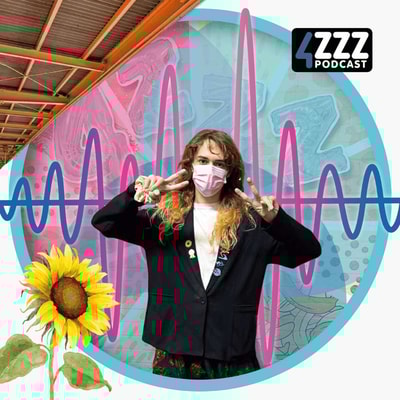
📸 ID: Imogen Buckley is nursing the for Tranzmission logo. She is wearing a pink face mask, black jacket with several enamel pins and is raising her hands in peace signs. She stands before the 4zzz wall with a Venn Diagram in the mid ground. Clockwise there is a sunflower in the lower left, train station roof in the upper left and 4zzz Podcast logo in the top right foreground.
4ZZZ's community lives and creates on Turrbal, Yuggera, and Jagera land. Sovereignty was never ceded.
Produced and recorded by Brody and Rae at 4zzz in Fortitude Valley, Meanjin/Brisbane Australia on Turrabul and Jaggera Country and audio and cover image edited by Tobi for podcast distribution for Creative Broadcasters Limited.