Writing ourselves into history
Today Rae (they/them) chats about recent trans rights issues in the news, including: Republicans in the House of Representatives introducing H.R. 7661, an anti-trans bill that would create a nationwide ban on LGBTQ+ books in public schools; the New South Wales government introducing proposed changes to the state’s Library Act aimed at protecting public libraries from book bans and censorship; and Brisbane drag performers winning an appeal, after an earlier vilification decision was overturned, finding that
Transcript
At 4zzz, we acknowledge the traditional owners of the land on which we broadcast. We pay our respects to the elders past, present and emerging of the Turbul and Jagera people. We acknowledge that their sovereignty over this land was never ceded and we stand in solidarity with.
Speaker B:Transmission on 4zzz, amplifying the trans and gender diverse community of mean in Brisbane and beyond. My name is Ray, I use they them pronouns and you're listening to Transmission. I'm very excited for today's show. I'm going to be chatting with or playing or recording of a interview I did with Eli Sutherland, who is the Festival Director of Trans Book Festival, and also chatting with Toby Fitch about their new book or an autobiography which is based on Virginia Woolf's Orlando. First of all, though, we will chat about some recent news. In international news, Republicans in the House of representatives have introduced HR 7661, an anti trans bill that would create a nationwide ban on LGBTQ books in public schools. The bill's vague language is key to where and how it would be applied and and its creation follows several local level and state level policies and laws across the countries banning quote unquote gender ideology and or trans books for minors in public schools and public libraries. A bill like this could potentially be used to outright ban all books by or about LGBTQ people under the guise of them being quote unquote sexually oriented. However, in more positive interstate news, the New South Wales government has introduced proposed changes to the state libraries to the state's Library act, aimed at protecting public libraries from book bans and censorships. The proposed new legislation aims to protect the right of public libraries to collect material some may find offensive and for the public to read what they choose at the State Library of New South Wales event. New South Wales Arts Minister John Graham introduced the amendments to the State Library act, saying, we're making freedom to read part of the legislation. There have been at least 309 attempts to exclude 184 titles from public library shelves around Australia since 2023, according to reports to the Australian Library and Information Association. Most of the complaints related to material about LGBTQIA communities. And also in local news, Brisbane drag performers Johnny Valkyrie, AKA Queenie and Duane Hill, AKA diamond, have won an appeal against Family First National Director Lyle Shelton after an earlier vilification decision was overturned. Finding that, quote, drag is a vital and central aspect of queer culture, the Queensland Appeal Tribunal ruled that the earlier 2023 complaint dismissal was affected by significant legal and factual errors. The Appeal Tribunal has roundly rejected the idea that homophobia and transphobia live in the past, said Equality Australia legal Director Heather Corkill. This recognition is important when we know the reality that LGBTQ people continue to experience coordinated campaigns online that cause terrible harm. The tribunal recognised that quote drag is a vital and central aspect of queer culture and affirmed that it is a quote predominantly queer art form. So that's some positive news for your morning and more exciting things for your morning. I'm thrilled to once again be showcasing local trans and gender diverse poets in the new monthly segment Trans Verse. So this is a poem from River
Speaker C:Snowdrop trans verse featuring the poetry of trans and gender diverse people from the gangjan and beyond. Our voices are vivid, valid and vital and we're not going away.
Speaker D:Hi, my name is River Snowdrop. My pronouns are they them. I'm from Manchester UK and you can find me on Instagram riversnowdrop this is my poem One month on tea my boyhood has really kicked in Crabapple blooms on testosterone skin I find my dermis punctured bruised with man's becoming else cryptid slicked blisters, hair unbolted each run through is discovery I am shredding hole upon hill the slippage of a grand stepping forward Recovering from girlhood rejecting My eyes contain storm fields white cranes I am as much telephone pole as I am heron as tall oil rig as softly current middle smudges in his hands we mustn't waste it.
Speaker B:My name is Ray, I use they them pronouns and you're listening to transmission on 4 triple Z and I'm excited to continue showcasing for you poets who are local and from around so called Australia and the world here on 4zzz Whenever I'm on the show because poetry is fantastic and I love how trans poets just look they do poetry really really well and I'm really excited to be showcasing more incredible poets. First of all though, in the show I want to play the first part of my interview with Eli Sutherland, who uses they them pronouns, who's the festival Director of Trans Book Festival. And Trans Book Festival is the only writers festival in the Southern hemisphere that's focused on uplifting and celebrating trans and gender diverse literary excellence in all narrative forms. And the festival will be held from the 17th till the 19th of April in Naam at the Wheeler Centre. So this is my the first part of my chat with Eli.
Speaker A:My name is Eli Sutherland, I use they them pronouns and I am here on Wurundjeri Country. I'm up in beautiful Preston and like kind of right near the Preston Markets which is the best spot. Trees and magpie warbles and a mosque right outside. It's very lovely. And I'm the festival director of Trans Book Festival. I'm also a writer. I'm on a couple of literary boards. I'm doing my master's in writing and literature.
Speaker C:What else am I. I was like, oh my goodness. So how's, how's the sleep schedule going?
Speaker A:Look, it's, it's a bit busy. I'm also in one of my best friend's weddings in less than two weeks. There's just a lot going on. But no, it's going really well.
Speaker C:I mean, look, relatable content. I. As we're talking about before we hit record, I know the feeling. I have, you know, 20 million jobs and 20 million things going on at any given point. And yeah, I'm really excited to talk to you about one of those things that you've got going on, which is Trans Book Festival happening in April in naam. Yeah. Do you want to tell our listeners a bit more about it? Because I think being here in, in Manganjan, a lot of people might not have heard of Trans Book Festival yet.
Speaker A:Well, and I think a lot of people in NAAM wouldn't have heard of it yet either because it's a very new phenomenon. So Trans Book Festival, we're in the second year now. Trans writer Sam Elkin had this beautiful brainchild last year in 2025, had this idea to run a Trans Book festival. And it was a one day festival plus a pre festival, like a zine making workshop. And, and it was in Feb. Of 2025 at the Wheeler Centre and it was the most incredible day. I chaired the young adult panel session then. And honestly, it was the day that I finally felt like a writer and I finally felt like accepted in the literary world and like I wasn't, I wasn't an imposter anymore. Yeah, I listened back to a voice note that I sent a friend the following day about it like a few weeks ago and I was like, oh my gosh, I literally said all of that. And that like, it feels like a future memory, like this day feels really important and there's going to be a ripple effect of this and I don't know what it is yet, but it feels important. And then like fast forward six, nine months and Sam asked me to take it over and run it again and here we are. So we're doing three days this time, the 17th to the 19th of April, and the first day, the 17th is a full day of Workshops. So that's going to be at Studio Take Care in Brunswick and then the 18th and 19th they're going to be back at the Wheeler Centre and just lots of panels and conversations and chatting with people and getting books signed and all the things.
Speaker C:And it's I think as you said, like with imposter syndrome. Like I definitely have felt that quite a lot in, in more like CIS het writer scenes. And there is that going to be that ripple on effect I think with Trans Book Festival because it means that yeah, trans people can see themselves and like go to panels and be inspired and hopefully inspire even, even more trans writers and trans creatives.
Speaker A:And that's the goal like that the people that are coming together in the room. For most of the workshops it's a trans and gender diverse space only. But for the one of the workshops and all of the actual weekend itself, that is for TGD people and our allies. So everyone's welcome and it's, I guess a way to showcase the literary excellence of trans folks. The whole programme is all trans artists. So yeah like it's engaging allies in the work that we're producing. But it's also this space where yeah, the majority of us are in predominantly CIS spaces and having a place where we are not the minority in that way. Like obviously there are intersectional identities in place in this and there's like a lot of, yeah like other considerations but if we're just looking at, at gender diversity. Yeah, it feels, it felt like incredibly special and, and I think, yeah, so motivating and creativity inducing because I think
Speaker C:like, yeah, often when I'm at festivals it's like me and one other trans person programmes and that's, it's great that there are trans people programme.
Speaker A:Absolutely.
Speaker C:But to have a festival that is entirely, you know, of, of trans artists and trans writers is just. Yeah, to be honest, it's something that, you know, when I first heard about it last year and then when you approached me this year about it, I was, I was just shocked and thrilled because it's kind of, it's kind of a dream and it's kind of a. I guess a. I wouldn't say utopia. That's like a contentious kind of vibe. But it's, it's, it's such an incredible vision and it's one that I think is gonna. Yeah, really, really like what's already creating an incredible legacy for, for trans writers, you know, within so called Australia. So it's, it's incredible.
Speaker A:Yeah, well, and I think like, yeah, I definitely am not trying to kind of trash talk the mainstream literary festival 100. Right. Like, and I know that you're not taking that stance either. And they, you know, a few of them. We've had a bit of drama in the literary festival world in the last few months, but I think, for the most part, it is really great to see that there is more progressive and diverse programming happening in those spaces. And some of the times it's on an identity basis. Like, we're kind of finding that you're talking about transness rather than talking about your creativity and your art. And so I think the really special thing about Trans Book Fest is that we are there to talk about the art and the creativity. And of course, identity comes into play in that and it has this. This quality of being present, but it doesn't have to be the only thing that's being talked about in the room. So I think you can just kind of like, push a bit further and move past some of these. Some of these things. And I think that's also how we were really trying to intentionally build the. This year's programme around that fact that on an intersectional lens. Like, we've got, say, for instance, like, first nations trans artists coming, and we have one panel that is specifically a First nations focused and led panel that was curated by Leigh Maloney, incredible YA writer. But. But then there are first nations artists, like, all throughout the programme. Like, it's not. You're not on a panel purely because of your identity or identities. You're on panels because you have really cool and interesting storeys to tell.
Speaker C:Yeah, exactly. You're on the panels because you've, you know, you love writing and you've got. Yeah, as you said, you've got storeys to tell that aren't, you know, obviously, at the end of the day, like, everything kind of intersect sex with. With our identities. But at the same time, you know, it doesn't necessarily have to be absolutely all about that. And yeah, I think that's. That's absolutely incredible. And like, I think the first time that I saw a trans person perform at a festival was like, Ivan Coyote, Queensland Poetry Festival. Like, it would have been a while ago now. And I was like, oh, yeah, I can do that. And so I think that there's that. That idea of, like, it's classic thing of, like, you know, you can't be what you can't see. And, like, there's going to be a lot of. And I think that, you know, there have already been like, a lot of opportunities for trans people. But I think, like, something like Trans Book Festival is incredible because it'll, you know, showcase those trans storeys and. Yeah. Encourage more. More people to. To write their own trans storeys. I was like, speaking of trans storeys, is there any panels or events or anything at the festival that you would like to. To highlight and kind of talk about.
Speaker A:Oh, even just as you were saying that, I was thinking about, like, yeah. Wanting people to have that inspiration to pick up the pen and write the storeys. But I think as well, we're not focusing purely on, you know, like, that capital L literature. Yeah, there certainly are some capital L literature panels and events and things happening, but I think, yeah, we've got some other really cool things. Like we've got one on interactive literature, which is a space that I. That I'm not super well versed in, but Alexander Swords is going to be running. Yeah. This workshop that is using. I think it's a twine. Like a programme called Twine.
Speaker C:Yeah, yeah.
Speaker A:And I just think it'd be really cool for people to come and explore, like, what different forms of literature there are and how. How, like, differently you need to approach that from a writing and a structure and whatever perspective. And. And then we've got one. Another workshop by a writer and, like, songwriter, Malaika, who, yeah. Is doing this workshop on body percussion and call and response using. Yeah. So using Swahili, East African principles of, like, creating music in community. And that in and of itself is a form of. Of writing and communication. And so they'll be running a workshop and also doing a live performance on the Sun Sunday. And. Yeah, so I think that there's some really cool capital L literature and some, like, alternative forms of storytelling things that I'm really excited for because I do
Speaker C:think that a lot of, you know, and when we talk about, like, queer writing and, like, queer storeys and, like, especially trans storeys, like, there's not. They're not linear. And I think that things like, you know, twine and Bitsy and songwriting and so many different forms of, like, storytelling lend themselves more to, like, trans storeys rather than necessarily, like, capital L literature vibes, which is good vibes. But, like, also there's alternatives out there and, like, honestly, as someone who's made a twine, it's way less daunting than writing a book. So, like, listeners should totally get on that.
Speaker A:That's so cool. I have no idea about twine, but it sounds really cool.
Speaker C:It's like a back in. The. Back in the day hypertext storytelling creation. I'M not sure if that's a thing that. Yeah, yeah, yeah, yeah. Look, hey, you don't need to know much coding and you can just have a red hot go, which is my favourite, my favourite way of writing things.
Speaker A:Love that. Yeah. When just like diving in. I think that's like the best way to learn, is just trying.
Speaker C:Yeah, exactly. And I think, like, workshops like the ones that you mentioned will give people, you know, those tools to have a red hot go. And, like, even if it's not something that they, you know, you don't need to necessarily have an end product. You can just have some fun as well, which is really important.
Speaker E:How many genders are there?
Speaker C:I don't know. I just got here
Speaker B:and the track was my interview with Eli Sutherland for the About Trans Book Festival, which I'm really excited about. It's the only writers festival in the Southern hemisphere focused on uplifting and celebrating trans and gender diverse literary excellence in all narrative forms. And it'll be held in Naam from the 17th to the 19th of April. So this is the second part of my chat with Eli Sutherland.
Speaker A:I'm kind of working on a few different manuscripts at the moment and there's one in particular that I'm feeling a little bit stuck on. And the other day I was at a first birthday party and. And I think I've been so separated from, like, creating for creation's sake and so focused on outcomes that I. Yeah, had. I just kind of like lost the wonder of the process a little bit. But I. At this first birthday party, I made two wands. Listeners. I'm showing these wands to Ray. Oh.
Speaker C:I was like, one is like a snowflake and one is a butterfly and they've got like little glittery gems and like bows. That's. That's some real gay ones. I love them.
Speaker A:Thank you. Thank you. Well, they're my two niblings who. One is obsessed with Frozen and one is a little nature boy. And so we. Yeah, so I made these little wands with one of my partners and it was such a beautiful, like, exercise in just focusing on the thing in front of me and having a go. I'm not really visually creative, very like, word creative. And it gave me such a bout of inspiration for the words. It was so interesting. So I feel like having those tangential creative experiences that are just fun and don't need to be about an outcome and don't need to be perfect can be so helpful in your main creative focus.
Speaker C:Yeah, I think that's one of the Things that I like about. Even things like ekrasis, which obviously, like, you know, if you're looking at a piece of art and then writing about it, that does still have an outcome, but there is that kind of intersection of an interplay between something that is not writing and writing and. I know exactly what you mean. Like, often if I go out and just, like, hang out with, you know, a bird that I see or something, or, like, go, you know, I don't know, do some pottery or something, which. Which I've done before, like, the next day my mind is kind of singing with all these new words and thoughts.
Speaker A:It's such a beautiful phenomenon. I love it. Is ekphrastic art, like, usually off the basis of visual art, or can it be any other art that you're kind of.
Speaker C:Well, see, this is the. I was like. I feel like this is the. There's, like, definitely tension in between what people think. I personally think it can be anything. I think ekrasis can be, like, about, you know, a visual art or, like, video games. I write a lot of video game poetry. I think that's ekrasis. And I think that there's, like. I feel like ekphrasis is just, like, a fancy word for fandom or fan fiction, so.
Speaker A:Right. That's what to say. Like, is it just fanfic then? Which.
Speaker C:Incredible, to be honest.
Speaker A:Yeah.
Speaker C:I'm sure that, like, people are going to listen to this and be like, absolutely not. Ekrasis is a fancy and important art. But, you know, I don't think it. It is a bad thing to say that. Yeah, crisis can be about whatever. Whatever you want it to be.
Speaker A:And I. I particularly love the idea of, like, deconstructing what we mean by capital L literature, capital A art, and. And like, giving certain art forms more cachet and relevance and, like, cultural credit over others. And I think, like, fanfic is one of those. And just genre fic in general is one of those. I'm such a genre fic person. I write fantasy. I read a lot of fantasy and sci fi. I, you know, I'll read a lit fic, but I'm gonna want the plotty genre fic model than anything. And I'm gonna enjoy it more because. Yeah, like, personally, I just find them really engaging and. And plotty and, like, interesting and fun, and they light up this part of my brain that is. Is a. I don't know. It's just how I like how I process information and how I learn and grow as a human being is through those Kinds of storeys rather than through like the meandering, character based, you know.
Speaker C:And I feel like they also like, lend themselves a lot more to. To trans storeys, like, and queer storeys because of, I guess, the way that, you know, you. You can kind of, I don't know, like, let loose a little bit more with. With fantasy and, and specific maybe, and not necessarily like, you know, there's that kind of. It can be like quite. Yeah. Plot based but also so exploratory. I don't know.
Speaker A:Sorry to interrupt you. I was just gonna say, like, because as a reader, you have already suspended your disbelief around a lot of the elements of the world and the. Yeah. The construction of reality. And so I think you are poised to enter into these worlds being like, oh yeah, polyamory is so normal and it's fine. Or like this kind of queer relationship, this kind of identity is like, that's normal and it just can. It has this power to expand realities and I think that's so incredible.
Speaker C:Like, honestly, I wish that like, a lot of people would take the template of, you know, the fantasy novels that they read and like, you know, and I'm talking about, you know, CIS people who hate trans people, but take that template and then like, sort of, you know, look. Look at our world and be like,
Speaker B:oh yeah, you know what?
Speaker C:Things are more expensive than I originally thought. So, yeah. If people are interested in heading to Trans Book Festival this year, how can they get tickets? How can they. They participate?
Speaker A:Incredible. Well, we have a website now. We were historically just putting everyone to our Instagram classic like just fledgling community Org. But we've been working really hard on this website. It's transbookfestival.org and the programme is now up there. So you can have a look at all of the workshops on the Friday and then all the panels and conversations on the Saturday and Sunday. There's also an evening storytelling event on the Saturday night at the Moat, which is just underneath the Wheel centre. Beautiful venue. Everything is wheelchair accessible and we've got lots of experience accessibility information on the website for each of the three venues. And then, yeah, there's different links. Like we are selling weekend passes to the Saturday and Sunday and then individual workshop and evening storytelling event tickets. So you can pick your price as well. We've got tiered ticketing rates, of course, and that's it. I think we're also on Instagram as Trans Bookfish Festival, so it's pretty easy to find us.
Speaker C:Yeah, definitely head to the website and you'll notice there that there's some. Some people that we've mentioned on the show before, including Zoe Tarakis, who I interviewed last year. And there's a lot of incredible. Yeah, Trans. Trans names in the festival programme.
Speaker A:Well, Zoe is going to be on an. Like, the opening in conversation between them and Dylan Hardcastle. So obviously Zoe came out with Eros recently and Dylan's A Language of Limbs, Such beautiful books. So they're going to be having a yarn on the Saturday morning. You are in two panels on the Sunday morning. So we've got Trans Poetics, which is just going to be incredible. So who's chairing that? I think it's Jas Money is chairing that.
Speaker C:I was like, it sure ain't me.
Speaker A:Imagine if I just threw you in the deep end, like, oh, yeah, I'll have a go. Give it a crack. It's about the process, not the end result. Then we've got obviously Ray, yourself, Kaya Ortiz and Ellen Van Nieven, and has Parani on the Trans Poetics panel. And then you're also on our literary industry panel, which we're calling Selling out in brackets Complimentary, which I just think is very funny. And so Michael Earp is chairing that. Michael has recently taken over the Little Book Room, which is, I believe, the oldest children's specialist bookstore store in the entire world. Very cool. But Michael has also worked as a writer and an editor and in publishing. It's just like, yeah, an incredible literary industry human. We're also going to have Savannah Hollis, who is an editor at Hardy Grant, on that panel. Alia Leasi, who works with Margabala Books, and Monty Weir, who is one of the, I think, board members, like, you know, founders of Meridian Australis, which is a relatively new, like, speculative fiction magazine, Slash. They're doing some anthologies that they're publishing, they're running writers groups and other things. It's a really cool collective. And then yourself, obviously, through, like, Uplift poetry is. That was called an MB Life and
Speaker C:my 20 million jobs.
Speaker A:Yeah, yeah. Just so many, so many things. And your poetry book exactly as I am. So there's just like, so many cool. So many cool people on all the things.
Speaker C:It's going to be so incredible. And just like, I was thinking of, like, as you were saying some of these names and I was like, I'm just going to have a suitcase full
Speaker B:of books to be signed.
Speaker C:Like, I might need to increase my luggage allowance. Like, this is going to be a problem. And then I'll be bringing two bags going back. Oh, My God. Honestly, though, that is me. A lot of the time at festivals, it's a bit of a. It's a bit of a problem. Maybe I could just get like a coat and like, I don't know, like, have lots of pockets inside the coat or something. And, like, put all the books in there, be like.
Speaker A:And then you'll be one of those flash, flashy books.
Speaker C:Yeah. Flash my books. Yeah, yeah. People IKEA love that.
Speaker A:I've got a funny storey about that in a subway in Paris. But no one needs to relive that.
Speaker C:Like, that's a future poem for you to write, maybe. I don't know.
Speaker A:Really. That's actually a very good idea.
Speaker E:Yeah, yeah.
Speaker A:Processing my trauma and. But we will have, like, artists signing books afterwards. We have, you know, little breaks in between the panels and stuff. So hares and hyenas are going to be selling books on the weekend. They're the queer specialist in naam. And the little book room microwaves bookstore is going to be the bookseller at the workshop day. So there'll be books for sale on the Friday as well. And yeah, artists assign them. It's very cool.
Speaker C:Amazing, yeah. If anyone listening wants to head to NAAM for Trans book festival, it's the 17th to the 19th of April, head to the. The website transbook festival.org and yeah, have a. Have a look around. Grab your tickets. Thank you so, so much for chatting with me today.
Speaker A:Thank you for having me. It's been such a delight. I'm so excited to have you in person as well.
Speaker C:I was like, I'm pretty giddy about it, to be quite honest. Yeah, I'm gonna. I'm going to be a menace. I'm going to see absolutely every single panel and talk to absolutely everyone. It's going to be great.
Speaker A:Love it. That was me last year and it was the best.
Speaker C:Thank you.
Speaker A:Thank you.
Speaker B:My name is Ray. I use they, them pronouns. And you're listening to transmission on 470Z. I'm thrilled to now air an interview that I had a couple of weeks ago now with Toby Fitch, who is in Gadigaland. And we spoke about their new book called An Autobiography, which explores fluidities of self, body and imagination. Its central long poem in the text called the Awe Tree, is a speculative version of the fictitious poem the Oak Tree by Virginia Woolf Orlando. And what I really love about this, this poetry book, is that it's also complemented by an understory, which is this kind of poetic essay that intertwines with the poem and Sort of plays with autobiographical. The autobiographical nature of the text and citations. So the book was released on 2nd March with Upswell Publishing. And this is the first part of my interview with Toby Fitch, done with men.
Speaker E:Literature was a farce. Two things alone remained to trust dogs and a vast amount of illusion. The oar tree dreamed secluded writing and reading Saw young ferns unfurl the moon sickle cobwebs bloom and fade with amazing punctuality. From the queer element of the human Came the strangest variety of selves. And from a numbskull phantom brain, from a parchment hustler heart Books and lit metaphors rushed cumbered the bottom of the sea grown about with bones and dragonflies of the drowned. My name is Toby Fitch. I guess I'm a poet. I lecture in creative writing at the University of Sydney and I've written my ninth book of poetry called or with a subtitle, An Autobiography. And it is a speculative version of the Oak Tree, which was a poem written by Virginia Woolf's character Orlando. And it took Orlando 300 years to write the poem the Oak Tree across the course of the novel Orlando, which has a subtitle, a biography. So it was heavily inspired by Virginia Woolf and her very transcendent novel Orlando.
Speaker C:And as someone who has, has read or an autobiography, it's just absolutely phenomenal and I think, you know, quite groundbreaking in terms of like, you know, like queer non binary poetics. And yeah, I'm keen to know kind of what came first in terms of like, you know, how did the idea of or for you, like first come about?
Speaker E:Well, the book started in 2017, so it's been, it's been in the works for a long time and there was, I knew a friend who was running this thing for a short while called the Centre for Deep Reading. And there's a guy called Nick Keys and he wanted to get together, get people together and read, read books deeply. And his first event was called Wolf down and he had presenters on various novels by Virginia Woolf. And I got to choose Orlando. I'd never read it, I'd always wanted to. And then I read it, I was like, I should have always, I should. This is. I've been drawn to this book for a reason and I had to also give a talk on it. And as is the way with some poets, doing a simple talk is not, not the way to go. And so I wrote poetry and I wrote the. Yeah, I wrote the first. So the idea of this poem of Orlando's called the Oak Tree, there's no quote from it in the novel. It's just. It's just a fictitious poem, which is some long poem that Orlando took 300 years to write and eventually published after they had changed gender from a man to a woman toward the end of the novel to great acclaim, eventually, in the sort of modernist era. And so I was like, well, has anyone written the Oak Tree? Has anyone done a version of it or something like that? And, of course I had to. Once I had that in mind, I started putting something together. And yeah, I read. I read out a very, very early version of one of the chapters of the poem, the long poem that's at the centre of my book for my talk, and also, you know, contextualised it, talked a bit about the book and its themes and that kind of thing.
Speaker C:And I love that it took you. I mean, it definitely didn't take 300 years and I'm very glad that it didn't.
Speaker E:I mean, I could keep writing it, like, as I said, like, it's probably nearly a decade now since it started. It's getting there.
Speaker C:I do feel like the way that it's written is so, like, beautifully fragmented and, like, fluid, you know, and gender fluid, that, like, it could kind of have, like, you know, it could just continue on, as you say, like. And I feel like the. The book itself kind of gives more questions than it actually answers, which is really a really beautiful thing.
Speaker E:Different, though the sexes are. They intermix in every human being of the clothes they keep. The odd effect it had in the particular case of OR's curious mix dress, random shabby formal power Tender donkey beaten kitten drowned at dawn One suit beyond the powers of the truth they did drink with burst tears Found mathematics rattling on the cobbles Always antipathetic to the man spirit as lines bent o' er the wrong way. They dressed lightly in skirts so as to submit to the new tinglings of wild autumn. Wings wet as in Botany Bay Revolving clouds answered pell mell among the violet plumed rain. Am single, am mateless, am alone and glanced nervously lest some malform flaunting a long cloak behind them like a silver pool came over the birds.
Speaker B:You just heard the first part of my interview with Toby Fitch. He they pronouns on the new book or An Autobiography, which is out now through Upswell Publishing and explores fluidities of self, body and imagination. Its central long poem, the Ore Tree, is a speculative version of the fictitious fictitious poem the Oak Tree by Virginia Woolfs Orlando. And this is the second part of my interview with Toby.
Speaker E:I mean genre In French means the category genre, but it also means gender. And Orlando, the novel, reimagines the genre of biography very clearly. You know, it's a biography, it's a, you know, fictitious. It's a novel, it's a fictitious biography partly about Vita Sackville West. And when I started writing this poem, I was like, well, it's going to be somewhat about me because I'm writing it. And, you know, there's that philosophy that anything one writes is autobiographical, whether it's about someone else or what have you, because of the subtext. And you wrote it at some moment in time which reflects upon your life invariably in some kind of way. And, you know, the. And so I started to play with the themes, think about the themes playing with the. The language that I found in the novel. And at. At one point, when Orlando is having trouble with poets and critics and things like that, he at the time, burns his entire oeuvre except for the oak tree. And this was another sort of inspirational moment where I burnt a copy, my copy of Orlando, so that I could then use the burnt fragments to assemble my poem in six chapters. It's, you know, absolutely in order of the six chapters of the. The novel itself. So my book has a long poem that goes across six chapters. It has other things in it as well, which we can get to, but. But because, you know, words get burnt and Orlando has awe in it, that awe became a character in this long poem and awe also became an avatar, in a sense, for me to play with and use all that beautiful, chewy, playful, just brilliant language of wolves in.
Speaker B:In.
Speaker E:In new. In a new context, in new ways, with my own kinds of subtexts and all kinds of themes came up, particularly the colour green, which is my favourite colour. And, you know, early on in the novel, Orlando has trouble thinking about how to write the word green because Orlando is a poet in the novel and how to represent the colour green. And of course, it's impossible because representation, you know, that. That is the contradiction that we have when we're trying to write. We're trying to write about life and the world, but it's. It's words and there's this. There's always a gap. This is between life and representation. And, you know, that's another theme in my work. I'm. You know, because it's so playful in a lot of ways and expressive, I'm able to. You. I try to use this colour green in so many different ways. Like I'm sort of projecting meaning onto a green screen in a Sense, like, there's all this. Yeah, yeah.
Speaker C:And I feel like I'll go. There's so much to. There's so many questions that I want to ask. I think that I. I love the. The idea of like, burning the. The copy of Orlando, because I feel like that is almost like. It's like black art poetry, but without the. It's kind of like with the choice taken away. Like, as you said, there's the. You know, the. What you had left to. To use was, you know, what hadn't been burnt. Yeah, I think that's incredible.
Speaker E:Yeah. I mean, the. The whole long poem is a kind of collage or assemblage, but there's also a kind of erasure poem. I mean, they're quite similar. They have a lot of crossovers. When you think about collage versus erasure, you still have to put things next to each other and rub them up against each other, and then they take on a new context. Even though they were someone else's formulations to begin with, they take on new formulations. I'm on the green sheets of our bed with my partner F, and our eldest child, E. I've been talking with F for some years about identifying maybe as non binary. But these have been private conversations, so it's a bit of a surprise when E not only comes out casually as they, but then goes on to ask me pointedly, like they'd always known, would you prefer to be classified as they, Daddy? Maybe. I don't know. Maybe I prefer to be declassified completely or reclassified as green, for example. Green can mean all kinds of things. Emotionally, psychologically, spiritually. Quote. Green things are flowers too, Frank o'. Hara. But can it stand in for the multiplicity I am, the fluidity I'd like to embody? Quote. Could I lose myself in this abstraction? Romaine brooks? Some memories are green, I once felt. Wrote a few sapphic stanzas about that. When I was a child, I played alone below silver helicopter leaves that autumn spun no wind down onto my skin and the toys I buried in the green. When bigger boys would bully me for being a girl, I'd stare into the dead seas of their eyes, stick a real gumnut up my nose and not speak to anyone. Now here I am, making all kinds of weird shapes of words to animate my whirling feelings and anchor them to the beauty of the world's waves. Oh, how it waves. I'm thinking partly of trees in the wind, watching their leaves undulate. I'm stricken by the vertigo of meaning. Trees and their Limbs have always been my favourite things to draw, centred in the landscape with flowers, mountains, river and moon. At age 7, among the leathery green leaves of bush lilies and bright heads of birds of paradise in our front garden, I imagined I was she Ra, not he man, and wore Mum's tights to fight an imaginary skeletor. Climbing the pale pink mountain of our house, the 50 odd winding front steps were a river when it rained Quote when you see your reflection in water, do you recognise the water in you? Ronny Horn I don't know whether you've had this experience, but when I'm watching water I hear snippets from books drifting up from the ripples away alone, alas, a loved along the river run past Eve and Adams from swerve of shore to bend of bay brings us by a commodious vicus of recirculation back to James Joyce. These bottom of the page passages were originally modelled on the footnotes in Ronny Horn. Another water cyclical fragments about water beneath her large close up photographs of the surface of the River Thames in London where I was born. A surface that is rippling multiple and mutable, unsettled and unsettling, and which stands in implicitly for the indeterminacy of an androgynous identity. I added footnotes to my poem jagging from the slippery shapes above, but they turned into vectors aimed like jets of urine at flowers. So I've chosen instead this fragmentary proto essayistic format, hoping that it functions to place the viewer reader in relation to the images text poem in a way that emphasises the experience of excess. Horn Hoping also that the particulars in these passages, placed at the bottom like roots, flow back up to the limbs and leaves of the poem. And above quote the self that writes itself into existence Mackenzie walk. Disturbed or turned to walk out and dipped describing as all young poets are forever describing in order to match it. The shade of green green in nature is one thing, in literature another. Precisely bring them together and they tear each other to pieces. A trifle clumsy clumsiness often mates with love of solitude or naturally loved Solitary places, vast views and to feel ever and ever uphill through ferns, startling deer, wild birds, the English Channel, wave upon wave of pleasure, gliding with puffs of smoke from which came the flung self on earth it was anything so long as it was hard. A heart that tugged, a heart filled with spiced and amorous gales.
Speaker C:What you said before about like genre was really interesting because like I think the you know or is is a book that kind of has those hybrid, like, forms of. Of writing because you've not only got the. The assemblage, like poem, the ore tree, but you've also got like the poetic essay, which is the understory, which I'm really interested to talk with you about as well.
Speaker E:I'll quickly say about the long poem the Oar Tree, which is sort of my speculative version of the oak tree, reconstructed from fragments of the novel. I tried to write it in six line stanzas, which is what apparently, according to the novel, Orlando, Orlando wrote the form for that poem and that it was in that form for a long time. But it needed something more fluid and something more suitable to me, what I was writing and how the words were coming together. And so I. I turned those six line stanzas into sonnets that are sort of amorphous shapes on the page. So there's these kind of like topiary, sort of sculpted like little plants, leaves on the page at the top of the. Or in the middle of the page. And because they were so flighty and floaty in a way, and expressive, I needed something to ground them. And the idea came up to do footnotes. And so that's what I did. I wrote, I read through all the poetry and I was like, what have I been reading? Found resonance between things I've been reading. And so I was doing all these citations below the poems below the sonnets to writers and artists like Ronnie Horne and Travis Alabanza and poets like John Ashbury and Frank O' Hara and MacKenzie walk and of course, Virginia Woolf. And so it was a kind of, you know, homage to them as well, in a sense. And I'm sort of interlinking these. This. These thoughts and these ideas about life and gender and all kinds of things with the poetry above and citations below. And I also started doing footnotes of my own memories that were sort of sparked by the images and the events or moments in the process. Poems above, in the sonnets above. And those were, yeah, they were my own memories of mostly childhood, so instances of dysphoria and questioning my gender and. And things like that. And so then there's this interplay between above and below, between top and bottom, so to speak. You've got the, you know, the flowery performative tops above and the more kind of reflective bottoming out in this essay at the bottom, which again follows the six chapters in six sections. But like I said, it was footnotes to begin with, and that wasn't working either. So I ended up fleshing out those footnotes in the spot that they were in. Into prosecution, which was more. Yeah. More linear. Kind of gives. Has narrative, it has thinking through of these issues which then allows a lot more kind of. Of those ideas to. To percolate back up into the poetry. The very expressive poetry above.
Speaker C:Yeah. I think what I like about the understory is kind of that it does play with that like idea of kind of like almost like the coldness of, of citations in like it's so incredibly like it is, it's reflective, it's, it's personal, it's memoir. It's very. Yeah, it's really beautiful and I think that it, it really like kind of adds that. That depth to the, to the poetry.
Speaker E:Yeah, and that's a, it's a bit confessional too. I was kind of like with the poetry. It's like am I just hiding in. In the poems in that sort of, you know, metaphorical language? You know, it's a nice contrast to actually and, and to. To kind of speak more plainly even if. Even though it's not particularly plain but you know, to speak more directly about some of those things and you know, freeing in a way too.
Speaker C:And it's like, yeah, hiding in the understory. But it's not, it's incredibly like, I guess, like, I guess metaphorically like, you know, any kind of, you know, where plants live, the sustenance. Like, it's just, I feel like it kind of, it gives the, the rest of the text kind of that, that life and that vibrance and like, like added context as well. And I feel like they, they speak to each other really well. Yeah, yeah.
Speaker E:And I got the idea for Footnotes initially from the, the artist Ronnie Horne, who, who did this, did this project called Another Water, which are these huge close up photographs of the River Thames which is just like, you know, ripples of water. And then if you look, if you have to see them physically to really see where the footnotes are marked in the water, where the numbers are, but then they refer down to like lots and lots of tiny footnotes below these massive photographs which are quote, thoughts and quotes about water and androgyny. And so it's. I was inspired very strongly by that work and so there's a lot of me in my, you know, in my wishy washy understory, quoting Ronnie Horn to some degree amongst others, and, and using water as well, you know, metaphorically, analogically, but also because it's called the ore tree, trees became that other thing. So I've got water and Then, you know, the sort of the community or the tree or. Or the sort of the arborealness of a tree. It's the way it sort of is above the ground and below the ground. And so they became the central kind of, along with the colour green, the central sort of uses of imagery throughout the work.
Speaker C:And I feel like it kind of really sort of reflects on how, you know, nature doesn't ask us to, like, perform gender. Nature doesn't need us to, like, you know, like, be any like it. Nature accepts us as we are, as the gender we are and the body that we are. And I think that that's kind of, yeah, like a really beautiful, beautiful reflection within the text as well.
Speaker B:My name is Ray. I use they, them pronouns. And you are listening to transmission on 4 triple Z. I'm thrilled now to air for you the final part of my interview with Toby Fitch, who uses he, they, pronouns on the new book or An Autobiography, which explores fluidities of self, body and imagination. Its central long poem, the Oar Tree, is a speculative version of the fictitious poem the Oak Tree by Virginia Woolfs Orlando. So this is the final part of our chat together when you were speaking
Speaker C:before about, you know, like, visual art. I'd love to talk more about like the. The collages as well that are in the text and the. And the COVID as well.
Speaker E:Yeah. So the COVID is. It is the base layer of a collage artwork that I did while I was writing the early versions of the poem with the burnt fragments of text. And so I had physical burnt fragments to play with. And, you know, after I'd kind of drafted the poem, I was like, well, I could do something with these physical things because they'd make an interesting artefact. And at the same time, I found. When I was doing a deep dive on Google at looking at cover images of Orlando, I came across this Spanish version which had this picture by a painting, a self portrait by an androgynous woman called Romaine Brooks from the early 20th century. And the picture of it just looked kind of very close to how I look.
Speaker C:It really does. It genuinely does, yeah.
Speaker E:And I was like, what am I looking at? And so I then I discovered this artist and I was really interested in her self portraits and. But that particular one just stuck with me and I had to use it. And so that I cut it out, I stuck it onto like a kind of digital looking background, which is quite purple, which was a heat map of a. Of a Reddit experiment. What was it called again? Called, Ah, Place and It was where everyone. Where everyone, anyone was invited to just place pixels on a particular sized space on online. And they had a time limit to do it. And when you see how they've sort of recorded or filmed it, in a way you see all people from around the world sort of like putting visual images into this space and it morphs over time and you get flags popping up because people are patriotic and you get historical figures popping up and. And they sort of dissolve and disappear into the background. So it's a really interesting kind of snapshot of who we are or who people are on the Internet in a way. It was a weird and interesting experiment. They've done it a couple of times, whoever the people are that organise it. But anyway, it. It was interesting and you know, there was the heat map created of it, which turned out to be quite purple and. And evocative. And I used that as the bottom. I stuck the picture of the self portrait of Romaine Brooks onto that and then I started crafting layer upon layer of a burnt tree over. Over the self portrait picture. And that is spaced out in sections throughout the book between the chapters. And the language that goes onto each layer is. It is from each of the six chapters one by one.
Speaker C:Yeah. And I love how it kind of.
Speaker E:It's hard to. Probably hard to picture on radio.
Speaker C:Yes. I was like. We are describing. This is. This is the problem with radio. I do feel like they like. I love how like. And I think it is. You've like given us a really great description and I think, like, it does like, as you've said, like kind of. It kind of grows as the. The book grows. Like it kind of continues to add more, I guess, like branches of words.
Speaker E:Exactly. Yeah. The tree grows incrementally as the book grows and I had to take a picture or a scan of each section as. As I was making the artwork. So it was quite a live thing when I was doing it at the time and. But there's only one version of it left. It's the full version of it. I can't take those layers away anymore. I burnt. The only record I have is the photos or scans that I took of each layer as I was making it.
Speaker C:Oh, that's. I was like. There's some kind of metaphor there of like, you know, we can't kind of. It's almost like when we're discovering gender and like contemplating, like, you know, different, you know, different expressions and things that like. It's almost like you can't take away what you've already Learned and you can't kind of. Yeah, my brain was just like, whoa, that's. Oh, I don't think that was your intention. But my, I also like, I'm like, I. Because I can't, you know, there's certain things that I, I, you know, will always carry with me as a non binary person. And like, and I do feel like Orlando is one of those texts that is always going to be something that I think about and carry with me because it is, is so. I, I don't know, I don't even know how to describe it, but it's something that is so incredibly important to, to like my canon, I guess, in my head.
Speaker E:Yeah. I mean, Orlando the character and the novel, you know, transcends place, time, gender and sexuality. Kind of an ur text or a kind of like we look back to it for the possibilities that it opens up, you know. And you know, so my work is an homage to that or a poetic homage, but it's, it's poetry and it's not a novel. So I'm playing a lot more with form and the fluidities of that exist there. Yeah.
Speaker C:And I do feel like the, you know, it is very non binary form of writing and like, because it is very like there's so many fragmentations, there's so much to kind of, you know, get to grips with and there's so many like, forms and genres and stuff that you, that you've played with.
Speaker E:Working on it has sort of reminded me and reinforced our right that writing is a form of liberation. And you know, it is a kind of artifice and a freedom of expression where you create an artificial world of secret third things where everything is, you know, measured by simile, analogy, metaphor or contradiction, you know, by figurative language and hybrid form, you know, that can shift about and between at least between many things, at least three things. Like you've got the strange thing, like the image or whatever, and then you've got the writer's perception of that thing. And, and then you've got the image or form that results from that collision or collusion of the first two. And so, you know, it's a place where, you know, writing is a place where one's multiple selves can coexist in free play, in negative capability, in ambiguity, in multitudes. So, you know, that, that, that's what it reminded me that writing can do. And I hope, I hope the book, you know, opens that out for others.
Speaker C:And I do think that like, I feel like I end every interview that I do with this. But I I always encourage listeners to, like, if they do want to start writing, they absolutely should because I think that, yeah, as you said, like, writing is such a. It's a form of liberation and that, you know, we are able to kind of, you know, create our own worlds and, you know, explore and expand and, you know, especially in, you know, tumultuous times such as these, having that kind of space and carving out your own space and, you know, creating and writing is just, I think so incredibly important. So, yeah, the book comes out with Upswell Publishing on the. I think it's the 2nd of March. Is that right? Amazing.
Speaker E:Yep. And I'm doing a little talk and reading from the book in Sydney, Gadigal Land, at something called. Most likely it's something called Fresh takes autumn 26 at the library bar State Library of New South Wales.
Speaker C:Amazing.
Speaker E:On March 26th, 6:00pm so, yeah, maybe see someone there. I think there'll be other. Other writers with new books doing similar sort of talks about the things that inspired their books and certain writers that inspired their books.
Speaker C:Yeah, amazing. So, yeah, people listening are on Gadigal Land. Definitely head along to that. Thank you so much for chatting with me today. It was absolutely incredible.
Speaker E:My pleasure. Thanks, Ray.
Speaker B:My name is Ray. I use they. Them pronouns. And you're listening to transmission on 4 triple Z 102.1 FM. I've got to get out of the studio soon and thank you so much for listening to me chat about poetry and trans. Trans books. I was very appreciative that I was able to have a chat with Toby Fitch about. Or an autobiography and before that with Eli Sutherland about Trans Book Festival. So thank you so much to my guests. You're listening to transmission on 4ZZZ. Thanks for listening to Transmission. Catch us every Monday live on 4zzz from 10am or listen to our podcast on the community radio plus.
Speaker A:Applause.
Hosts: Rae (they/them)
Today Rae (they/them) chats about recent trans rights issues in the news, including: Republicans in the House of Representatives introducing H.R. 7661, an anti-trans bill that would create a nationwide ban on LGBTQ+ books in public schools; the New South Wales government introducing proposed changes to the state’s Library Act aimed at protecting public libraries from book bans and censorship; and Brisbane drag performers winning an appeal, after an earlier vilification decision was overturned, finding that “drag is a vital and central aspect of queer culture.”
On Tranz Verse, poet River Snowdrop reads 'One Month On T'. Rae chats with Eli Sutherland (they/them) Festival Director of Trans Book Festival (TBF) about what you can expect from the festival being held on 17-19 April in Naarm. TBF is the only writers’ festival in the southern hemisphere focused on uplifting and celebrating trans and gender diverse (TGD) literary excellence in all narrative forms.
Rae also interviews Toby Fitch (he/they) about their new book Or: An Autobiography, which explores fluidities of self, body, and imagination. Its central long poem, ‘The Or Tree’, is a speculative version of the fictitious poem ‘The Oak Tree’, by Virginia Woolf’s Orlando.
🔗 If you'd like to listen back to the unedited episode - with the music - head to our On Demand website. And don't forget to follow our socials at Facebook and Instagram.
Timestamps and Links:
- 00:00 - Acknowledgement of Country
- 00:20 - Welcome to Tranzmission
- 01:13 - Community News and Events
- 04:25 - Tranz Verse: 'One Month On T' by River Snowdrop
- 06:24 - Eli Sutherland: Trans Book Festival (TBF) Part 1
- 20:11 - Eli Sutherland: Trans Book Festival (TBF) Part 2
- 32:13 - Toby Fitch: Or: An Autobiography Part 1
- 39:36 - Toby Fitch: Or: An Autobiography Part 2
- 47:34 - Toby Fitch: Or: An Autobiography Part 3
- 55:50 - Toby Fitch: Or: An Autobiography Part 4
Support Services
- QLife - 1800 184 527
- QC LGBT Mental Health Services
- Open Doors Youth Services Inc.
- LifeLine - 13 11 14
- Beyond Blue - 1300 22 4636
- How to Support Transgender & Gender-questioning Youth
- Transgender Map
Get Involved
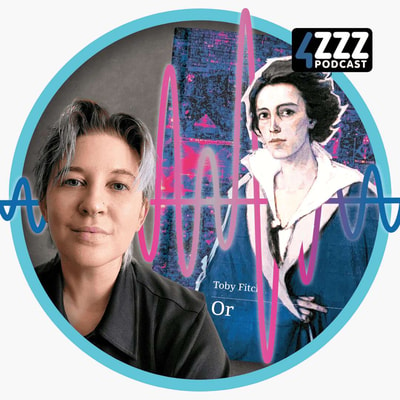
📸 ID: Eli Sutherland (left) and Toby Fitch's book 'Or: An Autobiography' (right) bursting out of the Tranzmission logo.
4ZZZ's community lives and creates on Turrbal, Yuggera, and Jagera land. Sovereignty was never ceded.
Produced and recorded by Rae at 4zzz in Fortitude Valley, Meanjin/Brisbane Australia on Turrabul and Jaggera Country and audio and cover image edited by Tobi for podcast distribution for Creative Broadcasters Limited.